News: Questrade Contest offers free money

Yup, it’s another promotion. Keep that gravy train going! This time, it’s a contest, so no guarantees, but the rewards are pretty nice if you happen to be so lucky.

  • $175k for your TFSA: (Ts and Cs here)
  • $50k for your RESP: (Ts and Cs here)
  • $40k for your FHSA: (Ts and Cs here)

In each case, all you need to do is to open and fund a new TFSA/RESP/FHSA account ($250), or contribute more than $250 to an existing account, or send a postcard with an essay (yes, really) before the end of the year. One entry per client, per investment vehicle. But you can only win ONE of the three prizes (shucks).

I wonder which contest will actually have the best odds? I contribute to my TFSA every month, so I guess I have a shot, too…

How to share an RESP among multiple kids

In a previous post, I shared my approach for investing in an RESP, and I promised I’d show you how I share the funds therein between my kids.

To me, it didn’t seem fair to split the cash value of the RESP between the kids. My kids (I have two) started higher education at different times, years apart, and so needed the money at different times. The investments in the RESP continue to grow even after decumulation begins, so how to account for that?

The way I track it is in this Google Sheet.

The idea behind it is pretty simple. You create a “mutual fund” on the day the first withdrawal happens with a fixed number of units. (I used 1 unit = $1, but you could set your unit value to whatever you like). Then, each child (if you want to be fair) gets the SAME number of units on that day. Children sell their units as they request money from the RESP. The unit price fluctuates depending on the value of the RESP overall.

So say you have a $10000 RESP divided among 4 kids. On launch day, you create the fund and create 10000 units, each priced at $1. You give each of your 4 kids 2500 units on that day. On that day, that means they also each have $2500.

Kid #1 needs $5000 for tuition, and this means they spend 5000 units. That’s row 17 in the example sheet.

Time passes, and Kid 1 needs more money. The wisely-invested RESP continues to grow, and has nearly made back all the money that was removed from it, valued on December 1 at $99,800, which is entered in column B. The unit price has increased as a result, from $1 to $1.05 (that’s an automatic calculation).

So Kid 1 has 20,000 units, each worth $1.05. The other kids still have all 25000 units, but they are now worth more money, $1.05*25000 =$26,250.00. Kid 1’s $3000 request costs 2885 units thanks to the growth, and Kid 1’s unit balance is updated accordingly.

This continues on, and all you need to do is fill down more rows as you need them, entering the values in the yellow cells yourself. You can even withdraw for multiple kids on the same date.

I’ve been running our family RESP fund since August 2018; unit price was $1. I just completed a transaction for kid #2, and the unit value was $1.46. The last two years have been exceptionally kind to this fund.

If you have questions or comments on this method, hit me up at comments@moneyengineer.ca!

What’s in my RESP portfolio?

As summer shifts into fall, I’m reminded that it’s back-to-school time. Or “Dad, I need money for tuition” time. I still have kids attending higher education, still making withdrawals from the family RESP we set up shortly after the birth of son #1, almost 25 years (!) ago now. RESP investing is a bit different from retirement investing given the (hopefully) shorter timelines of RESP investing1. Here’s how I approach it.

In the early days of the RESP, the contributions were invested in mutual funds; these were dark days, long before the rise of very cheap ETFs. Mutual funds were the ONLY way to make routine contributions (which I made, monthly, without fail — Pay Yourself First and all that). I had an 80/20 mix of equities and bonds in the first 18 years or so of its existence: 4 funds, one for US Equity, one for Canadian equity, one for international equity and one for bonds. I don’t remember the specifics of which ones and what percentages exactly. But the fund kept growing, thanks to market returns as well as CESG grant money, which I took full advantage of2!

As son #1 came close to entering post-secondary studies, I shifted the portfolio to a 60/40 mix using individual ETFs like HXS for US Equities, HXT for Canadian Equities, HXDM for International Equities, and CBO for Bonds. The GlobalX funds didn’t throw off dividends3 and so I just had to deal with the periodic (monthly) distributions of CBO, which ultimately were set to DRIP4.

I made the decision to move to 60/40 over 80/20 to preserve a bit more of the capital in the event of some kind of market meltdown5. Growth gets curtailed somewhat as a result, but there’s less volatility.

But I finally realized that all of this was completely unnecessary thanks to all-in-one ETFs. So now, the RESP has exactly ONE holding — XBAL, an all-in-one from iShares that takes care of the 60/40 split for me. And this is set to DRIP as well, so every quarter the RESP picks up a few more XBAL shares.

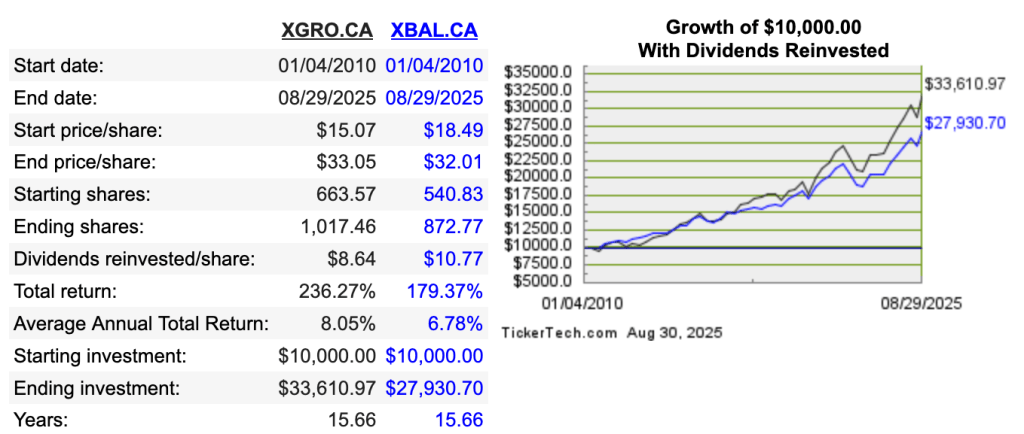
You can see how XBAL has preformed over the past 15 years or so. I’m comparing it to the 80/20 XGRO ETF from the same family, one that features prominently in my ETF All-Stars page6:

In a future post, I’ll explain how I fairly divide the RESP among my two sons — in essence, I pretended that the RESP was a mutual fund, with each son receiving the same number of units on the day the first withdrawal was made. Withdrawals are henceforth made in units, not dollars, and the unit price fluctuates with the value of the RESP.

How are you managing your RESP? Let me know at comments@moneyengineer.ca.

  1. Less time to build wealth, shorter runway for decumulation ↩︎
  2. As a certified cheapskate, it’s hard for me to resist free money of any kind. ↩︎
  3. They are “corporate class” ETFs that use a clever structure to avoid paying out dividends; all growth is buried in the increase of the ETF’s price. I still hold some of these in my non-registered accounts. ↩︎
  4. Dividend Reinvestment Plan. Instead of getting cash in the RESP account, the DRIP buys additional shares of whatever generated the dividend in the first place. ↩︎
  5. One may ask why I chose to stick with 80/20 in retirement, which is against some conventional wisdom. I figured that the RESP decumulation phase would be over a much shorter time period (say 5-10 years) and so I would be less able to wait for a market bounce-back. In retirement, I’m hopeful that decumulation will take much, much longer, and so with 80/20 I have a better chance of outliving my savings. ↩︎
  6. Chart is courtesy http://www.dividendchannel.com, featured on Tools I Use. When I rolled the comparison all the way back to 2007 the 60/40 XBAL actually OUTPERFORMED the (supposedly) more risky XGRO. Can’t explain that one. ↩︎

News: HISA Table for May, Questrade Plus, WealthSimple Self-Directed RESPs

Happy May to all, here’s some news from the world of Canadian DIY investing.

HISA rates are stable

HISAs, for those in the know, are “High Interest Savings Accounts” and offer a nearly zero risk1 way to earn some interest on your cash holdings. Read all about them here. “Class F” funds are usually available via your online broker, often bought and sold in the same module as mutual funds, although they are NOT mutual funds.

The periodically updated HISA table I maintain has been updated for May. No changes seen from last month, which is unsurprising, given both Canada and the USA have held interest rates steady over the past month. Here it is:

ProviderFundLinkRate SheetRate
RBCRBF2011, RBF2021, RBF2031, RBF2041RBCLink2.55%
ScotiabankDYN6004, DYN5004, DYN3065, DYN3055, DYN3075ScotiabankLink2.70%
Equitable BankEQB1001, ETR1001Equitable Bankn/a2.55%
TDTDB8151, TDB8156, TDB8158, TDB8160TDn/a2.55%
RenaissanceATL5071Renaissancen/a2.55%
Home TrustHOM101,
HOM201
Home TrustLink2.65%
B2BBTB101B2B Bankn/a2.75%
ManulifeMIP610, MIP810Manulifen/a2.40%
National BankNBC200, NBC6200, NBC8200NBI Altamira CashPerformern/a2.55%
Canadian HISA rates, last updated June 9, 2025

Here are the USD rates offered:

ProviderFundLinkRate SheetRate
RBCRBF2015RBCLink4.15%
ScotiabankDYN6005,
DYN5005
ScotiabankLink4.15%
Equitable BankEQB1101,
ETR1101
Equitable Bankn/a3.80%
TDTDB8153TDn/a4.15%
RenaissanceATL5075Renaissancen/a4.15%
ManulifeMIP611Manulifen/a3.30%
National BankNBC201NBI Altamira CashPerformern/a4.15%
USA HISA rates, last updated June 9, 2025

Questrade Plus Launches: Meh

In other news, Questrade launched a new subscription service2. Dubbed “Questrade Plus”, $11.95/month gets you free journaling, better quote data, and a subscription to Passiv Elite.

As a newly-minted Questrade user (got my first bonus payment yesterday, yay!) I see this as a net negative. Let’s look at why.

Passiv Elite is no Longer Free

One nifty (and unexpected) bonus I discovered being a Questrade client was getting access to Passiv’s advanced features. Questrade Plus means that particular freebie is coming to an end. Passiv’s “community” (i.e. free) service is still somewhat useful, but if you want automated rebalancing, you’re going to have either pay Questrade (and subscribe to Questrade Plus) or Passiv (currently $99/year) for that privilege in the near future.

Unlimited Journaling of Limited Use

The unlimited journaling feature of Questrade Plus targets people like me who do Norbert’s Gambit to convert USD to CAD on the cheap, but since I don’t do this sort of thing super-frequently (maybe 5-6 times a year at most), I’d rather pay-as-I-go (currently priced at $9.95 per request).

Real Time Data Streaming of No Interest

The “real time data streaming” feature targets the day trader. Other providers include this sort of thing for free (QTrade, Interactive Brokers). That’s not my thing. It does make me wonder who Questrade sees as their ideal client. Are they trying to be Wealthsimple? Or are they trying to be Interactive Brokers?

Wealthsimple Self-Directed RESPs, coming soon

Wealthsimple continues to chip away at the gaps in their self-directed portfolio offerings. RESPs were one of those gaps, but now it’s been filled, and the main website has been updated to reflect this. I can confirm that I have been offered a spot on the beta launch, so its release to the general public is imminent. Wealthsimple has offered robo-advisor RESPs for a while, but the DIY investor has been forced — until now — to look elsewhere for this.

  1. Unless banks fail. We are all in a lot more trouble if that happens. ↩︎
  2. Because, we all know, you can never have enough subscriptions, right? ↩︎

Significant birthdays for the DIY Investor

There are significant birthdays every DIY investor should be aware of. Did you know about all of them?

The list below is a gross simplification — like all things in the Canadian Tax code, the exceptions and caveats fill many pages, but this is roughly correct. I’ve included links so you can read the relevant sections yourself and see if you agree with my simplifications!

The day of your child’s birth

Per the feds, a birth certificate for your child is all you need to apply for a Social Insurance Number. And although their working days are far into the future, their RESP eligibility starts right away — but you can’t open an RESP for a child unless that child has a SIN. The lifetime limit for donations to an RESP is currently set at $50k/child. The sooner those contributions start, the sooner you can collect free money (the CESG, $500/year, $7200 per child lifetime), and the longer your contributions can benefit from the power of compounding.

Your 18th birthday

This is significant one for a number of reasons!

TFSA

Once you turn 181, you can open a TFSA and begin contributing. Even if you don’t start contributing, your TFSA limit starts to accumulate the year you turn 18. In 2025, that annual limit is $7000 per year, and it grows at the rate of inflation2. It’s cumulative, so it’s not a “use it now or lose it forever” kind of proposition. At the start of every calendar year, there are a flurry of announcements indicating the new annual limit.

You can contribute to your TFSA forever, even in retirement. I am!

CPP contributions kick in

If you’re over 18 and earn more than $3500 a year, you’ll have to pay CPP contributions. While current you may balk at this sort of reduction in your take-home pay, future you will appreciate the inflation-index adjusted salary you can collect later in life.

FHSA

You can open a First Home Savings Account on your 18th birthday…or maybe your 19th birthday3. And the year you open it, you add $8000 in eligible contribution room…which continues every year, to a maximum of $40000.

Your 19th birthday

The so-called “age of majority4” in Ontario allows you to roll in free money in the forms of GST credits, Trillium benefits5 (in Ontario) and carbon tax credits6 . The cost of admission is filing a tax return. No excuses — plenty of online providers offer free returns for “simple” returns and my friends at Wealthsimple offer “pay what you want” tax filing.

This is also a time you are eligible to open an RRSP7, which may make sense if you’re already maxing out your TFSA contributions.

Your 35th birthday (or later)

An RESP can only be open for 35 years.

Your 60th birthday

This is the first year you can choose to collect CPP; generally speaking, most experts recommend that you delay collecting CPP for as long as possible, for two reasons:

  • It may be the only inflation-protected income you have (this applies to me, I have no other pension)
  • You get more money the longer you wait. (you lose 0.6% of payment for every month you start before your 65th birthday. That adds up to a reduction of 36% if you start on the day you turn 60).

My tools page includes the very helpful CPP calculator, which can help you make a decision concerning your CPP start date.

Your 65th birthday

This is the first year you can choose to collect OAS. Experts are a little more split on whether or not to delay this one — the benefits to delaying to age 70 are not as strong as for CPP8. My plan is to delay, as it’s another inflation-adjusted benefit.

If you’re collecting any sort of pension (RRIF payments, CPP, employer pension) this is the first age at which you can split that income with your spouse. This can reduce your tax bill.

Your 70th birthday

You have to start taking CPP and OAS by this time.

Your 71st birthday

You can no longer contribute to an RRSP and you have to open a RRIF. Lots of the literature out there seems to imply that this is the ONLY time you can open a RRIF, but rest assured, there’s no minimum age for opening a RRIF — I’ve been collecting from mine since the start of the year 🙂

Your 85th birthday

This is the last year you can start collecting from an ALDA (advanced life deferred annuity) you have set up. The ALDA is a vehicle I just learned about, and need to do a bit more research. It may be a way to fund income in your later years when the complexity of managing withdrawals in a DIY fashion may be too cognitively overwhelming.

What birthdays are you thinking about? Let me know at comments@moneyengineer.ca.

  1. Or possibly 19, depending on where you live. ↩︎
  2. But only in increments of $500. Even though inflation is drifting back down to more usual levels, doing the math indicates that we should expect more frequent increases in the TFSA limits in the years to come. Adding $500 to a $7000 limit (a 7% bump)is a lot easier than adding $500 to a $5000 limit (a 10% bump) ↩︎
  3. Per https://www.canada.ca/en/revenue-agency/services/tax/individuals/topics/first-home-savings-account/opening-your-fhsas.html “certain provinces and territories, the legal age at which an individual can enter into a contract (which includes opening an FHSA) is 19 years old” ↩︎
  4. This language is so opaque, it’s like a parody of government speak. Or maybe it’s a commentary on the aging demographic of Ontario? ↩︎
  5. Some of the benefits even kick in earlier ↩︎
  6. A limited time offer, presumably ↩︎
  7. Per CRA, there is NO minimum age at which you can open an RRSP. Contributing to an RRSP requires that you enter into a contract (meaning you have to be of an age that permits this, either 18 or 19) and you have to earn money. ↩︎
  8. It’s still 0.6% per month of delay, or 36% over 5 years. That’s pretty good RoI, in my view. ↩︎