I’m retired and the market is tanking. What do I do?

TL/DR: Look at your asset allocation and rebalance if needed. Otherwise go for a nice run.

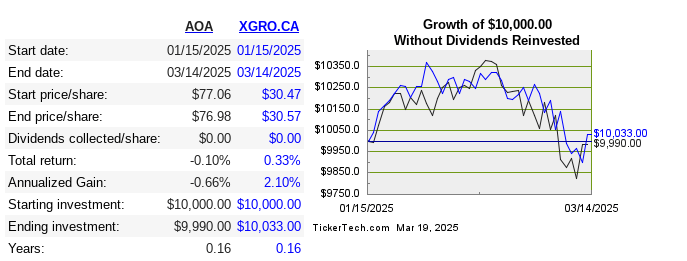
Yesterday was pretty ugly. My retirement holdings, dominated by AOA and XGRO took a huge hit this week. And today will likely bring more of the same. Before Friday’s open, AOA is down 3.31% for the week, and XGRO is down 3.64% for the week. No doubt about it, I’m quite a bit poorer than I was on Monday1. What actions am I taking?

As always, I keep an eye on my asset allocations

In market downturns, some asset classes (e.g. Canadian equity, Bonds, International Equity) will suffer more than others, typically. This allows for effective asset rebalancing, possibly. (If you want to better understand how I think about asset allocation, this article might shed a bit of light on that.)

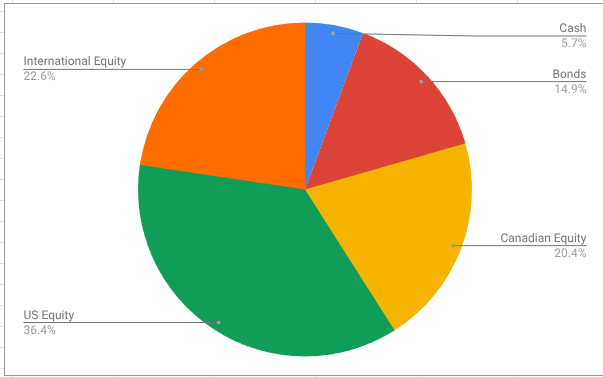
If the asset class allocation drifts too far from my targets, then that’s an indication to make a move out of one class and into another. A 1% drift off my target is usually enough for me to make a move. That hasn’t happened in my portfolio as of this morning, but I notice that the percentage of US equity is quite a bit down from the last time I looked.

As an aside, I track my asset allocations using my own Google Sheets tool, which you can find here.

If you do place trades in markets like this, do it wisely

If prices are swinging wildly, it might make sense to wait for a quieter day. But if not, then do use limit orders so you’re getting a price for the asset you can live with, either on the buy side or the sell side2.

Oh, and if you trade in ETFs (as I do), the start and end of the day are not good times to do that. Read more about why here.

In retirement, use a withdrawal scheme that helps you weather storms

I use “Variable Percentage Withdrawal” (VPW), a scheme that is designed to make sure you only spend what you can afford based on your age, your net worth, and your current (or future) pensions. And it comes with a built-in shock absorber so that even though the market looks like a roller coaster, the payout of VPW is considerably less wild. You can read about VPW over here.

Don’t do anything silly

I read all the time about people “moving to cash” at times like this. This will lock in your losses, and cause you to miss the inevitable gains that will return. Gains have a habit of showing up very quickly, and trying to “time the bottom” is not a winning strategy.

Case in point: per https://en.wikipedia.org/wiki/List_of_largest_daily_changes_in_the_S%26P_500_Index two of the worst days on the S&P 500 in recent history (March 12, 2020 and March 16, 2020) were followed by two of the best days (March 13, 2020 and March 24, 2020).

If all else fails

Step away from the news feed. Go for a nice long walk/run/bike.

  1. I was also going to write something about the USD/CAD exchange rate, which yesterday was really NOT in my favour, but it already appears to be recovering. A lot of my retirement holdings are in USD, so if the CAD gets stronger, those holdings are negatively impacted. ↩︎
  2. During the COVID meltdown of the markets (remember March, 2020?), my online broker started posting warnings on their trade screens to use limit orders. Guess they had too many angry traders. ↩︎

What’s in my retirement portfolio (March 2025)

This is a (hopefully monthly) look at what’s in my retirement portfolio. The original post is here. Last month’s is here.

Portfolio Construction

The retirement portfolio is spread across a bunch of accounts1:

  • 7 RRIF accounts (3 for me, 3 for my spouse, 1 at an alternative provider as a test)
  • 2 TFSA accounts
  • 5 non-registered accounts, (2 for me 1 for my spouse, 2 joint)

The target for the overall portfolio is unchanged:

  • 80% equity, spread across Canadian, US and global markets for maximum diversification
  • 15% Bond funds, from a variety of Canadian, US and global markets
  • 5% cash, held in savings-like ETFs.

The view as of this morning

As of this morning, this is what the overall portfolio looks like:
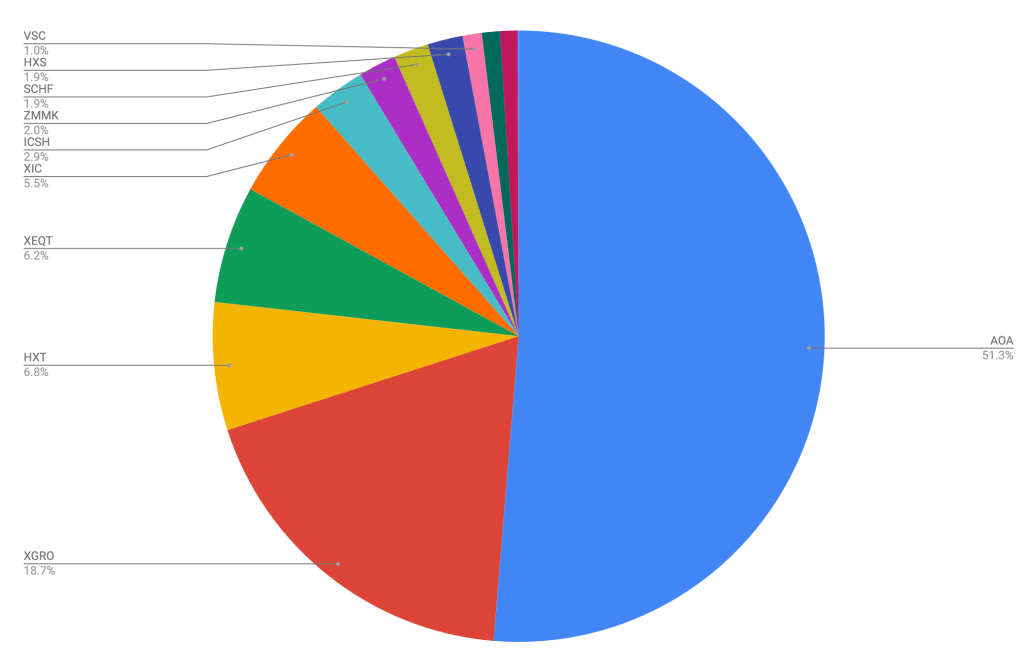
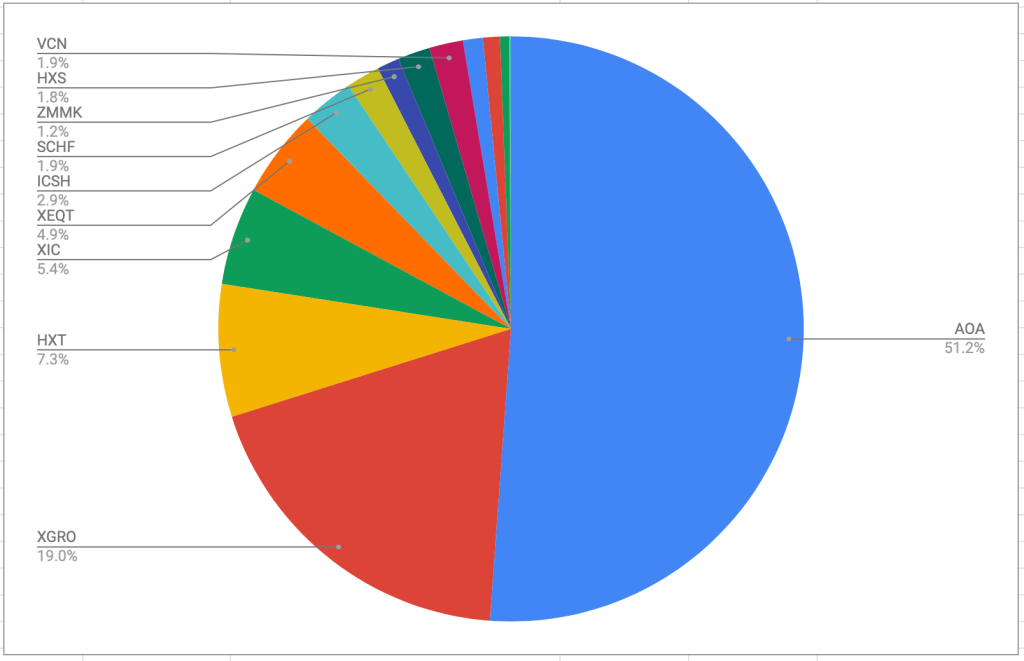
Overall retirement portfolio by holding, March 2025

The portfolio, as always, is dominated by AOA and XGRO which are 80/20 asset allocation funds in USD and CAD, respectively. The rest are primarily either cash-like holdings in two ETFs: ZMMK2 in CAD and ICSH3 in USD) or residual ETFs held in non-registered accounts for which I don’t want to create unnecessary capital gains just for the sake of holding AOA or XGRO.

The biggest month over month change is due to switching brokers. My old broker (QTrade) allowed the purchase of HISAs, but my new broker (Questrade) doesn’t seem to offer them4. So I replaced DYN6004 with ZMMK and DYN6005 with ICSH. I made these changes in my QTrade account to avoid any problems with doing an “in-kind” transfer to Questrade.

I’m still in need of USD to pay off some vacation bills, so there is a small hit to SCHF to help out.

Plan for the next month

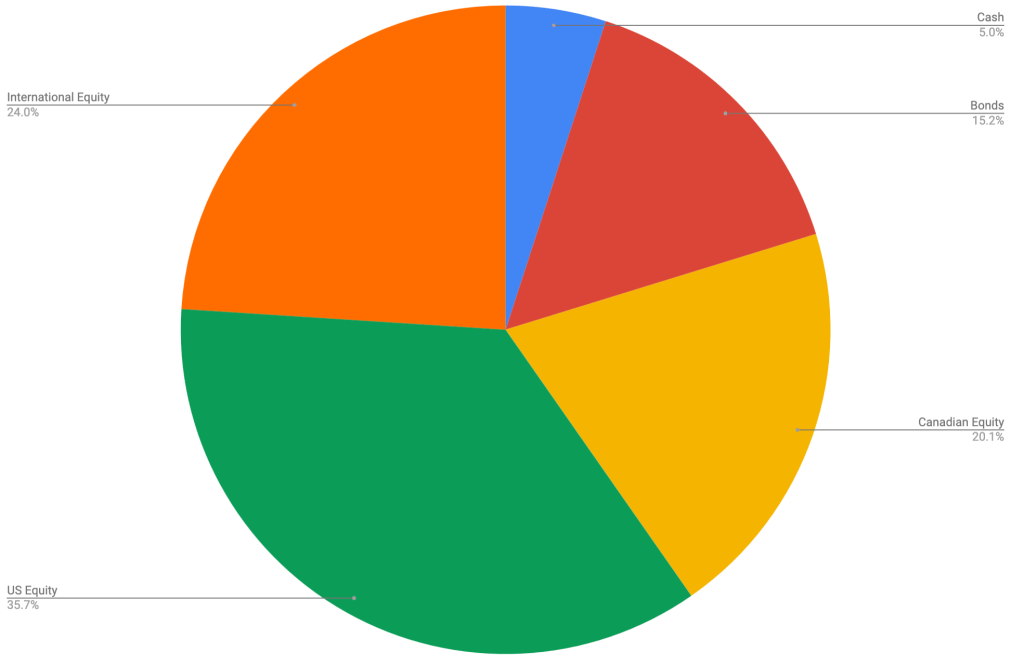
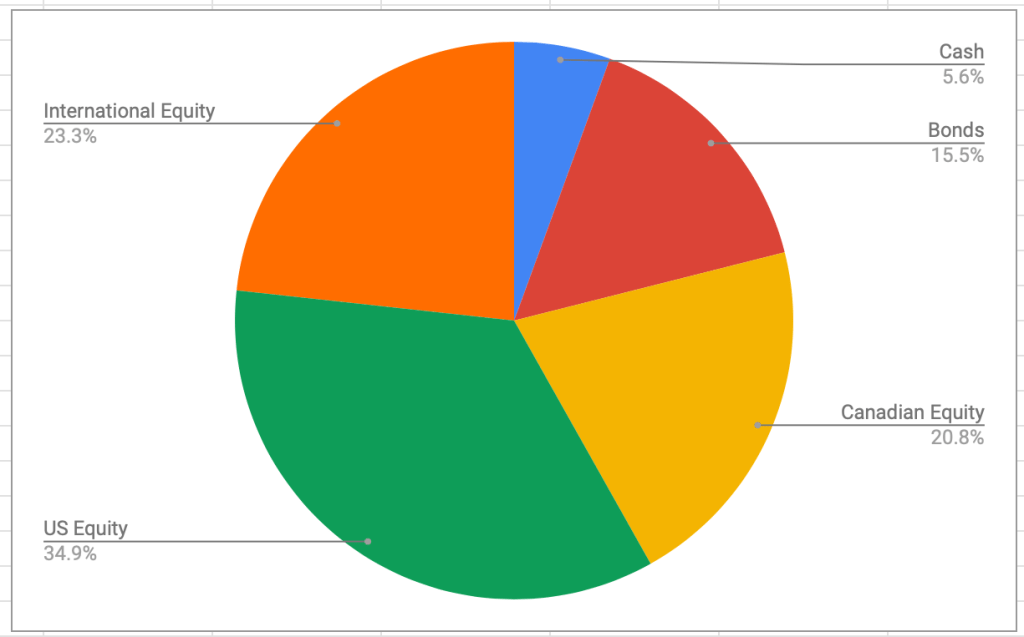
The asset-class split looks like this
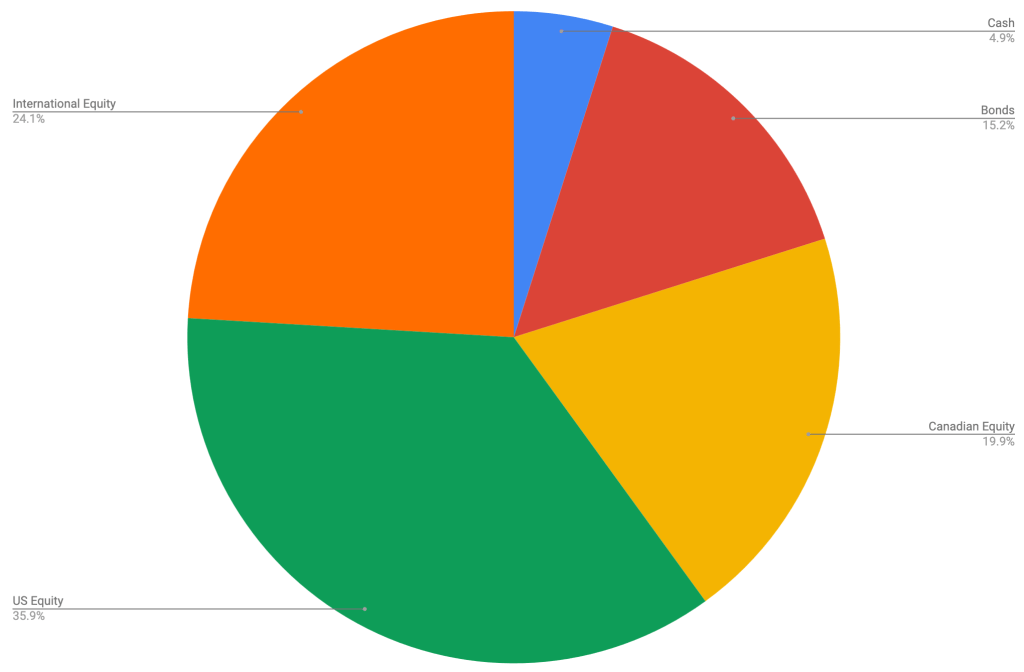
Overall retirement portfolio by market, March 2025

The international equity percentage is below my target of 24%, and so I’ll have to fix that5. VEU looks like it provides exposure to both developed and emerging markets at a rock-bottom price6. XEF would be a perfect fit in the Canadian market, although I should probably also consider XEC to get some emerging markets exposure.The cash position is artificially high because I already did the necessary transactions to get paid out of my RRIF and non-registered accounts (if I did this exercise at the beginning of the month, rather than mid-month, that would disappear). That extra cash will flow to my bank account in the coming days.

A quarterly activity that I’ll be performing this month7 is to shift some of my USD RRIF holdings into my CAD RRIF. I do this to make sure I’m not overexposed to changes in the CAD/USD exchange rate. My current provider reportedly allows me to make RRIF payments natively in USD, so that may be another option to consider. I’ll make an attempt at some point!

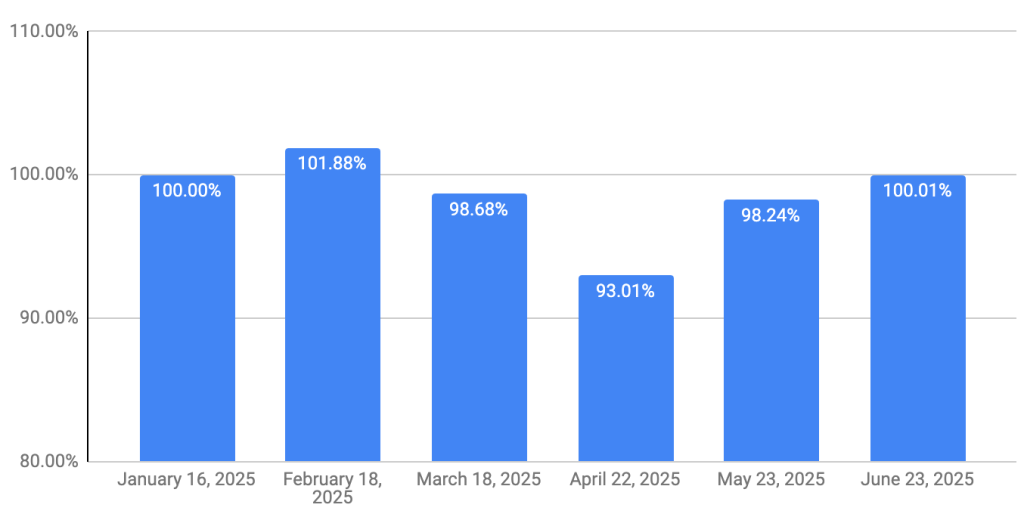
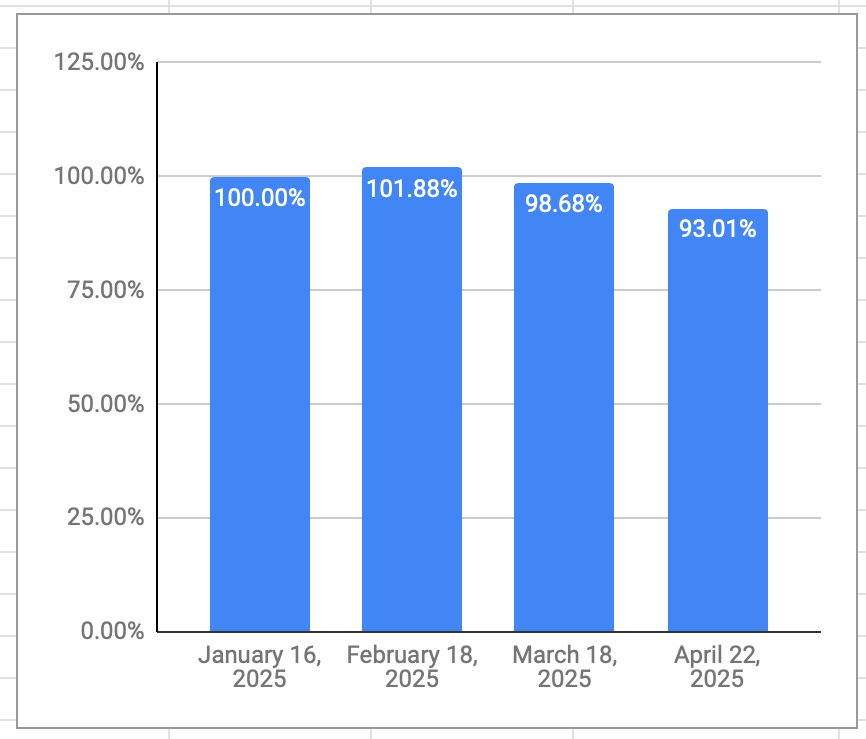
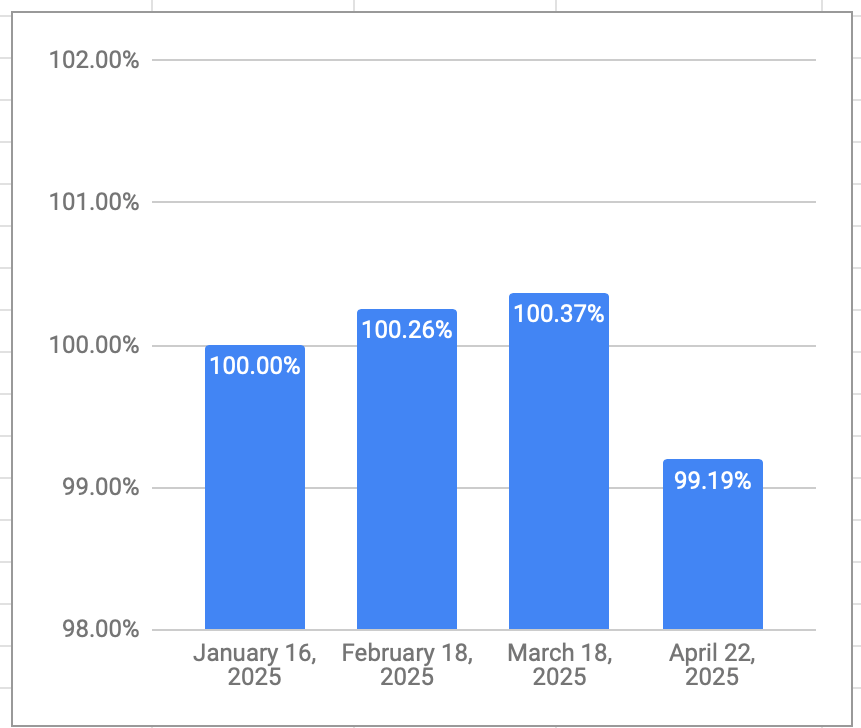
One final note: my retirement savings declined 3%8 over the month due to the wild (mostly downward) swings in the stock market, but this leaves me roughly even since my retirement started at the beginning of the year. Here’s the monthly returns for the 2 ETFs that make up the lion’s share of my portfolio9.

XGRO and AOA monthly returns so far
  1. The list is sort-of accurate. I’m in the middle of changing online brokers and since Questrade combines USD and CAD assets in one account, the number of accounts is diminishing. ↩︎
  2. Current 12-month yield: 3.6% ↩︎
  3. Current 30-day SEC yield: 4.61% ↩︎
  4. This specific topic addressed at https://www.financialwisdomforum.org/forum/viewtopic.php?t=125308. ↩︎
  5. The observant reader will note I also said this LAST month. That was before I decided to switch brokers. Once my holdings settle at Questrade, I’ll revisit. ↩︎
  6. MER = 0.04%. VEU has some Canadian exposure too, which isn’t ideal, but I don’t think there’s a USD ETF that excludes both Canada and the USA. ↩︎
  7. And should have done last month, sorry. ↩︎
  8. It would have been worse, except the USD also went up versus the Canadian dollar in the time period. Diversification works 🙂 ↩︎
  9. “Without dividends reinvested” since these two ETFs only pay out quarterly. There haven’t been any yet — next month! ↩︎

What’s in my retirement portfolio (Feb 2025)

This is a (hopefully monthly) look at what’s in my retirement portfolio. The original post is here.

Portfolio Construction

The retirement portfolio is spread across a bunch of accounts:

  • 7 RRIF accounts (3 for me1, 3 for my spouse, 1 at an alternative provider as a test)
  • 2 TFSA accounts
  • 5 non-registered accounts2, (2 for me 1 for my spouse, 2 joint)

The target for the overall portfolio is unchanged:

  • 80% equity, spread across Canadian, US and global markets for maximum diversification
  • 15% Bond funds, from a variety of Canadian, US and global markets
  • 5% cash, held in high interest savings accounts (list available to me shown here)

The view as of this morning

As of this morning, this is what the overall portfolio looks like:

Overall retirement portfolio by holding, February 2025

The portfolio, as always, is dominated by AOA and XGRO which are 80/20 asset allocation funds in USD and CAD, respectively. The rest are primarily either cash holdings in HISAs (DYN6004/5 in CAD and USD) or residual ETFs held in non-registered accounts for which I don’t want to create unnecessary capital gains just for the sake of holding AOA or XGRO.

The biggest month over month change is due to a small re-balancing exercise. I replaced some of my XGRO (which is an 80/20 equity/Bond asset allocation fund) with XEQT (a 100% equity asset allocation fund). I do re-balancing any time my asset allocation drifts more than 1% off my target allocations3. The trigger for me was an overweighting in bonds, which had drifted to represent 16% of my portfolio instead of the desired 15%. Upon reflection, the reason was obvious: both AOA and XGRO are 20% bonds, and if I want only 15% bonds, I will periodically need to fund an all-equity alternative. The net effect will be that you will see more XEQT show up in the portfolio over time.

The observant reader will also notice a bit of a shift between DYN6004 and DYN6005. The reason? I raided some USD from DYN6005 to pay my US credit card bill and replaced it with CAD in DYN6004 using the spot FX rate at the time. Seemed the easiest way to get some USD4 without having to resort to my friends at Knightsbridge.

SCHF percentages drifted down a bit since that’s the ETF I’m selling in my non-registered portfolio to augment my monthly RRIF payments. That will continue for the next few months at least since the USD payouts are needed to fund a few holidays5 I’m taking that are billed in USD.

Otherwise, nothing interesting to see in the month to month changes.

Plan for the next month

The geographic split looks like this

Overall retirement portfolio by market, February 2025

The international equity percentage is below my target of 24%, and so I’ll have to fix that. SCHF seems a good choice in USD6 since it’s free to trade with QTrade. XEF would be a perfect fit in the Canadian market.

A quarterly activity that I’ll be performing this month is to shift some of my USD RRIF holdings into my CAD RRIF. This wasn’t something I had planned to do but since my provider has backtracked on allowing me to get paid out of my USD RRIF in USD, I needed a way to keep the USD exposure at a constant-ish level in the overall portfolio. I’ll talk about the USD in my portfolio in a future dedicated post.

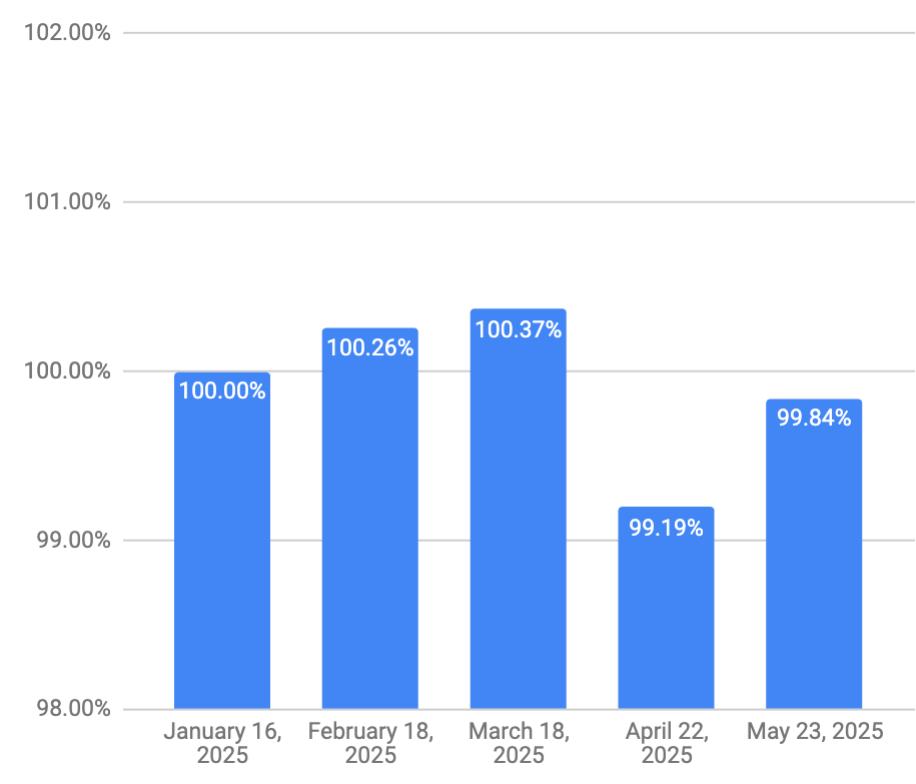
One final note: my retirement savings continue to grow even though I’m now actively removing assets out of it. On paper, this makes perfect sense since an 80/15/5 portfolio ought to grow at a rate greater than my rate of removal. In practice, of course, it’s rather stock market dependent. Here’s the monthly returns for the 2 ETFs that make up the lion’s share of my portfolio7.

XGRO and AOA monthly returns so far8
  1. For me, that’s one personal RRIF that has 2 accounts, one for CAD, one for USD, and one spousal RRIF. My spouse has one spousal RRIF in two currencies, and a personal RRIF. The alternative provider RRIF exists because I wanted to give Wealthsimple a try. ↩︎
  2. For me, two because one each for CAD and USD. The 2 joint accounts are my cash cushion accounts for the VPW methodology outlined here and here. ↩︎
  3. Completely spreadsheet-driven. I don’t trade on news, analyses, gut feelings, hot tips, or guesses. ↩︎
  4. I did hesitate a bit because the interest rate on DYN6005 is over 1% higher, but given the amounts involved, I’m clearly overthinking things. ↩︎
  5. All booked before this current tariff nonsense. Sorry. ↩︎
  6. Although it does have a 9% exposure to the Canadian market so not 100% “international”. Hard to beat the MER of this, though. ↩︎
  7. I don’t think this tool accounts for FX so it’s probably not totally accurate. Check out https://moneyengineer.ca/tools-i-use/ for other useful tools. Canadian dollar gained 1.4% against the USD in the past 30 days, per https://www.bankofcanada.ca/rates/exchange/daily-exchange-rates/ so that will reduce the effective return of AOA by the same amount. ↩︎
  8. “Without dividends reinvested” since these two ETFs only pay out quarterly. There haven’t been any yet. ↩︎

Caution! Spousal RRSP/RRIF Attribution Rules

Summary: The spousal RRSP is a great way to reduce current taxes, but if you’re planning on using the money in that spousal RRSP soon, be aware of the rules concerning who declares the income!

Disclaimer: As this article will demonstrate, I’m not a tax expert, lawyer, CPA or anything else. Use with discretion, some assembly required.

I made substantial use of spousal RRSPs during my working life. Spousal RRSPs are a way for the higher earning spouse to take advantage of the lower earning spouse’s unused RRSP contribution room, thus leading to a lower overall tax bill1. All good so far.

Some vocabulary will help with the next bit.

  • The contributor is the person providing the cash for the spousal RRSP and is the one who gets the tax deduction. Usually this is the higher income spouse.
  • The annuitant is the person whose name is on the spousal RRSP statements. This is usually the lower income spouse.

What most primers on spousal RRSPs don’t mention is that there is a restriction when it comes to withdrawing from the RRSP2. Paraphrasing the source material:

If the annuitant withdraws from a spousal RRSP within three years of the last contribution, the income from that withdrawal is considered to belong to the contributor, not the annuitant.

What? Why?

As with all things, there’s no free lunch. CRA doesn’t want to make tax avoidance so easy3, so this little detail will prevent the purely hypothetical scenario of a higher earning spouse making a large spousal RRSP contribution in the last year of their employment, and then getting the lower earning spouse to take out that same money at a much lower tax rate when the calendar moves from December to January.

There is one, small, bone that CRA throws our way in this case. Paraphrasing again:

If the annuitant withdrawal is instead made via a spousal RRIF, and the payment is RRIF minimum, then fine, the annuitant can declare that income.

So, as long as our lower income annuitant spouse opens a spousal RRIF, and as long as for the three years4 following the last spousal contribution, that spousal RRIF only pays out RRIF minimums, then all is well. The annuitant spouse declares the income, as expected.

Now of course, this rule may not matter to you. If you’re newly retired and don’t have much in the way of income, then it may not trouble you that you have to declare the income from your spouse’s spousal RRIF/RRSP. It’s just a bit more paperwork (a T2205, looks like).

In my case, I’m only taking RRIF minimums for the time being. So no extra paperwork for me.

  1. And future income splitting before the age of 65 when the option becomes available to all. ↩︎
  2. I’ve never myself made a withdrawal from an RRSP. That would break my rule of keeping retirement savings firewalled. And it looks to me to be an expensive proposition — your provider will surely charge a deregistration fee, your provider will have to withhold tax, and you have declare the full amount as income in the year you grab it. ↩︎
  3. I have learned to be guided by the humbling tenet of: “If I think I’ve figured out a way to outsmart the taxman, it’s probable that I’m simply demonstrating an incomplete understanding of how it actually works….” ↩︎
  4. To illustrate/clarify: the rule applies in the year the contribution is made, and the previous two years. So the contribution I made in 2024 will be free from all constraints in the 2027 tax year. ↩︎

Getting paid in retirement: a DIY challenge

Summary: The mechanical details of getting paid in retirement require careful review of how your provider allows cash movements between accounts, a handle on how much money is coming in via a RRIF, and, for bonus points, an annual decumulation plan to minimize household taxes.

I covered how I get paid in retirement previously, but this was nothing more than a restatement of how VPW (Variable Percentage Withdrawal) works. My reality is not quite as simple as the Idealized Monthly Routine I laid out in that post.

The actual work required looks more like this:

Actual monthly work needed to get paid in retirement

The first 3 steps are the ones I covered in the last post, and there’s nothing new to talk about there. In brief, you calculate your retirement savings, enter that number into the VPW spreadsheet, and out pops the monthly VPW suggestion (“v”), which is then added to the current value of your cash cushion (“c”) to calculate your salary (“s”).

It’s probably worth noting what specific accounts I hold at my provider to make things a bit clearer1

  • There are 4 total RRIF accounts (two for me, two for my spouse)
  • There are 2 non-registered accounts that hold retirement investments (one for me, one for my spouse)
  • There is 1 non-registered joint account that serves the role of VPW’s cash cushion, which is invested in DYN6004 so I can earn a bit of risk-free interest.

So ideally, my RRIF payments would flow into the cash cushion account, and I would pay myself out of the cash cushion account to my everyday joint chequing account. That is unfortunately NOT how it works.

Let’s pick up the process starting at step 4.

Do the RRIF minimum payments cover the calculated salary?

When I opened my RRIF accounts (and yes, there’s more than one2), one of the questions asked was “what bank account should the payments go to?” Asking for RRIF payments to go to a non-registered account was not presented as an option, and it’s not possible. So already the simple RRIF to cash cushion transaction outlined in the ideal scenario wasn’t possible.

The other questions asked by my provider was: how much do you want to be paid? (RRIF minimum, some percentage/amount higher than that, gross/net?)

(If you’re new to the RRIF world, or if you think that RRIFs are just for 71-year-olds, you may want to check out my previous post on debunking this and other myths.)

The amount each of my RRIFs3 pays me monthly is a well-known fact since I opted to collect RRIF minimum from each RRIF — and RRIF minimum is based on my RRIF value and age as of January 1, 2025. It will stay constant throughout 2025. So while simple, the amounts involved aren’t enough to pay my suggested salary. I’m free to ignore the suggested salary and simply (try to) live off my RRIF minimums, but that would be counter to my “you can’t take it with you” ethos. And so, I have to augment my RRIF minimum salary with money from elsewhere.

If your RRIF minimum payments are higher than the salary, then I suppose it makes sense to re-invest those payments somewhere. Or give the money away. Up to you 🙂

Sell required assets in non-registered account and move $ manually

The title is clear enough — sell something in the non-registered portfolio and use it to make up the salary shortfall. But whose holdings4? Which ones?

To help me decide, at the beginning of the year, I played around with tax scenarios using the calculators referenced in Tools I Use to concoct a high level plan on how to best minimize my household’s collective tax bill. (This was a tip my financial advisor gave me; her advice was to try to pay no more than an average tax rate of 15%5).

I assumed my income sources were

  • My RRIF minimum payments (same for my spouse)
  • My spouse’s salary
  • Minor dividend income6
  • Capital gains caused by the sale of non-registered assets7

Since the first three items above were already known, there was no decision to make; the tax owing on those was already clear8. The capital gains were the only variable — how much should I take versus my spouse? There was a bit of estimation involved in the actual amounts here (the actual gains would depend on the actual sale price), but it gave me a high level plan for 20259. Any additional income needed would be paid by capital gains realized from MY holdings since my income was forecast to be lower than that of my spouse10.

With the pre-work done, it boils down to making the required sell trade, waiting two days for the cash to settle, and then clicking the right buttons to get the cash out of my investment account and into my chequing account. Should be simple, but if you’ve never done it before, you need to make sure it’s all working as you expect.

Sell required assets in RRIF

Yes, you have to make sure that there’s cash available in your RRIF accounts (and remember, I have 4) BEFORE the monthly payment goes out. My provider would only be too happy to do this on my behalf, charging me their “telephone trading rates” for the trade — something like $30 plus $0.06 a share for XGRO. Compared with “free” if I do the work myself, that’s a pretty decent hourly rate…Do not forget that it takes two days for a trade to settle into cash. Since my provider does not pay interest on cash holdings, I’m highly motivated to keep any cash balance to a strict minimum. I hate not earning money on my money.

Adjust cash cushion up or down by comparing VPW suggestion to calculated salary

In my previous post I talked about moving “v” to the cash cushion and then simply taking 1/6th of it as salary. And that is exactly what I do. But practically, it’s impossible to do this maneuver in exactly the way I describe with my current provider (QTrade). Here are the specific reasons I can’t do what VPW asks me to do:

  • QTrade RRIF payments must be made to an external bank account. So right away, part of my salary cannot flow through an intermediary cash cushion account.
  • QTrade does not allow cash transfers between non-registered accounts on their online platform. This means that the asset sales in my non-registered account cannot be moved directly to the cash cushion accounts either11.

I have worked around the limitations imposed by my provider by either

  • moving money from my chequing account to my cash cushion if the VPW suggestion is higher than my salary (market is moving up)
  • moving money from the cash cushion to my chequing account if my salary is higher than the VPW suggestion (market is moving down)

I have set up smart-ish spreadsheets to break down all the various movements of money which I will share at some point once I figure out how to make them a bit more generic. I’ve also documented a step-by-step guide for my spouse which she uses as we sit together walking through the monthly tasks12 so that I have confidence she could execute on them if I became incapacitated. There is no substitute for handing over the controls to see where the gaps in knowledge — and documentation — are.

The future

Having witnessed what happens to savvy adults as they get older, I know deep down that this DIY strategy isn’t sustainable forever. There are too many moving parts, and too many opportunities to make mistakes.

At present, I don’t have a future plan mapped out. I have updated my “death binder“, but beyond this, nothing more. I will dedicate more research (and future posts) on that topic.

  1. For your benefit I have not mentioned the USD variants I have of a few of these. This post is long enough as it is, and I presume that most readers don’t hold assets that are traded on US stock exchanges. ↩︎
  2. My own RRIF and my spousal RRIF account for two, and my spouse has two as well. Total four. They are with the same provider. Spousal RRIFs are generated from spousal RRSPs, in case you were wondering. If you deal with more than one RRIF provider (I would NOT recommend that), you’ll also have to consider that. All this to say that I saw 4 distinct payments made to my joint chequing account on Friday last week, one for each of the 4 RRIFs. ↩︎
  3. I keep saying “my RRIFs” for simplicity, but all 4 RRIFs (2 in my name, 2 in my spouse’s) are treated the same way. All four payments end up in our joint chequing account. ↩︎
  4. Both my spouse and I have non-registered accounts. My spouse’s was funded via a spousal loan I set up years ago to achieve some degree of income splitting. ↩︎
  5. After years of thinking of taxation in terms of what I paid on the LAST dollar I earned, this was admittedly a very different way of considering the problem. ↩︎
  6. Most of my dividend income (via XGRO and AOA) is buried in my RRIF and TFSA to avoid any taxation of it ↩︎
  7. Because I make a lot of use of HXS and HXT in my non-registered portfolio, I earn no dividend income; it’s all capital gains… ↩︎
  8. If you’re not aware, RRIF payments are treated as no-special-treatment taxable income, reported on a T4-RIF form by CRA. ↩︎
  9. Since I get paid monthly, I could always adapt if my assumptions were radically off. ↩︎
  10. I could have also paid the extra from my TFSA holdings, but my advisor suggested that this is the LAST bucket to use in retirement. ↩︎
  11. Unless I like waiting on hold. I do not. ↩︎
  12. Who says romance is dead? ↩︎