
What’s in my retirement portfolio (March 2026)?

This is a monthly look at what’s in my retirement portfolio. The original post is here.

Portfolio Construction

The retirement portfolio is spread across a bunch of accounts:

  • 5 RRIF accounts
    • 3 for me (Questrade, Wealthsimple)
    • 2 for my spouse (Questrade)
  • 2 TFSA accounts (Questrade)
  • 4 non-registered accounts, (1 for me, 1 for my spouse, 2 joint, all at Questrade)

The view post-payday

I pay myself monthly in retirement, so that’s a good trigger to update this post. On March 30, this is what it looks like:
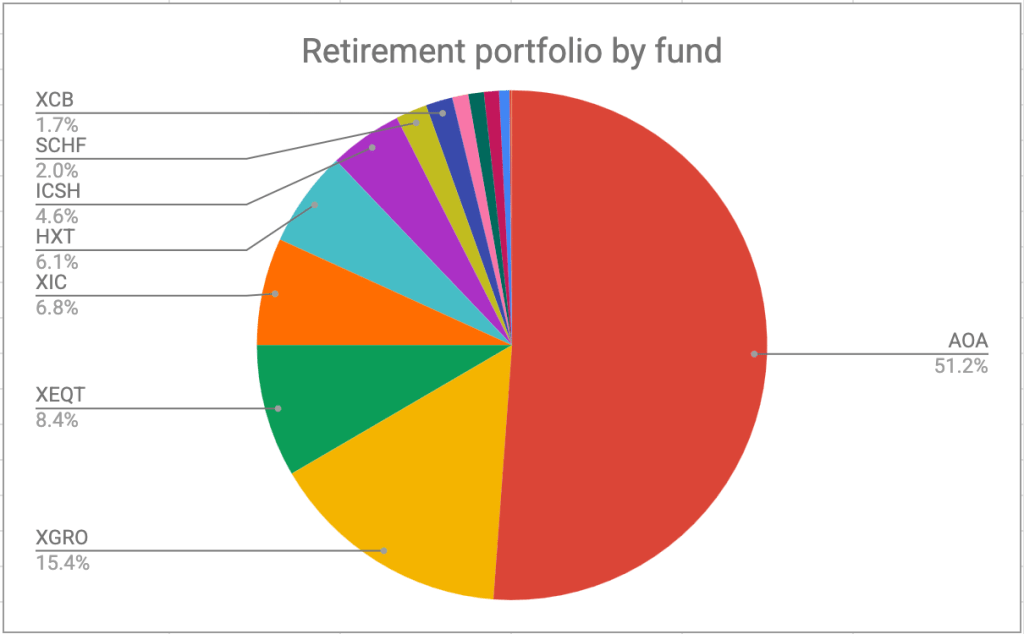
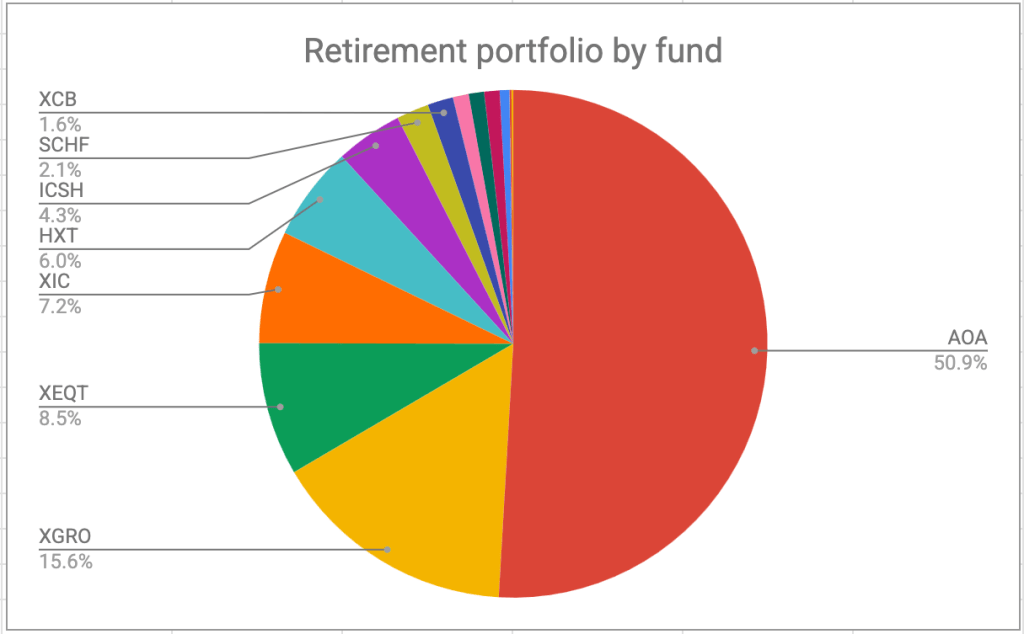
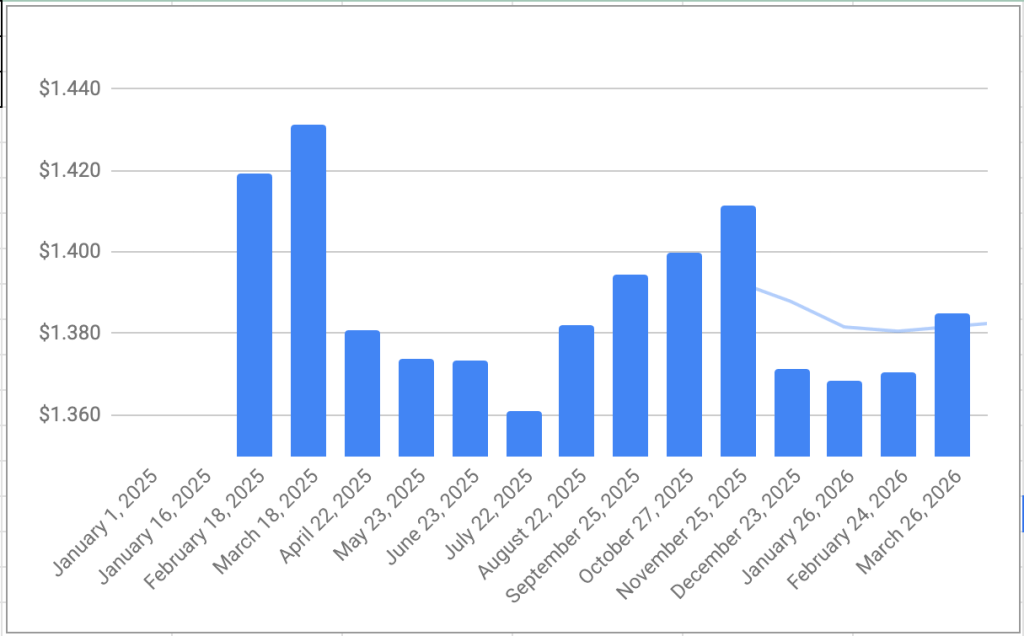
The portfolio is dominated by my ETF all-stars, (and if not an all-star, they are probably on the Magnificent Seven ETFs list). This split is before all the quarterly dividends have paid out. AOA, XGRO, XEQT, XIC all have a quarterly payment that collectively might skew the numbers a bit — I have all these investments on DRIP so I just buy more of the same. All that to say that there weren’t big changes month to month; my USD holdings got a bit of a boost this month thanks to a favourable exchange rate. (A lot of my retirement holdings are in USD, so the FX rates matter somewhat). Here’s what the USD has looked like in CAD since my retirement:
Plan for the next month

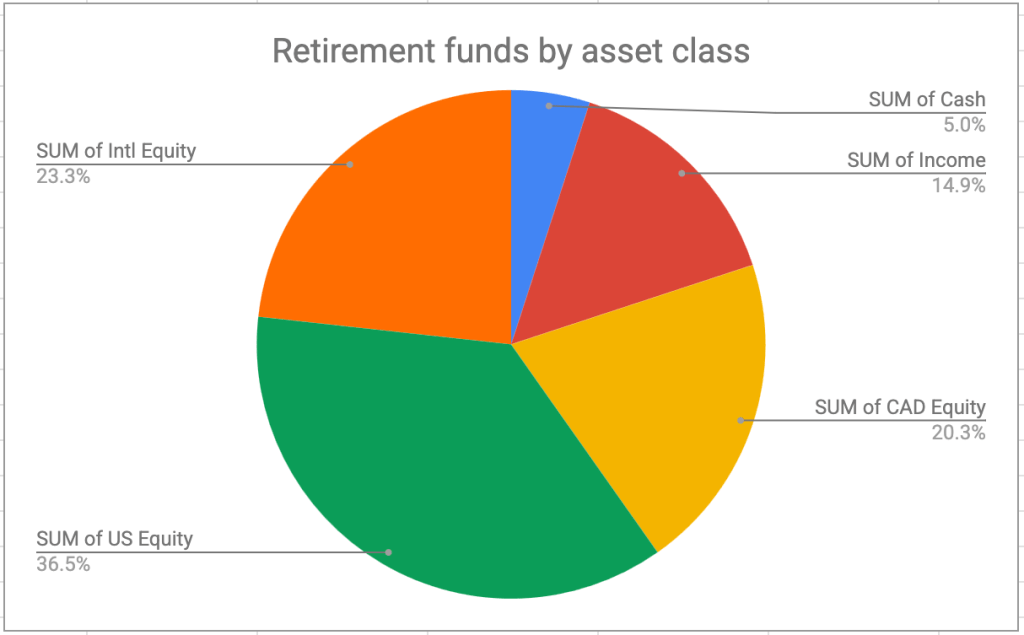
The asset-class split looks like this; you can read about my asset-allocation approach to investing over here.
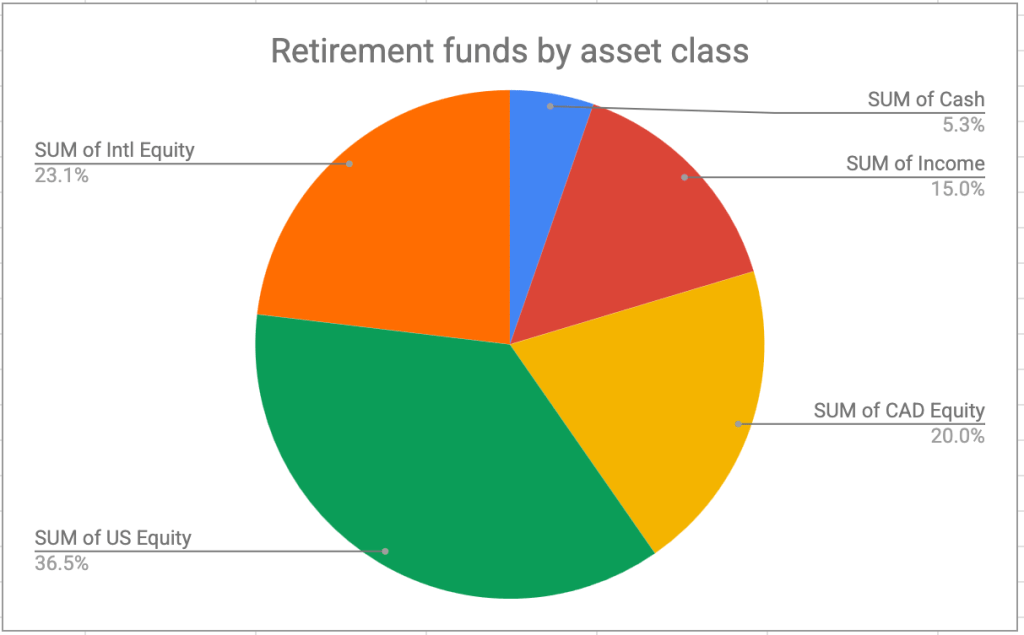
It’s looking pretty close to the targets I have, which are unchanged:

  • 5% cash or cash-like holdings like ICSH and ZMMK
  • 15% bonds/income (most are buried in XGRO and AOA, rest are in XCB)
  • 20% Canadian equity (mostly based on ETFs that mirror the S&P/TSX — HXT and XIC)
  • 36% US equity (dominated by ETFs that mirror the S&P 500)
  • 24% International equity (mostly, but not exclusively, developed markets)

The alignment with target is what drives my investment decisions; seeing the chart above tells me there’s no movements needed, which makes things simpler.

Since we’re just about in to the 2nd quarter of the year, it’s time for me to move some AOA into XGRO using Norbert’s Gambit1. The Gambit has worked out pretty well for me so far; I track my effective FX rate every time I do it, and it’s always less than relying on the instant (and relatively expensive) FX conversions offered by my broker2.

Overall

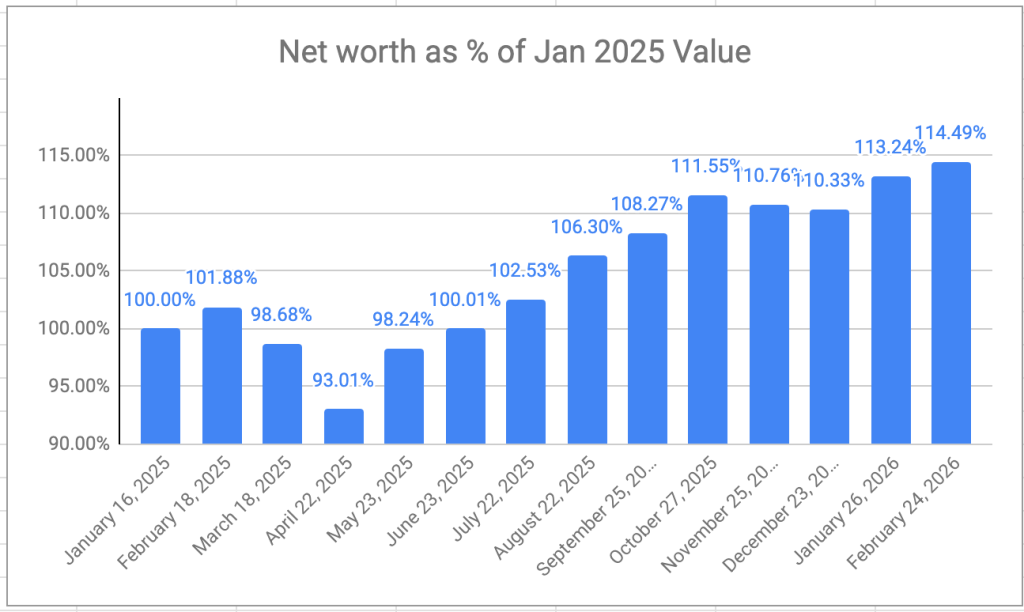
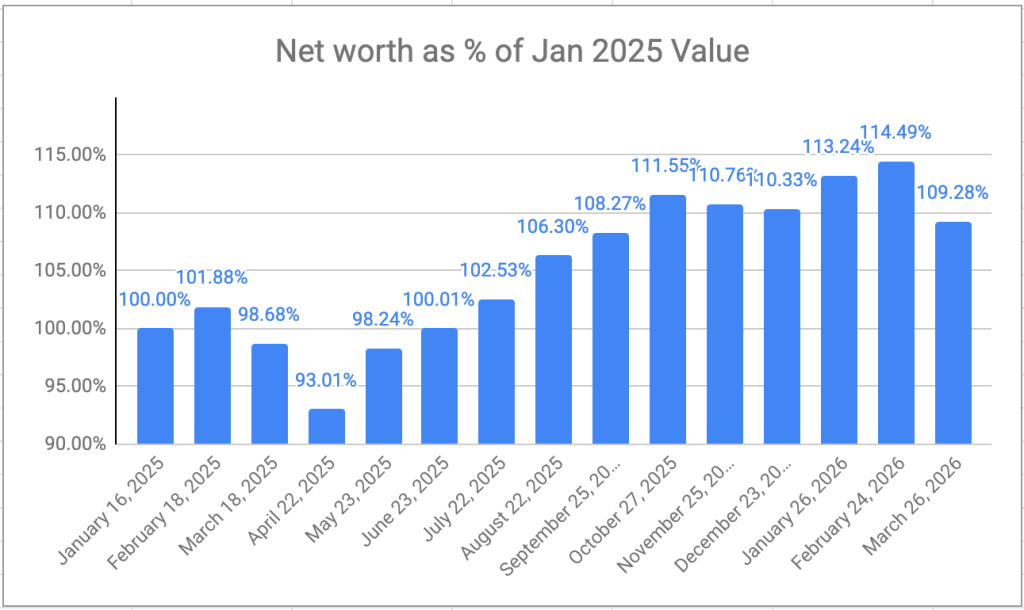
Part of using VPW3 as a strategy is the need to calculate your retirement net worth on a monthly basis. As you can see below, the most recent market gyrations have had a bit of an impact on the bottom line, taking me back to a value I haven’t seen since September last year:
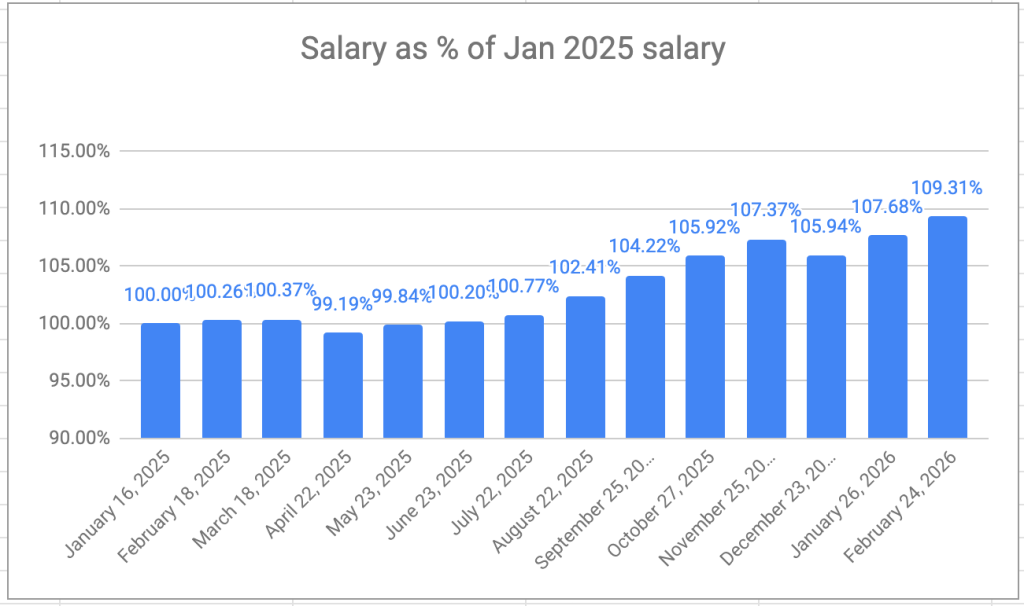
But my VPW-calculated salary, which has a built in shock absorber (aka cash cushion), continued its upward trend nonetheless:
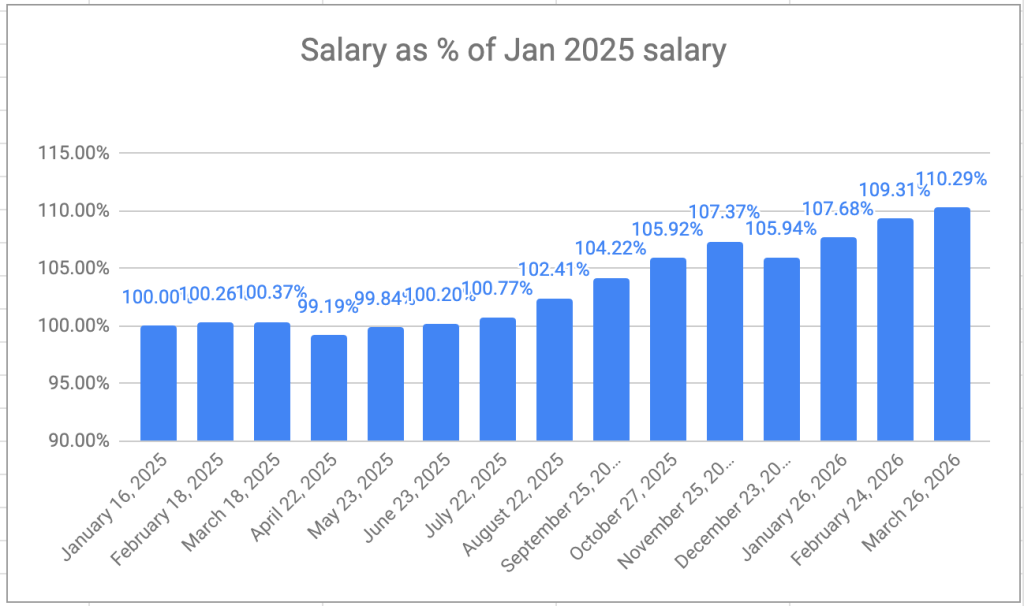
I’m expecting to take a pay cut at some point if the markets fail to recover, but pay cuts are an expected outcome of using VPW as a strategy. The “V” is for “variable”, after all. At this point, I’m still taking over 10% more than I did a year ago, so no matter how you slice it, things are more than on track.


  1. Of late, my need for spending in USD seems not so critical anymore. ↩︎
  2. Typically 1.5% of the amount converted. ↩︎
  3. Variable Percentage Withdrawal, my chosen decumulation strategy. ↩︎

Ex-Dividends and Getting Paid in Retirement

As mentioned elsewhere, getting paid in retirement for me is a monthly activity involving selling shares (mostly XGRO), moving funds and so on. The exact date I actually DO the work is a little variable. Questrade and Wealthsimple both automatically move my RRIF payments to my bank account on the last business day of every calendar month; this means I could conceivably do my sell trades to free up cash on the next-to-last business day of every calendar month1, but usually I do it sometime in the last week of the month.

Today, (the 23rd of the month), I noticed the market doing something it hasn’t done much lately, namely go up. And since the 23rd is in the right window (nearing the end of the month), I thought, “well, maybe I could do my monthly payment today”. Admittedly, it’s probably a day or two earlier than I would normally do this, but I didn’t think it mattered too much in the big scheme.

Part of me felt a bit uneasy about doing this, it felt a bit like timing the market. But then I also remembered that since this was March, it meant that XGRO was due to pay its quarterly dividend around now.

A quick search revealed that XGRO’s “ex-dividend date” is in fact March 26, 20262. This means that anyone holding XGRO at close of business on March 25th would qualify for the dividend, which per the XGRO page, is $0.117 per unit held.

So this would mean that selling today would have been at the expense of the dividend payout for the quarter. Now, I know that this really should not matter; it’s a well established fact that the dividend-paying stock drops by the same amount as the dividend paid out on the ex-dividend date, meaning it should make zero difference whether I sell just before or just after the ex-div date.

In the end, I decided not to sell today. My usual day would actually be closer to the ex-dividend date, and psychologically, I feel like I’ve earned the dividend by holding XGRO the entire quarter. What do you think? Do you ever time your buys/sells based on ex-dividend dates? Let me know at comments@moneyengineer.ca.

  1. Since the settlement time of ETF trades is T+1, meaning the day after the trade completes. Notable is that Questrade requests you have funds available 3 business days before payment date; I haven’t quite figured out how strictly they enforce that. ↩︎
  2. Look at the “Distribution” section, specifically the table. ↩︎

What’s in my retirement portfolio (Feb 2026)?

This is a monthly look at what’s in my retirement portfolio. The original post is here.

Portfolio Construction

The retirement portfolio is spread across a bunch of accounts:

  • 5 RRIF accounts
    • 3 for me (Questrade, Wealthsimple)1
    • 2 for my spouse (Questrade)
  • 2 TFSA accounts (Questrade)
  • 4 non-registered accounts, (1 for me, 1 for my spouse, 2 joint, all at Questrade)

You will notice that QTrade is no longer in the mix. I successfully moved the last RRIF accounts during the month; I learned a lot in the process. QTrade was the victim in the chase for free money offered by Questrade last year; based on current offerings, I’d say that QTrade still has an edge in terms of user experience over Questrade. I’ll go into more detail in a future post.

The view post-payday

I pay myself monthly in retirement, so that’s a good trigger to update this post. On February 28, this is what it looks like:

The portfolio is dominated by my ETF all-stars, (and if not an all-star, they are probably on the Magnificent Seven ETFs list) but if you’ve been following along, you’ll see a few changes.

  • I dropped XAW since I realized I didn’t need it if I was smarter the ratios of holdings I already owned (XEQT/XIC/XCB). Less is more.
  • I sold XIC instead of HXT in my non-registered account this month to help pay the bills because I reasoned that eliminating its dividend payouts would be better from a tax perspective2.

Plan for the next month

The asset-class split looks like this; you can read about my asset-allocation approach to investing over here.

It’s looking pretty close to the targets I have, which are unchanged:

  • 5% cash or cash-like holdings like ICSH and ZMMK
  • 15% bonds3 (most are buried in XGRO and AOA, rest are in XCB)
  • 20% Canadian equity (mostly based on ETFs that mirror the S&P/TSX — HXT and XIC)
  • 36% US equity (dominated by ETFs that mirror the S&P 500)
  • 24% International equity (mostly, but not exclusively, developed markets)

I am mulling over making a small tweak to these percentages, increasing US equity exposure at the expense of International equity based on some calculations I’ve done4 but this is neither urgent nor will it be massively impactful to the overall picture.

Overall

There is a bit of an anomaly this month that I should mention. A number of readers have questioned my wisdom of contributing monthly to a TFSA in retirement. From a tax-free growth perspective, it would be far better to make the contribution at the beginning of the year. And many studies have shown that lump sum investing provides better returns than spacing them out. And so, I have taken their advice5 and made all my TFSA contributions for the year this month. And since my TFSA is part of my net worth, there’s a bump being caused by that contribution.

And so, net worth overall is up month over month, a two month winning streak.

My VPW-calculated salary also continues its upward trend.

  1. One spousal, one individual. One at Wealthsimple because (a) I like their user experience and may consider them as my primary broker in the future and (b) they offered me free money and a laptop to move some fees their way. I can be bought. ↩︎
  2. HXT does not pay dividends and instead uses swap contracts to convert them into capital gains, which receive better tax treatment for me ↩︎
  3. Referred to as “Income” on the chart above ↩︎
  4. I’ll share those in a future post ↩︎
  5. With thanks to Steven and Sylvain ↩︎

Caution: Transferring RRIFs between brokers

DIY investors include a growing number of RRIF holders (like me). If you want a primer on RRIFs, you can read that here. There are some strange nuances involved with moving RRIFs between brokers which may not be obvious and are not documented anywhere — or if they are, I have yet to find where.

I’ve covered parts of this topic before, (here and here) but this post attempts to summarize the weirdness so you don’t get caught unaware. It is my belief that the cautions outlined below are applicable to ALL brokers, but happy to learn otherwise, just drop me a line at comments@moneyengineer.ca, I read all my mail.

For simplicity, I’m going to refer to the “sending” broker (the broker that currently manages the RRIF) and the “receiving” broker (the broker to whom you’re transferring those same assets).

Caution 1: A sending broker cannot transfer a RRIF unless it has fully paid out RRIF minimum for that year.

As RRIF aficionados will know, at the end of the calendar year, a new “RRIF minimum” amount is calculated by the broker based on the market value of the RRIF at that time and the age of either the RRIF owner or the spouse of the RRIF owner. This is a well-known fact. What is perhaps not so well known is that the broker who holds the RRIF at the start of the year is obligated to pay out the full amount of the RRIF minimum, even if that RRIF is transferred in the course of the year1.

This has implications, especially if you attempt the transfer early in a calendar year:

  • You are going to end up with “extra” cash that you weren’t expecting. You’ll have to be prepared to do something with that money, but what? Leave it as cash? Invest it in a HISA? Invest it in an all-in-one?
  • This early windfall also means that your potential tax-free growth2 is lost.

Caution 2: Waiting past end of November to initiate a RRIF transfer runs the risk of tying up your RRIF funds for multiple months

“Fine”, you think, “if I wait until late in the year to transfer my RRIF, I can avoid the problems inherent in Caution 1”. This is what I thought, too. I was, again, wrong.

There seems to be an industry-wide pause on RRIF transfers that starts in late November and lasts until January of the following year. I’ve seen more than one mention of it. Questrade’s message when I attempted to transfer-in my RRIF to them was

Please be advised that RRIF/LIF account transfers are subject to the industry-wide cut-off date, November 28, 2025. This cut-off date is not specific to Questrade, but is arranged and agreed upon by all Canadian financial institutions to ensure yearly payments are made in an orderly and timely manner to all account holders.”

It appears I got extremely unlucky: the transfer STARTED before November 28th, but failed to fully complete before the deadline. Performing a transfer is a multi-step process using a service called “ATON”34. You can read all about how ATON works over here.

In my case, it took until mid-February for the transfer to complete. During that time, the account was in limbo, and no payments could be made. For someone who expects to be paid monthly from a RRIF, this was a bit of a problem.

Advice: Initiate RRIF transfers before November 1.

This ought to give enough time for the transfer to complete before the cut-off date. And minimizes the amount and time you have “extra” money floating around. You can help make sure your transfer goes as expected:

  • Make sure the assets you hold are supported at both institutions. GICs are a frequent problem. So are bank-backed HISAs. If you hold assets like that, do yourself a favour and sell them before you initiate the transfer so that they are just cash.
  • If you hold fractional shares in your account5, get rid of them by selling off the fractions or buy more so that you have whole shares. From what I’ve read, fractional shares are a construct that is broker-specific and will cause issues when you attempt to transfer them.
  • Make sure you have enough cash in your RRIF so that the sending broker can pay out your RRIF minimum before the transfer begins.

Happy investing. If a transfer really goes astray, it looks like OBSI can help.

  1. This CRA link seems to be the one that states this. ↩︎
  2. Since the average gains of the market are positive, I’m always going to make the assumption that it’s better to be invested than not. You could of course get lucky and avoid a big market downturn because your RRIF cashed early, but that’s not how I think about investing. Time in the market is always better than timing the market, per Ken Fisher ↩︎
  3. “Account Transfer Online Notification”, apparently per https://cffim-fcmfi.ca/wp-content/uploads/aton-best-practices-guide-Jan-15-2021-v9.9.pdf ↩︎
  4. I am indebted to Financial Wisdom Forum users NorthernRaven and OptsyEagle for their help in understanding what went wrong in my case ↩︎
  5. Wealthsimple (for all shares/ETFs) and Questrade (for some US shares/ETFs) both offer this option. There may be others. ↩︎

RRIF Support Showdown: Wealthsimple, Questrade, QTrade

I’m currently holding RRIF accounts at three different online providers (QTtrade, Questrade and Wealthsimple)1. So I am perhaps uniquely positioned to comment on the relative goodness and badness of the support of this kind of account at these three brokers. I also have some experience with BMO Investorline in this regard, but that experience is getting a bit long in the tooth now.

So without further ado, let’s take a look:

Wealthsimple

Wealthsimple now provides support for both RRIFs and (relatively recently) Spousal RRIFs. And although Wealthsimple supports USD accounts, they do not (for whatever reason) support USD RRIFs2, which, for many readers, isn’t a big deal, but to me it is.

But for all that, I still hold a CAD RRIF with Wealthsimple. It started last year, when I realized my DPSP couldn’t be immediately converted to a RRIF, and Wealthsimple was offering a shiny new Macbook to win the business. How could a certified cheapskate refuse?

Since I only opened the RRIF last year, this year is the first year where I’m obliged to take out RRIF-minimum payments. Wealthsimple makes this stupidly easy on many levels:

  • They clearly display what your minimum payment for the year is right on the account screen, and they also show how much you have left to go against that minimum
  • They make it easy to create a “recurring withdrawal” from the RRIF, which is something I do every month, and I can easily change this whenever I want, although I’m not planning on doing that.
  • And — bonus — they support XGRO fractional shares AND the ability to place a sell trade in dollars and cents rather than # of units. This means I can sell EXACTLY the number of XGRO units I need to every month, with no excess dead-money cash floating around.

You have to set up your bank account for EFT withdrawals before this works, of course.

QTrade

I still hold 3 RRIF accounts at QTrade, although I’ve been trying to move them to Questrade since late November. Seems that there is an industry-wide freeze on moving RRIF accounts in the month of December.

QTrade supports USD and CAD RRIF accounts, and they keep them completely separate — different account numbers, even. They are linked, however, because the TOTAL value of the 2 accounts is used to determine your CAD RRIF minimum payment. I’ve only withdrawn RRIF funds in Canadian dollars, because I couldn’t get a straight answer whether I could withdraw USD funds natively to my USD account.

QTrade also supports Norbert’s Gambit, which is important if you want to convert between USD and CAD cheaply.

With QTrade, you have to send in a form to set up your RRIF withdrawals, either monthly/quarterly/annually. And per their fee schedule, if you deviate from this, you owe them $503.

Once the schedule is in place, the withdrawals happen automatically. You have to make sure you sell your assets in advance of the withdrawal date. What happens if you don’t have enough funds? Not sure, cannot find any documentation that addresses this. There is also no indication online as to what your RRIF minimum payment is; you have to contact support if you want the exact amount.

Questrade

The majority of my RRIF holdings are here. As mentioned above, I’m trying to move 3 RRIF accounts from QTrade to Questrade. The delay from end of November to beginning of January seems like it’s explainable by the aforementioned industry-wide freeze. But since then, I lay the blame fully on Questrade for dragging their feet on getting the right forms in QTrade’s hands.

Questrade supports USD RRIFs, and combines them with CAD holdings. Same account for both, and they do a nice job of providing you with multiple views so you can see your portfolio in either currency.

Questrade also supports Norbert’s Gambit, and I’ve used it multiple times already to convert USD holdings into CAD holdings.

Questrade requires a form to set up RRIF payments, and like anything involving a form at Questrade, you have to sit on top of support to make sure someone actually reads the form.

Like QTrade, Questrade treats RRIF minimum payments as some sort of secret, forcing you to contact support if you don’t know what the value is.

You can also exceptionally get “extra” payments using the “Move Money” menu. I am not sure how withholding tax would work if you did this. It appears that you could also withdraw USD from this menu. The “Move Money” menu is one that seems to be rather fragile — bank accounts previously linked have a habit of disappearing from this screen.

As I write this, Questrade is only batting .500 in delivering the first RRIF payment. I got mine, but my spouse did not. Unclear why this may be, the support person I spoke to also seemed perplexed.

The Verdict

If you have USD in your RRIF, I would probably pick Questrade over QTrade. Questrade’s support of “on demand” payments is a nice flexibility. The one downside is that Questrade charges a flat fee to execute Norbert’s Gambit, whereas QTrade, as far as I can tell, does not.

But once Wealthsimple supports USD in RRIFs and Norbert’s Gambit4, they would be my #1 pick for managing the RRIF payments. High degree of automation, high degree of flexibility, high degree of transparency. If you don’t have USD in your RRIF, then I could recommend Wealthsimple over the other two.

  1. Mishaps and greed have contributed to this current situation. I don’t condone it. ↩︎
  2. Proof: https://help.wealthsimple.com/hc/en-ca/articles/17933575404315-Open-a-RRIF#h_01H8Y8853951RYHHA80S11T5Y9:~:text=Can%20I%20hold%20USD%20cash%20in%20my%20self%2Ddirected%C2%A0RRIF%3F ↩︎
  3. I’ve never had the need, but be forewarned! ↩︎
  4. Coming this quarter per this PR. ↩︎