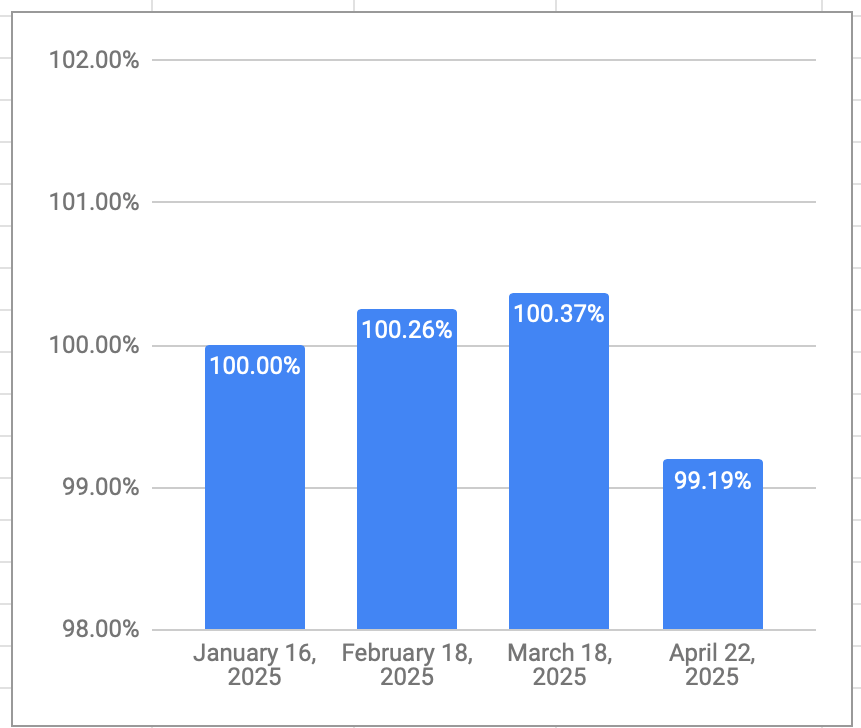
What’s in my retirement portfolio (March 2025)

This is a (hopefully monthly) look at what’s in my retirement portfolio. The original post is here. Last month’s is here.

Portfolio Construction

The retirement portfolio is spread across a bunch of accounts1:

  • 7 RRIF accounts (3 for me, 3 for my spouse, 1 at an alternative provider as a test)
  • 2 TFSA accounts
  • 5 non-registered accounts, (2 for me 1 for my spouse, 2 joint)

The target for the overall portfolio is unchanged:

  • 80% equity, spread across Canadian, US and global markets for maximum diversification
  • 15% Bond funds, from a variety of Canadian, US and global markets
  • 5% cash, held in savings-like ETFs.

The view as of this morning

As of this morning, this is what the overall portfolio looks like:

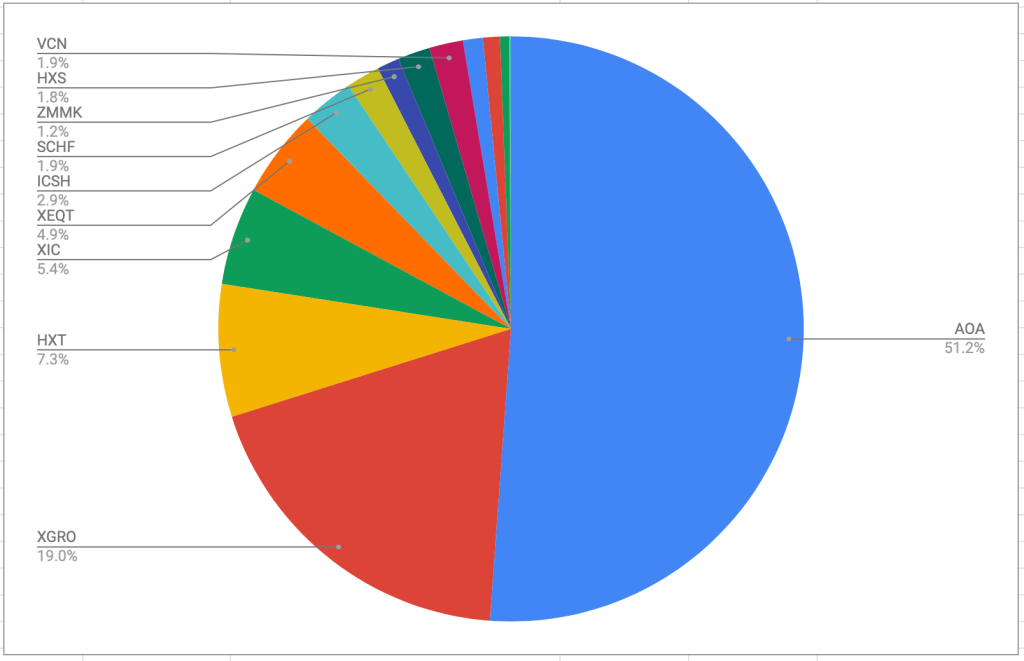
Overall retirement portfolio by holding, March 2025

The portfolio, as always, is dominated by AOA and XGRO which are 80/20 asset allocation funds in USD and CAD, respectively. The rest are primarily either cash-like holdings in two ETFs: ZMMK2 in CAD and ICSH3 in USD) or residual ETFs held in non-registered accounts for which I don’t want to create unnecessary capital gains just for the sake of holding AOA or XGRO.

The biggest month over month change is due to switching brokers. My old broker (QTrade) allowed the purchase of HISAs, but my new broker (Questrade) doesn’t seem to offer them4. So I replaced DYN6004 with ZMMK and DYN6005 with ICSH. I made these changes in my QTrade account to avoid any problems with doing an “in-kind” transfer to Questrade.

I’m still in need of USD to pay off some vacation bills, so there is a small hit to SCHF to help out.

Plan for the next month

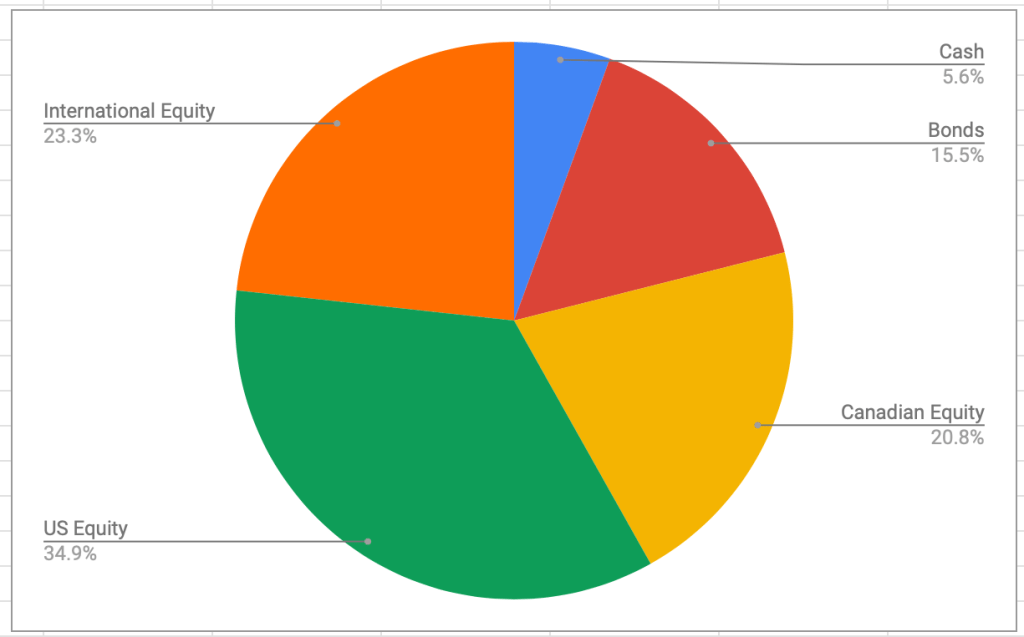
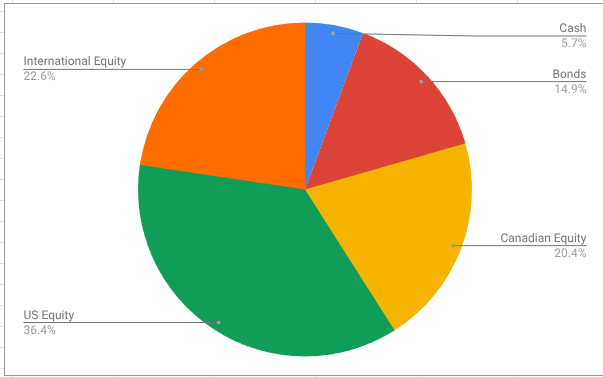
The asset-class split looks like this
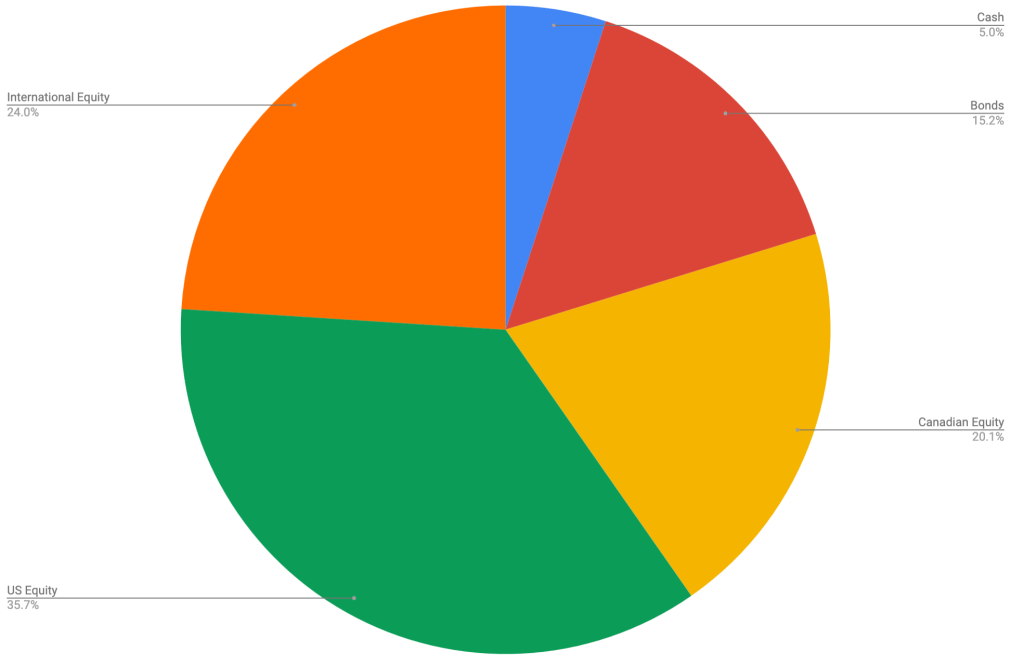
Overall retirement portfolio by market, March 2025

The international equity percentage is below my target of 24%, and so I’ll have to fix that5. VEU looks like it provides exposure to both developed and emerging markets at a rock-bottom price6. XEF would be a perfect fit in the Canadian market, although I should probably also consider XEC to get some emerging markets exposure.The cash position is artificially high because I already did the necessary transactions to get paid out of my RRIF and non-registered accounts (if I did this exercise at the beginning of the month, rather than mid-month, that would disappear). That extra cash will flow to my bank account in the coming days.

A quarterly activity that I’ll be performing this month7 is to shift some of my USD RRIF holdings into my CAD RRIF. I do this to make sure I’m not overexposed to changes in the CAD/USD exchange rate. My current provider reportedly allows me to make RRIF payments natively in USD, so that may be another option to consider. I’ll make an attempt at some point!

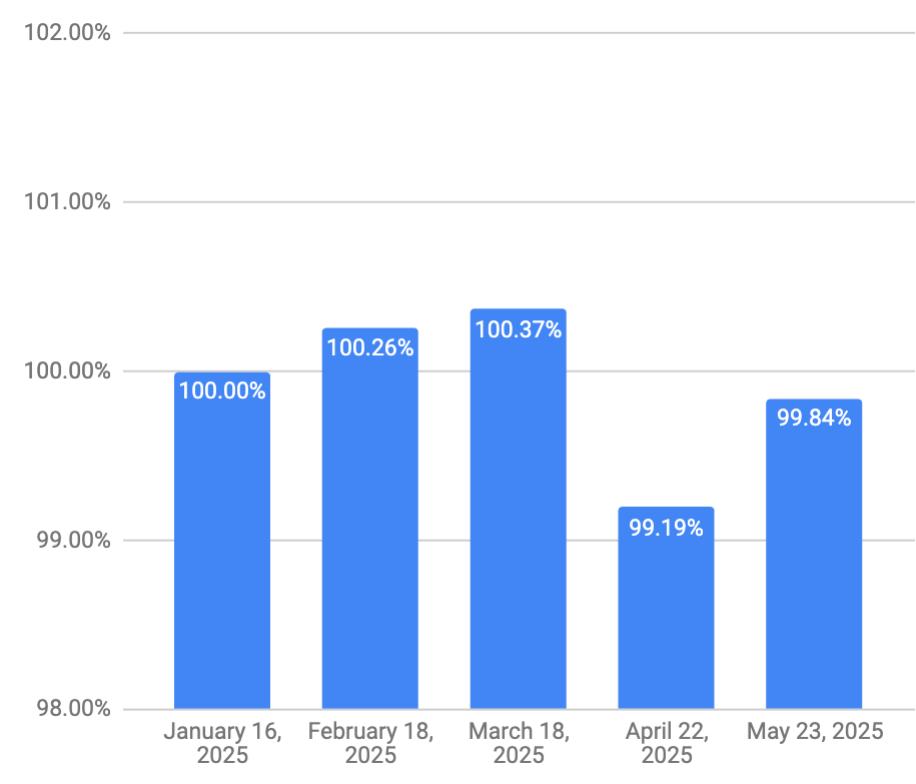
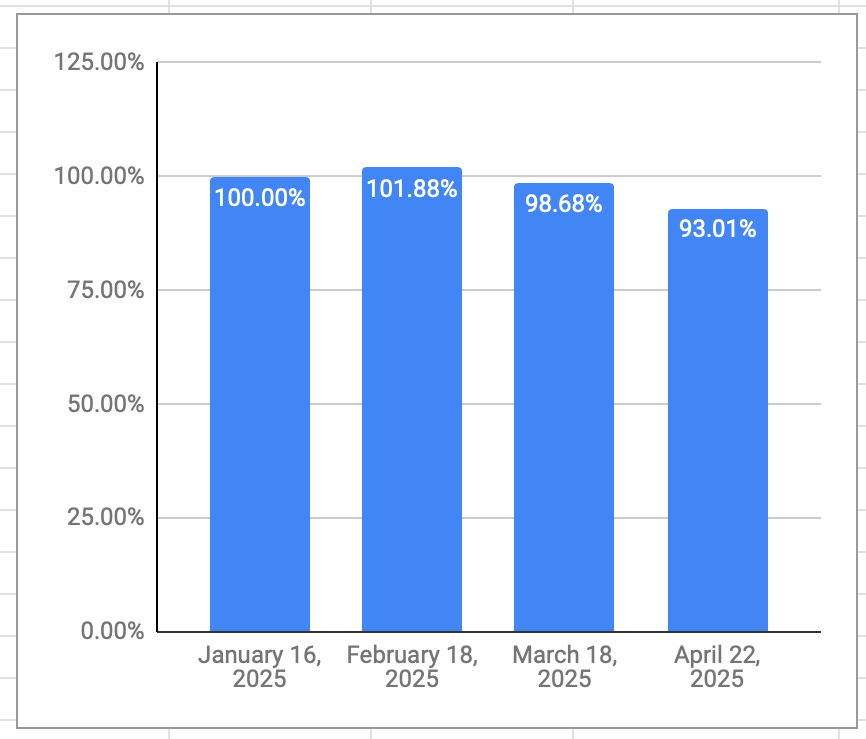
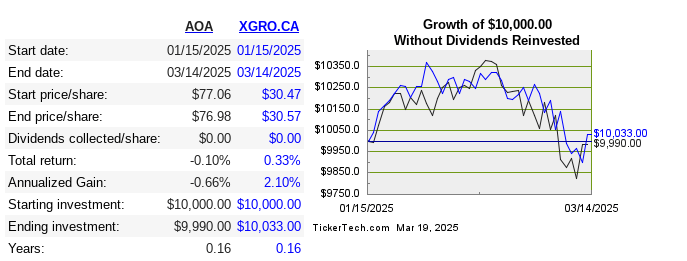
One final note: my retirement savings declined 3%8 over the month due to the wild (mostly downward) swings in the stock market, but this leaves me roughly even since my retirement started at the beginning of the year. Here’s the monthly returns for the 2 ETFs that make up the lion’s share of my portfolio9.

XGRO and AOA monthly returns so far
  1. The list is sort-of accurate. I’m in the middle of changing online brokers and since Questrade combines USD and CAD assets in one account, the number of accounts is diminishing. ↩︎
  2. Current 12-month yield: 3.6% ↩︎
  3. Current 30-day SEC yield: 4.61% ↩︎
  4. This specific topic addressed at https://www.financialwisdomforum.org/forum/viewtopic.php?t=125308. ↩︎
  5. The observant reader will note I also said this LAST month. That was before I decided to switch brokers. Once my holdings settle at Questrade, I’ll revisit. ↩︎
  6. MER = 0.04%. VEU has some Canadian exposure too, which isn’t ideal, but I don’t think there’s a USD ETF that excludes both Canada and the USA. ↩︎
  7. And should have done last month, sorry. ↩︎
  8. It would have been worse, except the USD also went up versus the Canadian dollar in the time period. Diversification works 🙂 ↩︎
  9. “Without dividends reinvested” since these two ETFs only pay out quarterly. There haven’t been any yet — next month! ↩︎

Death, Taxes and Estates: Part 1

I am not a lawyer, accountant or tax expert. Your situation may be a lot different than mine. Seek professional guidance if needed.

What happens to our investments when we die? Having lost both my parents in the past 2 years, I’ve (regrettably) had a lot of exposure to the ins of outs of estates and how they work.

Being Ready for the Inevitable

Fact: we’re all going to die. Pretending this isn’t true isn’t helpful to your survivors. So there are some concrete things you should have in place before that happens.

  • Have a will. Whether DIY, software-assisted1, or prepared by a suit, just get it done — here’s a nice step-by-step guide. And if you do have one, is it up to date? Take a look.
  • Have the will name exactly one executor, with alternate executors in the event your first pick isn’t available . Hearing multiple stories from multiple sources about how much extra work and delay having joint executors causes, I cannot recommend this all-too-common approach. You’re not “playing favourites” by naming one person2.
  • Make sure your executor knows how to get a hold of the will. Be very specific, and repeat this information frequently so it’s top-of-mind.
  • Make sure your RRIFs/RRSPs/TFSAs name successors and/or beneficiaries. I covered that topic in more detail here.
  • Make sure any life insurance policies name a beneficiary
  • Make sure your workplace pension3 names a survivor4.
  • Prepare a death binder5 with all assets clearly specified — provider name, account numbers, name on the account. Is the list really long? Maybe it’s time to trim that list down. Every provider on that list will create work for your executor. So if you want to be kind, keep the list of providers small. Make sure your executor knows where to find it.
  • Have a month or two of expenses in cash that is accessible by those who survive you, like in a joint chequing account. Assets held solely in your name will be frozen when you’re dead, possibly for weeks or months.
  • Set up someone (your executor, for example) as your authorized representative with CRA. This makes dealing with taxes much easier for those that you leave behind. How? Read here.

My Situation

My parents held no real estate, and all their assets were held in DIY investments (RRIF, TFSA and non-registered accounts). They each had a will and named the other as the executor with me as the alternate. They dealt with two providers — one for their DIY investments (BMO Investorline) and one for their day-to-day banking (CIBC). So in terms of complexity I think I had it pretty easy.

Dealing with the death of the first parent

My Dad’s death was not a surprise, and because of this I was able to maximize his TFSA contributions before he died. Dad did hate paying taxes.

Although my Mom was legally the executor, I did almost all the work involved. Most providers seemed to be pretty good about dealing with me once they got confirmation from my Mom. The key documents and facts you’ll be asked for in almost every encounter are the same, so have these ready each and every time:

  • Date and place of birth of the deceased
  • Date and place of death of the deceased
  • SIN number of the deceased
  • A death certificate (this is issued by the funeral home, typically)
  • The will
  • Funeral home invoice (if applying for a death benefit)

Dealing with the bank was easy. One 30 minute meeting6 and all was sorted.

As many DIY financial services providers don’t have brick and mortar locations, high quality digital versions7 are also generally accepted. In the case of BMO Investorline, I had to visit a BMO branch8 with the documents so they could send them as “true copies”. How a provider with no affiliation with a bank does this, no idea9.

In the case of any DIY investment held in the deceased’s name — those assets get frozen upon notifying the provider. This can be problematic if one is relying on those assets to say, pay rent, or pay for funeral arrangements.

The unexpected complication arose from the non-registered joint account — it didn’t just “convert” to removing one person’s name from the account — you have to open a new, individual account, involving all the same paperwork as though you were a new client, and then transfer the joint assets “in kind” to the new account. During this time, the funds were not accessible. This is beyond annoying, but I suspect this is the same regardless of who your provider is. My mom lost access to her joint account for about 6 weeks while this was settled.

Taxes for the death of the first parent

The tax return you file for a person who has died in this scenario is called (ominously) the Final Return. A person who dies is treated as though they sold all their assets on the day of death. I did not file a T3 Return10 return for my Dad, since all the assets passed through to my Mom. If he had had non-registered assets held solely in his name, I think I would have had to.

  • For a RRIF or RRSP, this means CRA assumes you sold all the holdings on the day you died and recognized it as income11
  • For a non-registered account held solely in one name, CRA assumes you sold all the holdings on the day of death and recognized any capital gains at that time.

I was able to successfully file the Final Return for my Dad using Wealthsimple’s tax software12. The Final Return cannot be eFiled — you have to print it and send it using snail mail.

Adjustments after the death of the first parent

After my Dad died and my Mom had all the combined TFSA/RRIF assets in place, we updated her TFSA and RRIF to name me and my siblings as beneficiaries by filling out a form. This proved to be helpful in reducing the tax bill a bit when she died. More on that in a future post.

  1. “willful.” seems to be a trendy option nowadays: https://www.willful.co/ ↩︎
  2. One could argue the opposite — just give the duties to your least favourite relative as a last vengeful act ↩︎
  3. Some workplace pensions provide death benefits and/or an ongoing survivor pension, but only if you take the trouble to name a survivor in that pension. ↩︎
  4. And if you do, I’m envious 😉 ↩︎
  5. Paper is probably less trouble than trying to provide a file location/passwords, but YMMV. ↩︎
  6. Prearranged online of course. You can’t just walk into a branch to do anything these days. ↩︎
  7. You’ll get good at this workflow or go crazy trying. Take photo on phone, airdrop to laptop, compress/convert image so it can get through email… ↩︎
  8. Do NOT assume that the brokerage has anything to do with the bank with whom they share a logo. I learned this the hard way with BMO/BMO Investorline. ↩︎
  9. Maybe notarized documents? Let me know at comments@moneyengineer.ca. ↩︎
  10. AKA “Estate Return”. A person who dies becomes a new tax entity, typically named Estate of <dead person> ↩︎
  11. Which is why you name a successor for your RRIF — this tax penalty is thereby avoided ↩︎
  12. It was because Intuit Quicktax could not handle this scenario that I ended my decades-long relationship with them. ↩︎

Significant birthdays for the DIY Investor

There are significant birthdays every DIY investor should be aware of. Did you know about all of them?

The list below is a gross simplification — like all things in the Canadian Tax code, the exceptions and caveats fill many pages, but this is roughly correct. I’ve included links so you can read the relevant sections yourself and see if you agree with my simplifications!

The day of your child’s birth

Per the feds, a birth certificate for your child is all you need to apply for a Social Insurance Number. And although their working days are far into the future, their RESP eligibility starts right away — but you can’t open an RESP for a child unless that child has a SIN. The lifetime limit for donations to an RESP is currently set at $50k/child. The sooner those contributions start, the sooner you can collect free money (the CESG, $500/year, $7200 per child lifetime), and the longer your contributions can benefit from the power of compounding.

Your 18th birthday

This is significant one for a number of reasons!

TFSA

Once you turn 181, you can open a TFSA and begin contributing. Even if you don’t start contributing, your TFSA limit starts to accumulate the year you turn 18. In 2025, that annual limit is $7000 per year, and it grows at the rate of inflation2. It’s cumulative, so it’s not a “use it now or lose it forever” kind of proposition. At the start of every calendar year, there are a flurry of announcements indicating the new annual limit.

You can contribute to your TFSA forever, even in retirement. I am!

CPP contributions kick in

If you’re over 18 and earn more than $3500 a year, you’ll have to pay CPP contributions. While current you may balk at this sort of reduction in your take-home pay, future you will appreciate the inflation-index adjusted salary you can collect later in life.

FHSA

You can open a First Home Savings Account on your 18th birthday…or maybe your 19th birthday3. And the year you open it, you add $8000 in eligible contribution room…which continues every year, to a maximum of $40000.

Your 19th birthday

The so-called “age of majority4” in Ontario allows you to roll in free money in the forms of GST credits, Trillium benefits5 (in Ontario) and carbon tax credits6 . The cost of admission is filing a tax return. No excuses — plenty of online providers offer free returns for “simple” returns and my friends at Wealthsimple offer “pay what you want” tax filing.

This is also a time you are eligible to open an RRSP7, which may make sense if you’re already maxing out your TFSA contributions.

Your 35th birthday (or later)

An RESP can only be open for 35 years.

Your 60th birthday

This is the first year you can choose to collect CPP; generally speaking, most experts recommend that you delay collecting CPP for as long as possible, for two reasons:

  • It may be the only inflation-protected income you have (this applies to me, I have no other pension)
  • You get more money the longer you wait. (you lose 0.6% of payment for every month you start before your 65th birthday. That adds up to a reduction of 36% if you start on the day you turn 60).

My tools page includes the very helpful CPP calculator, which can help you make a decision concerning your CPP start date.

Your 65th birthday

This is the first year you can choose to collect OAS. Experts are a little more split on whether or not to delay this one — the benefits to delaying to age 70 are not as strong as for CPP8. My plan is to delay, as it’s another inflation-adjusted benefit.

If you’re collecting any sort of pension (RRIF payments, CPP, employer pension) this is the first age at which you can split that income with your spouse. This can reduce your tax bill.

Your 70th birthday

You have to start taking CPP and OAS by this time.

Your 71st birthday

You can no longer contribute to an RRSP and you have to open a RRIF. Lots of the literature out there seems to imply that this is the ONLY time you can open a RRIF, but rest assured, there’s no minimum age for opening a RRIF — I’ve been collecting from mine since the start of the year 🙂

Your 85th birthday

This is the last year you can start collecting from an ALDA (advanced life deferred annuity) you have set up. The ALDA is a vehicle I just learned about, and need to do a bit more research. It may be a way to fund income in your later years when the complexity of managing withdrawals in a DIY fashion may be too cognitively overwhelming.

What birthdays are you thinking about? Let me know at comments@moneyengineer.ca.

  1. Or possibly 19, depending on where you live. ↩︎
  2. But only in increments of $500. Even though inflation is drifting back down to more usual levels, doing the math indicates that we should expect more frequent increases in the TFSA limits in the years to come. Adding $500 to a $7000 limit (a 7% bump)is a lot easier than adding $500 to a $5000 limit (a 10% bump) ↩︎
  3. Per https://www.canada.ca/en/revenue-agency/services/tax/individuals/topics/first-home-savings-account/opening-your-fhsas.html “certain provinces and territories, the legal age at which an individual can enter into a contract (which includes opening an FHSA) is 19 years old” ↩︎
  4. This language is so opaque, it’s like a parody of government speak. Or maybe it’s a commentary on the aging demographic of Ontario? ↩︎
  5. Some of the benefits even kick in earlier ↩︎
  6. A limited time offer, presumably ↩︎
  7. Per CRA, there is NO minimum age at which you can open an RRSP. Contributing to an RRSP requires that you enter into a contract (meaning you have to be of an age that permits this, either 18 or 19) and you have to earn money. ↩︎
  8. It’s still 0.6% per month of delay, or 36% over 5 years. That’s pretty good RoI, in my view. ↩︎

USD Assets in the retirement portfolio. Good idea?

I’m not sure when I first made a purchase of a USD-denominated ETF. Probably over 10 years ago. Clearly, I thought it was a good idea, because as of today I find that 57% of my retirement savings1 are denominated in US Dollars.

And unlike other people I’ve talked to, there’s no underlying rationale for that. I’ve never earned employment income in USD and I don’t own property in the US. So why?

I’m a cheapskate.

I started investing in USD based ETFs simply because they were a much better deal than their Canadian equivalents. This is less true now than it used to be, but it’s still true. Take for example the comparison between comparable USD and CAD ETFs that track the same index:

IndexWhat’s in itUSD ETFMERCAD ETFMER
S&P 500Top 500 US stocksIVV0.03%VFV, XUS0.09%
Russell 20002000 mid-market US StocksVTWO0.07%XSU2, RSSX30.36% for XSU, 0.25% for RSSX
FTSE Developed ex USGlobal stocks outside of the USASCHF0.06%VDU0.22%
USD versus CAD ETFs tracking the same index4

The Canadian market has become more competitive, and MERs have come down, but given the size of the US market, it’s still cheaper to invest there.

I’m not a very savvy cheapskate.

So although the MERs of US ETFs were stunningly attractive, I failed to consider the cost of currency conversion. For this I blame naivete as well as a lack of transparency on the part of my provider. It was not possible for me to easily figure out how much each CAD to USD transaction was costing me. A good estimate is about 1.5% the cost of the transaction, but some providers make this much cheaper5.

I also had USD investments in my TFSAs, which, from a tax perspective, isn’t the best idea.

Over time, I discovered the joys of Norbert’s Gambit to do currency transactions on the cheap and I became more savvy. And I eliminated all US holdings from my TFSA.

Preparing for Retirement

In preparing my portfolio for retirement (steps I took are outlined here), I did seriously consider converting everything to CAD in the interest of keeping things simple. I did not, and here’s why:

  • I figured that having ready access to USD would be rather useful to retired me, since I do vacation there. And I had made other preparations in light of that, setting up a USD credit card and USD savings account for RRIF payments to go to.
  • Although I knew that having USD RRIFs would make getting paid in retirement more complicated, I thought I had worked out a plan with my provider6 that would make extracting USD RRIF payments achievable, with some effort on my part.
  • I sort-of liked having some of my investments in USD since it’s a stable currency. Usually.
  • I also liked the additional boost I got from USD HISAs. (That’s probably an anomaly but one I’m happy to take advantage of)
  • I could change my mind at any time.

Current Reality

This isn’t working like I thought it would.

My provider decided to backtrack on allowing me to extract USD from my USD RRIF;7 we’re still going back and forth on that front, but my friends at QTrade are on my naughty list as a result. I’m not hopeful.

What it means practically is that although the value of my USD RRIF is used to calculate my RRIF minimums, I can only withdraw RRIF payments from the Canadian side. At present, the Canadian side of my RRIF will fund my RRIF minimum payments for a while, but at some point I’ll have to use Norbert’s Gambit to move funds from the USD RRIF to the CAD RRIF.

My Advice

I don’t think that holding USD assets in retirement — especially in a RRIF — is a great idea for the DIYer. Unless platform providers give really clear processes8 for how to extract that money from a USD RRIF, expect trouble.

At some point, I will either switch providers to find one that supports my requirements9, or I will convert everything to CAD. Right now, I have a process that works, but older me I expect will find it too complicated.

  1. Majority of the USD holdings are in my / my spouse’s RRIF; small portion is in my non-registered account. ↩︎
  2. Not an apples to apples comparison, admittedly. This ETF is hedged so it’s less impacted by changes in the CAD/USD exchange rate but this comes at a cost. ↩︎
  3. This is ALMOST the same thing; RSSX uses a capped version of the index ↩︎
  4. And try as I might, I couldn’t find a USD ETF that invested in the TSX/S&P 60. Not really surprising, and my USD retirement holdings have very limited Canadian exposure. AOA has about 2.4% Canadian exposure. ↩︎
  5. Notably, Interactive Brokers and lately, Wealthsimple especially if you hold more than 100k with them. ↩︎
  6. Involving multiple phone conversations and multiple emails ↩︎
  7. You may ask, “what’s the point of having a USD RRIF if you can’t extract USD from it”? I had the same question… ↩︎
  8. RBC says they support it and so does Questrade. ↩︎
  9. I had sorely hoped Wealthsimple could be that provider, but (sigh) they don’t support spousal RRIFs at the moment. ↩︎

What’s in my retirement portfolio (Feb 2025)

This is a (hopefully monthly) look at what’s in my retirement portfolio. The original post is here.

Portfolio Construction

The retirement portfolio is spread across a bunch of accounts:

  • 7 RRIF accounts (3 for me1, 3 for my spouse, 1 at an alternative provider as a test)
  • 2 TFSA accounts
  • 5 non-registered accounts2, (2 for me 1 for my spouse, 2 joint)

The target for the overall portfolio is unchanged:

  • 80% equity, spread across Canadian, US and global markets for maximum diversification
  • 15% Bond funds, from a variety of Canadian, US and global markets
  • 5% cash, held in high interest savings accounts (list available to me shown here)

The view as of this morning

As of this morning, this is what the overall portfolio looks like:

Overall retirement portfolio by holding, February 2025

The portfolio, as always, is dominated by AOA and XGRO which are 80/20 asset allocation funds in USD and CAD, respectively. The rest are primarily either cash holdings in HISAs (DYN6004/5 in CAD and USD) or residual ETFs held in non-registered accounts for which I don’t want to create unnecessary capital gains just for the sake of holding AOA or XGRO.

The biggest month over month change is due to a small re-balancing exercise. I replaced some of my XGRO (which is an 80/20 equity/Bond asset allocation fund) with XEQT (a 100% equity asset allocation fund). I do re-balancing any time my asset allocation drifts more than 1% off my target allocations3. The trigger for me was an overweighting in bonds, which had drifted to represent 16% of my portfolio instead of the desired 15%. Upon reflection, the reason was obvious: both AOA and XGRO are 20% bonds, and if I want only 15% bonds, I will periodically need to fund an all-equity alternative. The net effect will be that you will see more XEQT show up in the portfolio over time.

The observant reader will also notice a bit of a shift between DYN6004 and DYN6005. The reason? I raided some USD from DYN6005 to pay my US credit card bill and replaced it with CAD in DYN6004 using the spot FX rate at the time. Seemed the easiest way to get some USD4 without having to resort to my friends at Knightsbridge.

SCHF percentages drifted down a bit since that’s the ETF I’m selling in my non-registered portfolio to augment my monthly RRIF payments. That will continue for the next few months at least since the USD payouts are needed to fund a few holidays5 I’m taking that are billed in USD.

Otherwise, nothing interesting to see in the month to month changes.

Plan for the next month

The geographic split looks like this

Overall retirement portfolio by market, February 2025

The international equity percentage is below my target of 24%, and so I’ll have to fix that. SCHF seems a good choice in USD6 since it’s free to trade with QTrade. XEF would be a perfect fit in the Canadian market.

A quarterly activity that I’ll be performing this month is to shift some of my USD RRIF holdings into my CAD RRIF. This wasn’t something I had planned to do but since my provider has backtracked on allowing me to get paid out of my USD RRIF in USD, I needed a way to keep the USD exposure at a constant-ish level in the overall portfolio. I’ll talk about the USD in my portfolio in a future dedicated post.

One final note: my retirement savings continue to grow even though I’m now actively removing assets out of it. On paper, this makes perfect sense since an 80/15/5 portfolio ought to grow at a rate greater than my rate of removal. In practice, of course, it’s rather stock market dependent. Here’s the monthly returns for the 2 ETFs that make up the lion’s share of my portfolio7.

XGRO and AOA monthly returns so far8
  1. For me, that’s one personal RRIF that has 2 accounts, one for CAD, one for USD, and one spousal RRIF. My spouse has one spousal RRIF in two currencies, and a personal RRIF. The alternative provider RRIF exists because I wanted to give Wealthsimple a try. ↩︎
  2. For me, two because one each for CAD and USD. The 2 joint accounts are my cash cushion accounts for the VPW methodology outlined here and here. ↩︎
  3. Completely spreadsheet-driven. I don’t trade on news, analyses, gut feelings, hot tips, or guesses. ↩︎
  4. I did hesitate a bit because the interest rate on DYN6005 is over 1% higher, but given the amounts involved, I’m clearly overthinking things. ↩︎
  5. All booked before this current tariff nonsense. Sorry. ↩︎
  6. Although it does have a 9% exposure to the Canadian market so not 100% “international”. Hard to beat the MER of this, though. ↩︎
  7. I don’t think this tool accounts for FX so it’s probably not totally accurate. Check out https://moneyengineer.ca/tools-i-use/ for other useful tools. Canadian dollar gained 1.4% against the USD in the past 30 days, per https://www.bankofcanada.ca/rates/exchange/daily-exchange-rates/ so that will reduce the effective return of AOA by the same amount. ↩︎
  8. “Without dividends reinvested” since these two ETFs only pay out quarterly. There haven’t been any yet. ↩︎