
What’s in my non-registered portfolio? (Oct 2025)

Every month, I try to share with you what’s in my overall retirement portfolio (September 2025 post is here). That retirement portfolio is actually distributed over a bunch of accounts held by me and my spouse and includes RRIFs, TFSAs and non-registered accounts. This is what it looks like at the moment:
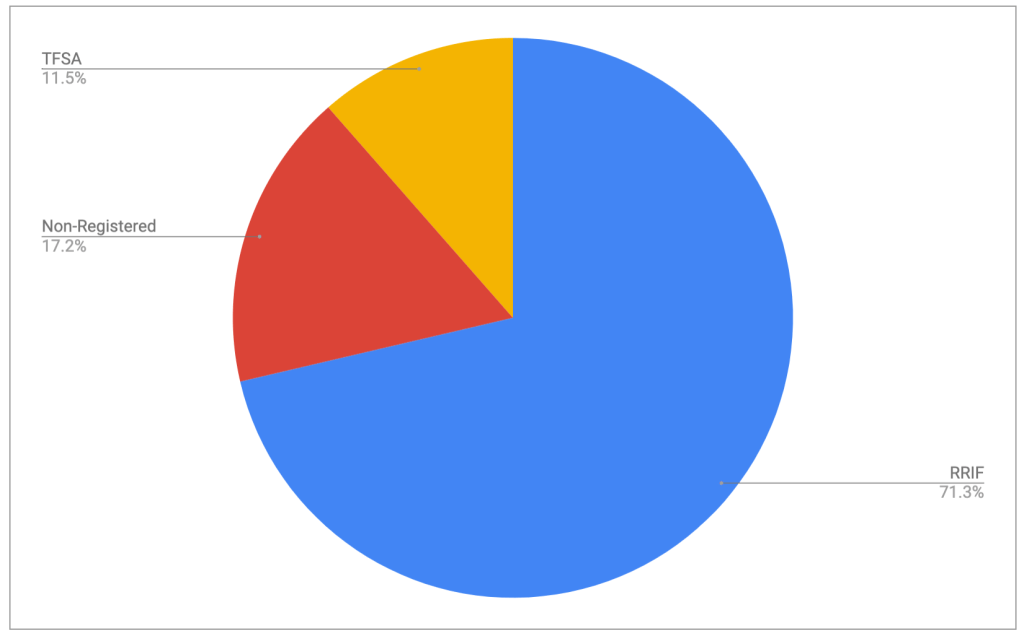
Retirement savings as of October 1, 2025 by account type

(My multi-asset tracker is a handy tool to help you quickly create charts that look like the above one).

My current strategy for these three account types looks like this:

  • RRIF: This is 100% invested in my ETF all-stars. I’m currently withdrawing RRIF minimum payments for two main reasons:
    • To avoid problems with attribution. I cover that topic over here.
    • To avoid withholding tax. RRIF minimum payments don’t attract withholding tax, but I am setting aside some of my payments to deal with the unavoidable tax bill come April 2026. I talked about that topic over here.
  • TFSA: This is mostly invested in the ETF all-stars, but there’s a few stragglers in here1 that I really ought to get rid of. Nothing wrong with the funds in there, but it’s a needless complexity. The TFSA continues to get new funds since it’s hard to beat tax-free growth, and I only buy all-stars with those funds. It will get drawn down last in my retirement planning.
  • Non-registered accounts: Here it’s a bit of a dog’s breakfast, with very little invested in the all-stars, mostly because most of the equity found here was bought long ago, and changing what I hold would attract capital gains that I would prefer to take on my own terms. It’s where the majority of my early-retirement decumulation takes place.

Here’s what that breakfast looks like:
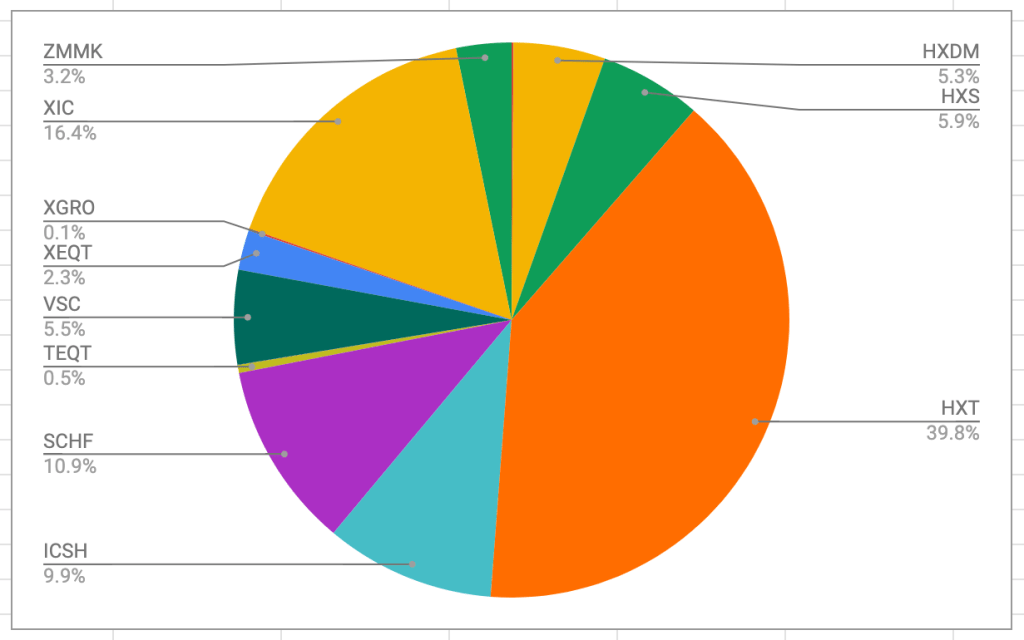
What’s in my non-registered portfolio, October 2025

Here’s a look at each holding, from highest to lowest percentage.

HXT: This is a Canadian equity ETF that does not pay dividends, instead using some wizardry to bury it all in the per-unit price of the ETF. This simplifies taxes, and I have held this fund for a long time. Due to increasing costs of this ETF, it’s among the first to get liquidated as I need funds.

XIC: Canadian equity fund, very popular. I think I bought it to create a bit of dividend income. It will get liquidated after the Horizons funds go (HXS, HXT, HXDM).

SCHF: A very low-cost international equity2 fund in USD that I’ve held for a very long time. It’s funds like SCHF that attracted me to investing in USD, which, at present, adds a lot of complexity.

ICSH: This is one of the all-stars. It is what my VPW cash cushion is invested in3. I use ICSH more than ZMMK in the cash cushion because US interest rates are quite a bit higher than Canadian rates at the moment. I talked about that here.

HXS: Same idea as HXT, except it invests in the S&P 500. This one is held only by my spouse who is still working for a living, so this will just stick around a while, until she stops working and can take on the capital gains.

VSC: A bond fund held by my spouse. I may sell this to harvest some capital gains losses.

HXDM: Same idea as HXT, except international equity. It is on the list to liquidate.

ZMMK: An all-star, held in the same account as ICSH.

The rest (XEQT, TEQT, XGRO) are all new arrivals in the portfolio, purchased using dividends4 from the other funds as well as the bonus payments I keep collecting from Questrade for switching to them.

My non-registered accounts are only a small portion of my retirement holdings, but there’s a fair bit of complexity there. Over time, these accounts will go to zero other than the cash cushion portion (ZMMK, ICSH or whatever replacements I discover) which will remain as long as VPW is my decumulation strategy.

  1. Mostly pure Canadian equity funds. This is to offset AOA that has next-to-no Canadian equity component. ↩︎
  2. 0.03% MER. Cheap! ↩︎
  3. VPW = Variable Percentage Withdrawal, an absolutely brilliant strategy for making sure you don’t run out of money in retirement and don’t leave a lot on the table. Read all about it here. ↩︎
  4. With all ETF trades being free, I hold very little actual cash in any of my accounts. ↩︎

USD Assets in the retirement portfolio. Good idea?

I’m not sure when I first made a purchase of a USD-denominated ETF. Probably over 10 years ago. Clearly, I thought it was a good idea, because as of today I find that 57% of my retirement savings1 are denominated in US Dollars.

And unlike other people I’ve talked to, there’s no underlying rationale for that. I’ve never earned employment income in USD and I don’t own property in the US. So why?

I’m a cheapskate.

I started investing in USD based ETFs simply because they were a much better deal than their Canadian equivalents. This is less true now than it used to be, but it’s still true. Take for example the comparison between comparable USD and CAD ETFs that track the same index:

IndexWhat’s in itUSD ETFMERCAD ETFMER
S&P 500Top 500 US stocksIVV0.03%VFV, XUS0.09%
Russell 20002000 mid-market US StocksVTWO0.07%XSU2, RSSX30.36% for XSU, 0.25% for RSSX
FTSE Developed ex USGlobal stocks outside of the USASCHF0.06%VDU0.22%
USD versus CAD ETFs tracking the same index4

The Canadian market has become more competitive, and MERs have come down, but given the size of the US market, it’s still cheaper to invest there.

I’m not a very savvy cheapskate.

So although the MERs of US ETFs were stunningly attractive, I failed to consider the cost of currency conversion. For this I blame naivete as well as a lack of transparency on the part of my provider. It was not possible for me to easily figure out how much each CAD to USD transaction was costing me. A good estimate is about 1.5% the cost of the transaction, but some providers make this much cheaper5.

I also had USD investments in my TFSAs, which, from a tax perspective, isn’t the best idea.

Over time, I discovered the joys of Norbert’s Gambit to do currency transactions on the cheap and I became more savvy. And I eliminated all US holdings from my TFSA.

Preparing for Retirement

In preparing my portfolio for retirement (steps I took are outlined here), I did seriously consider converting everything to CAD in the interest of keeping things simple. I did not, and here’s why:

  • I figured that having ready access to USD would be rather useful to retired me, since I do vacation there. And I had made other preparations in light of that, setting up a USD credit card and USD savings account for RRIF payments to go to.
  • Although I knew that having USD RRIFs would make getting paid in retirement more complicated, I thought I had worked out a plan with my provider6 that would make extracting USD RRIF payments achievable, with some effort on my part.
  • I sort-of liked having some of my investments in USD since it’s a stable currency. Usually.
  • I also liked the additional boost I got from USD HISAs. (That’s probably an anomaly but one I’m happy to take advantage of)
  • I could change my mind at any time.

Current Reality

This isn’t working like I thought it would.

My provider decided to backtrack on allowing me to extract USD from my USD RRIF;7 we’re still going back and forth on that front, but my friends at QTrade are on my naughty list as a result. I’m not hopeful.

What it means practically is that although the value of my USD RRIF is used to calculate my RRIF minimums, I can only withdraw RRIF payments from the Canadian side. At present, the Canadian side of my RRIF will fund my RRIF minimum payments for a while, but at some point I’ll have to use Norbert’s Gambit to move funds from the USD RRIF to the CAD RRIF.

My Advice

I don’t think that holding USD assets in retirement — especially in a RRIF — is a great idea for the DIYer. Unless platform providers give really clear processes8 for how to extract that money from a USD RRIF, expect trouble.

At some point, I will either switch providers to find one that supports my requirements9, or I will convert everything to CAD. Right now, I have a process that works, but older me I expect will find it too complicated.

  1. Majority of the USD holdings are in my / my spouse’s RRIF; small portion is in my non-registered account. ↩︎
  2. Not an apples to apples comparison, admittedly. This ETF is hedged so it’s less impacted by changes in the CAD/USD exchange rate but this comes at a cost. ↩︎
  3. This is ALMOST the same thing; RSSX uses a capped version of the index ↩︎
  4. And try as I might, I couldn’t find a USD ETF that invested in the TSX/S&P 60. Not really surprising, and my USD retirement holdings have very limited Canadian exposure. AOA has about 2.4% Canadian exposure. ↩︎
  5. Notably, Interactive Brokers and lately, Wealthsimple especially if you hold more than 100k with them. ↩︎
  6. Involving multiple phone conversations and multiple emails ↩︎
  7. You may ask, “what’s the point of having a USD RRIF if you can’t extract USD from it”? I had the same question… ↩︎
  8. RBC says they support it and so does Questrade. ↩︎
  9. I had sorely hoped Wealthsimple could be that provider, but (sigh) they don’t support spousal RRIFs at the moment. ↩︎