

Underlying indices of all-in-ones

(New to asset allocation ETFs aka all-in-ones? Here’s a good place to start.)

Asset allocation ETFs can be purchased from any number of companies. In this article, we look at 4 of the biggest names:

  • TD, with TEQT, TGRO, TBAL et al
  • Blackrock/iShares with XEQT, XGRO, XBAL et al
  • BMO with ZEQT, ZGRO, ZBAL et al
  • Vanguard with VEQT, VGRO, VBAL et al

The blueprint for each of these ETFs are similar: pick Canadian, US, International and (where applicable1) bond indices, pick a target percentage allocation for each slice of the pie, and carry on…

I previously talked about the variations in percentage allocation (the size of the pie slices) between the major funds over here.

But what about the indices that each of the major fund families track? What’s in the pie? Are there significant differences? Here’s a summary of what I found:

TD
iSharesBMO Vanguard
TEQT, TGRO, TBALXEQT, XGRO, XBALZEQT, ZGRO, ZBALVEQT, VGRO, VBAL
CAD EquitySolactive Canada Broad MarketS&P/TSX Capped Composite
S&P/TSX Capped Composite
FTSE Canada All-Cap
US EquitySolactive US Large Cap CAD IndexS&P Total MarketS&P 500
S&P Midcap 400
S&P SmallCap 600
CRSP US Total Market
Int’l EquitySolactive GBS Developed Markets ex North America Large & Mid Cap CADMSCI EAFE® Investable Market, MSCI Emerging Markets Investable MarketMSCI EAFE Index, MSCI Emerging Markets IndexFTSE Developed all-cap, FTSE Emerging all-cap
Bonds FTSE Canada Universe Bond IndexFTSE Canada Universe Bond Index and othersFTSE Canada Universe Bond Index and othersBloomberg Global Aggregate Canadian Float Adjusted Bond

So there is variation in the pie recipes (the underlying indices), but is it really of any significance? At a glance, I wonder how different the offerings from iShares and BMO actually are — the same index providers show up in each. Without looking at what stocks are actually found in each of these, here’s a quick take, simply based on the names of the indices:

  • Canadian Equity: All of these funds hold the broad Canadian market, over three different index providers23. iShares and BMO use a capped index, which, in theory, should limit exposure to the very largest Canadian businesses somewhat.
  • US Equity: Three different index providers seen here (Solactive, S&P and CRSP). TD only holds large US companies, the others hold smaller and midsized US companies. In the last ten years, this has been a winning strategy, but it’s not always been that way.
  • International Equity: Three different index providers: Solactive, MSCI, FTSE. TD excludes emerging markets (e.g. Brazil, Russia, Taiwan, China, India). The others don’t.
  • Bonds: Hard to tell just based on the names, but three of them use the same FTSE index. Vanguard uses a Bloomberg index. So I’ll say that it’s likely that Vanguard’s bond portfolio will look different from the other three.

In a future post, I’ll delve into what the main holdings of each of these funds are in each of these categories to see what differences emerge. And whether these differences actually matter!

  1. This excludes 100% equity funds like XEQT, naturally ↩︎
  2. The “composite” in “Capped Composite” means “all the stocks of the TSX”. ↩︎
  3. Solactive, S&P and FTSE ↩︎

How to read an ETF fact sheet: what’s in a name?

Summary: The standard ETF fact sheet is 4 pages of information a Canadian ETF provider is required to provide. Here’s some tips about what to look for in a name.

Google AI, which is never wrong, tells me that there are more than 1500 ETFs available for purchase on the Canadian market. For those new-to-DIY-investing1, that can seem a little overwhelming. Most of my retirement holdings are tied up in just two asset-allocation ETFs, but prior to retirement, I enjoyed juggling a bunch of index ETFs to roll my own custom asset allocation that I rebalanced manually.

A good skill to have is to understand some of the basic language used in these fact sheets so you can decide if a given ETF is right for you and your investment objectives.

What’s the name of the ETF?

So much is captured in the full name of a given ETF. There’s key words I look for, and key words that I avoid.

Words I look for: “Index” or maybe “Idx”

An index is a list of assets that comply to a set of rules laid out by the index manager. You can think of an index as a detailed recipe for building a list of stocks or bonds. What’s important is that the index is not invented by the company selling you the ETF. The index is a third-party invention, and any ETF company can make use of the recipe in offering you, the investor, a product to buy. The index is the recipe, and the ETF company is the chef that prepares the dish that you buy. You could become a chef yourself, and buy the individual components of the index on your own. However, since some of the indices are comprised of hundreds or even thousands of assets, not every index is realistic for the home chef to create.

An ETF that uses the word “index” in its name suggests it’s a passive ETF, meaning there’s a skeleton crew of managers making trades based solely on what’s in the index. I like index funds because they are generally cheap, and over time, they beat the active traders2 again and again.

Like the ETF market itself, there has been an explosion in the number of indices3 out there created by the likes of FTSE Russell or MSCI. Knowing the names of some of the most popular indices can help:

  • S&P/TSX 60: Canadian stock market’s largest 60 companies. Canadian ETFs that track this include XIU and ZIU.
  • S&P 500: US Stock market’s largest 500 companies. Canadian ETFs that track this include VFV, ZSP, and XUS.
  • Russell 2000: US Stock market’s next-largest 2000 companies after first dropping the top 10004. A Canadian ETF that uses this index is XSU.
  • MSCI EAFE: Developed country index, excluding USA and Canada. Canadian ETFs that use this index include ZEA and XEF5
  • FTSE Canada Universe Bond Index: A broad set of Canadian corporate and government bonds. Sold as ZAG by BMO and XBB by BlackRock/iShares.

A quick search reveals all kinds of very specific index funds: sector based (e.g. “AI” or “Healthcare”) and country/region based (e.g. “China”, “BRICSA”). I ignore these kinds of funds because betting a sector or a region feels like market timing to me, and market timing is a proven loser in terms of long-term returns.

Words I avoid: “Hedged”

“Hedged” means that the ETF uses some kind of strategy to smooth out the ups and downs in the Canadian dollar’s exchange rate. And on one level, it makes sense: if you buy the S&P500, you’re owning a bunch of US stocks priced in US dollars. If the Canadian dollar gets stronger, then your US holdings are worth less in CAD. If the Canadian dollar gets weaker, then your US holdings are worth more to you in CAD. So some funds try to make this variance go away.

I avoid hedged funds for a few reasons:

  • It adds cost and complexity to the fund, two things I dislike about where I choose to invest.
  • It’s imperfect; while it makes the bumps in the foreign exchange rate get smaller, it would be overly expensive to make them go away completely
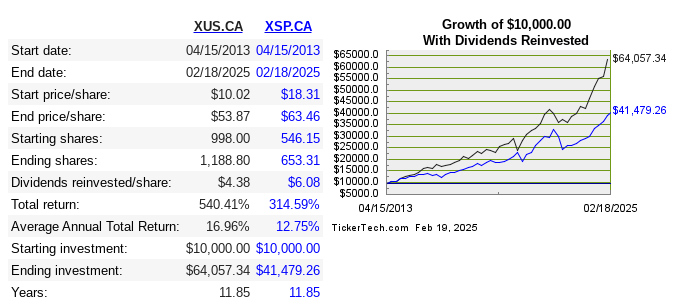
  • If you hold an asset long enough and reinvest your dividends, it will be a wash in the end, and the extra cost just creates a drag on your returns. For example, let’s compare XUS versus XSP, which are identical, save for XSP’s use of hedging:
The long term cost of using hedging: XUS vs XSP (hedged)

Words I avoid: “Leveraged” / “Bull” / “Bear”

“Leveraged” means “we’re buying stocks using borrowed money”. And while buying stocks using borrowed money can significantly enhance your returns in an up market, the opposite is true in a down market. No free lunch.

Any ETF that has Bull or Bear in the name is making a bet based on short term returns. Buying scratch tickets at Christmastime is enough gambling for me, and gambling has no place in my retirement strategy.

Summing up

Looking at the name of an ETF is a good starting filter to decide if it’s for you. It’s just one piece of many included in an ETF’s fact sheet.

  1. Tips on how to execute on that decision were the topic of a previous post ↩︎
  2. For example: https://www.spglobal.com/spdji/en/research-insights/spiva/#canada ↩︎
  3. One tip I can offer: if more than one ETF exists offering the index, it’s probably a decent index to consider. Be a bit suspicious if only one company has an ETF that mirrors said index — I’d consider it a bit of a fringe offering, of no interest to me. ↩︎
  4. This is normally seen as a “mid cap” or “small cap” index, meaning “US stocks that aren’t in the S&P 500”. I looked at https://www.marketbeat.com/types-of-stock/russell-2000-stocks/ and the first company I recognized was Duolingo. ↩︎
  5. As an illustration of the insanity regarding the explosion of indices, XEF tracks not MSCI EAFE but MSCI EAFE IMI, which adds a few more smaller companies into the mix. But if you refer to https://www.msci.com/documents/10199/11a56df6-0f09-4477-a168-cce49e1719cd you will see that the long term performance differs by 0.01%. ↩︎