What broker(s) do you deal with?

I hang out a bit on Reddit1 to see what people are talking about. Often times, the post reads something like

“I am new to investing, I have $x to invest, who should I use ?”.

The crux of every 5th question posted to r/PersonalFinanceCanada

Personally, I find this kind of question a bit odd. “Investing” is a noble pursuit but it’s a term that means a lot of things to a lot of people. For me, “investing” is reserved for retirement savings since the timelines are long and I don’t need immediate access to the funds therein. A lot of people who ask this question want very near term access to the money, and to me that’s not investing. It’s saving. Timeline matters. The answer I’d give to a saver2 is a lot different than the answer I’d give to an investor.

I suppose the amount of money involved may influence the decision of platform provider (especially if there are freebies associated with having a balance above a certain amount, a common-enough practice), but it’s not the first thing I’d have in mind. Here are the main things I think about when it comes to choosing a financial provider, either for the first time, or if you’re thinking about making a change.

Does the provider have the account types you want?

Any provider I use has to offer Investment accounts, RESP, TFSA, RRIFs and spousal RRIFs. USD options for Investment accounts and RRIFs would be useful to me as well. Your own circumstances will offer up a different list. But don’t dismiss the RRIF if you’re nearing retirement. You may want one sooner than you think!

Does the provider have the products you want?

My needs here are really simple. I need access to trade a handful of ETFs on the US and Canadian markets, and I need a way to get a good interest rate on cash holdings. My assumption is that every major provider has a way to accomplish this. I don’t need access to bond markets3, options trading, fractional trading, margin trading or crypto. You might.

What fees that matter to you are charged by the provider?

The list of fees for any provider can get pretty long, but I only consider the things that impact me in my normal usage of the platform. The things I look for and expect are:

  • They don’t charge anything for “account maintenance”
  • The don’t charge fees for trading the ETFs I care about4
  • They need to offer a way to access daily interest rates in the neighborhood of the Bank of Canada overnight rates (some do this by paying good rates on any cash lying around your accounts, some do this by offering access to purchase HISAs, and as a last resort, there are ETFs that buy HISAs, too5)
  • They need a “much more generous than the bank”6 way of doing forex7

I’ve used QTrade8 as my main provider for the last 15 years or so. They offer the things I need. But for the first time, I’m seriously considering making a switch to Wealthsimple9. I’m test driving them now with part of my retirement portfolio, but I’ve found at least one show-stopper that make them unsuitable for me — they don’t offer spousal RRIFs10 in their self-directed product offering!

Switching providers can be quite onerous, so it’s not something I take lightly, especially since my holdings are paying my monthly salary! The DIY market is getting more competitive, so it can pay to take a look around. What do you like/dislike about your current provider? Drop me a line at comments@moneyengineer.ca.

  1. Specifically, r/PersonalFinanceCanada mostly ↩︎
  2. Put your money in the highest interest rate savings account you can find, or buy a GIC. ↩︎
  3. Beyond bond ETFs. I don’t need to own individual bonds. ↩︎
  4. Had I written this phrase 5 years ago, I would have said “low fees”. However, in today’s competitive landscape, many brokers charge nothing to buy and/or sell ETFs. If yours does, maybe it’s time to take a look around. ↩︎
  5. e.g. CASH by GlobalX, HISA by Evolve ↩︎
  6. Most banks happily tack on 1.5% to spot rates on currency exchanges, just like most credit cards do ↩︎
  7. Norbert’s gambit would apply here, although it’s somewhat cumbersome. I’ll cover forex in some future post. ↩︎
  8. But I’m also somewhat familiar with BMO Investorline, Interactive Brokers and Wealthsimple. ↩︎
  9. Free ETF trading, good interest rates for cash holdings, just-launched zero fee FX transactions for amounts over $100k, and their currently running promo are all rather attractive features. ↩︎
  10. And, as I write this, I get a friendly email from Wealthsimple support confirming this, with a promise to let the development team know about it. ↩︎

What’s the deal with XGRO?

***Numbers updated November 30, 2025****

As mentioned elsewhere, I rely heavily on all-in-one ETFs in my retirement portolio. New to all-in-ones? Read a bit about them here. While it may seem unwise to have (seemingly) so little diversification, when you buy an all-in-one like XGRO, you are actually getting a piece of THOUSANDS of different assets.

The main all-in-one Canadian ETF that I hold is an 80/20 fund1 called XGRO. There’s nothing special about XGRO other than it being free to trade on the platform I use — there are other 80/20 funds out there (e.g. ZGRO, HGRW). There’s also other all-in-ones with different equity percentages; there’s something for everyone!2

I thought it would be interesting to see what, exactly, is underneath every $100 you invest in XGRO. So by reading XGRO’s ETF description, following the ETF descriptions of what’s inside XGRO, and doing a little math, I came up with the following breakdown:

FundWhat is it?How much?Colour Commentary
ITOTBroad US stock coverage that tracks the S&P Total Market Index, about 2508 companies (top holdings: Alphabet, Apple, Nvidia, Microsoft, Amazon, Broadcom)$36.42 of your $100 investment

(of which ~2$ is in each of Alphabet, Apple, Nvidia, and Microsoft, and another $1 is in each of Amazon and Broadcom)
The Magnificent 7 and 2501 other companies
XICBroad Canadian stock coverage that tracks the S&P/TSX Capped Composite Index, about 223 companies (top holdings: RBC, Shopify, TD, Enbridge, Brookfield)$20.68 of your $100 investment

(of which RBC gets $1.40, Shopify gets $1.26, TD gets 93 cents)
You want banks? We got banks!
XEFBroad international (Europe, Asia, Australia) stock coverage that tracks the MSCI EAFE Investable Market Index, about 2500 holdings$19.49 of your $100 investment
(of which 24 cents goes to AstraZeneca, 34 cents goes to ASML…)
One of these years, MSCI EAFE is going to have another year like 2017…
XBB1400 or so investment-grade Canadian bonds that comprise the FTSE Canada Universe Bond Index$12.26 of your $100 investment (of which $3.89 is in federal bonds, $1.50 is in Ontario bonds, 91 cents is in Canada Housing Trust #, 85 cents is in Quebec bondsBonds got a lot of hate in 2023/4, but staying the course has been nice of late
XEC3000+ emerging market stocks that track the MSCI Emerging Markets Investable Market Index$4.18 of your $100 investment (of which 41 cents is in Taiwan Semi, 18 cents is in Tencent3…)“But honey, buying a case of power banks from Alibaba is helping our retirement portfolio”
XSHAbout 540 short term Canadian Corporate Bonds that track the FTSE Canada Universe + Maple Short Term Corporate Bond Index$2.96 of your $100 investment (of which 24 cents is in Royal Bank debt, 23 cents is in TD debt, 18 cents is in BMO debt)You want bank debt? We got bank debt!
USIGOver 10000 (!) US corporate bonds$1.95 of your $100 investment (of which 4 cents is JP Morgan debt, 3 cents is BoA debt)No idea how they track 10,000 bonds, but look at the yield4!
GOVTExposure to 191 US T-Bills$1.94 of your $100 investmentThey say “No pain, no gain”. I guess there’s only minuscule pain in T-Bills5.

If you were so inclined to run the numbers yourself, I’m pretty sure you’d get something similar to my numbers. It does change daily, mind you. And the percentages are routinely rebalanced, of course.

The big takeaway is that investing in an all-in-one like XGRO provides you with exposure to a bunch of different asset types across many different geographies in one product, including all of the “hot” stocks you read about ad nauseam. No FOMO here!

  1. A spirited discussion on the wisdom of 80/20 over here: https://www.bogleheads.org/forum/viewtopic.php?t=210178 ↩︎
  2. More equity=more risk=higher returns. No free lunch. ↩︎
  3. I desperately wanted the math to work out to “10 cents in Tencent”, but alas ↩︎
  4. https://stockanalysis.com/etf/usig/dividend/ ↩︎
  5. No gain. I feel much pain: https://www.google.com/finance/quote/GOVT:BATS?sa=X&window=MAX ↩︎

What’s in my retirement portfolio?

So what’s in my retirement portfolio these days? A fair question. My portfolio is 100% in ETFs excepting the cash position. For historical reasons, a lot of my retirement savings are in US dollars. As as result, you’ll see ETFs listed here that trade on the US stock exchange, in US dollars. It’s not an approach I’d recommend for most people as it adds a lot of complexity to the mechanics of moving money around, which is really what decumulation boils down to!

The pie

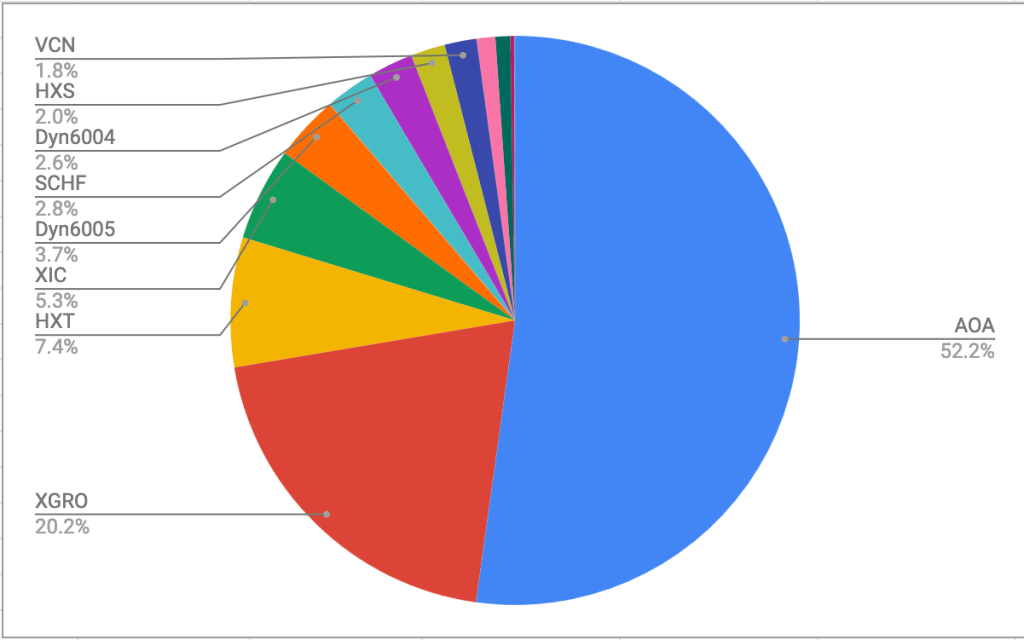
The chart shown below is the summary of all my accounts: personal and spousal RRIFs in CAD and USD, TFSAs for me and my spouse, and non-registered accounts in USD and CAD. It comes pretty close to my target of 80/15/5: 80% equity, 15% bonds, 5% cash. Let’s visit how that comes about.

Summary of funds held in my retirement portfolio

What’s in the pie?

AOA: This is what I call an “All-in-one” ETF that trades on the US stock exchange. It’s an 80/20 fund, 80% equity, 20% bonds. Its US weighting is pretty high, its Canadian weighting is pretty small (about 2.4% by my calculation).

XGRO: This is the Canadian sibling of AOA. An “all-in-one” ETF that trades on the Canadian stock exchange. It’s also an 80/20 fund, with a much stronger tilt to the Canadian equity market.

HXT: Is a fund that I only hold in my non-registered account. Through behind-the-scenes accounting and swap contracts, it provides no-dividend access to the S&P/TSX 60. This is useful from a tax perspective if you’re still earning a salary since it effectively defers any tax impact until you sell shares.

XIC: A variant of the S&P/TSX 60 that caps the contribution of any one company to prevent the “Nortel effect” seen in the late 1990s. I’ve been too lazy to clean this out of the account.

DYN6004/DYN6005: Are Scotiabank HISAs in Canadian and US funds (High Interest Savings Accounts). On my provider’s trading platform, they look like mutual funds, but are just savings accounts that pay a decent interest rate, monthly. They have consistently provided the best rates of all the HISAs available on my provider’s platform.

SCHF: A very low cost equity fund that trades in USD. It provides exposure to international developed markets except the USA. It has about 8.5% weighting for the Canadian equity market. I used to have this in my registered accounts, but dropped it in favor of AOA. It’s still in my non-registered accounts so I don’t have to take an unnecessary capital gain.

HXS: The sibling of HXT, but it covers US markets. Only held in non-registered accounts.

VCN: Provides broad exposure to the Canadian market including smaller companies.

In an ideal world, my portfolio would just hold AOA/DYN6005 for US funds and XGRO/DYN6004 in Canadian funds. Eventually, as I decumulate my holdings, that’s what it will look like. Simple is best.

So why is my portfolio not aligned with my ideal model? Three main reasons:

  • Some of the “extraneous” holdings are in my non-registered accounts and I don’t want to incur a capital gain just to make the portfolio simpler.
  • I want a little bit more Canadian market exposure since I do live and spend money here.
  • No pressing need to. The splits between Canada/US/International equities are fine where they are. I try to trade only when necessary.

I’ll revisit this post from time to time as I go through decumulation to see how it evolves. Prior to hitting the button on retirement, I had a lot more ETFs in the list, basically attempting to build the equivalent of XGRO and AOA through other ETFs. For a small cost, (roughly 0.15%) AOA and XGRO rebalance their holdings quarterly so I can just let them run on autopilot, confident that they will always be close to my desired 80/20 splits. That’s why these two ETFs make up the lion’s share of my retirement portfolio.