
What’s in my retirement portfolio (March 2026)?

This is a monthly look at what’s in my retirement portfolio. The original post is here.

Portfolio Construction

The retirement portfolio is spread across a bunch of accounts:

  • 5 RRIF accounts
    • 3 for me (Questrade, Wealthsimple)
    • 2 for my spouse (Questrade)
  • 2 TFSA accounts (Questrade)
  • 4 non-registered accounts, (1 for me, 1 for my spouse, 2 joint, all at Questrade)

The view post-payday

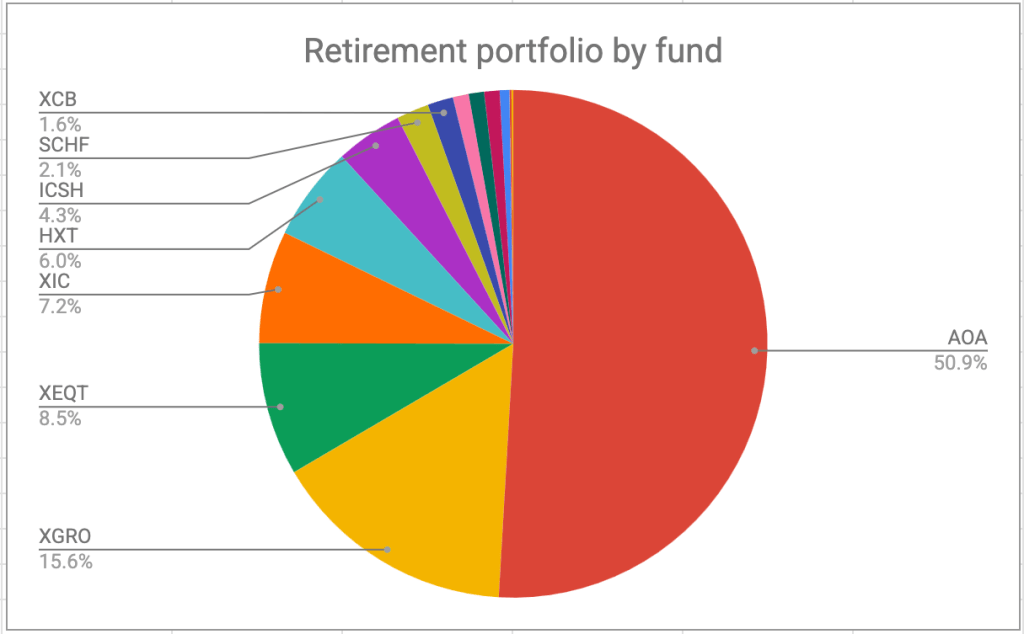
I pay myself monthly in retirement, so that’s a good trigger to update this post. On March 30, this is what it looks like:
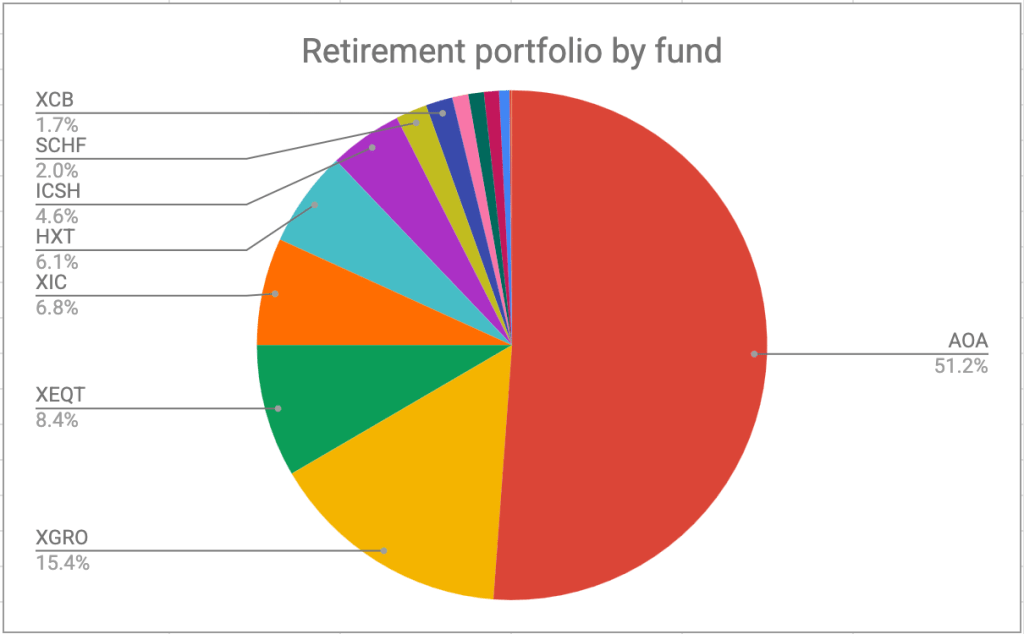
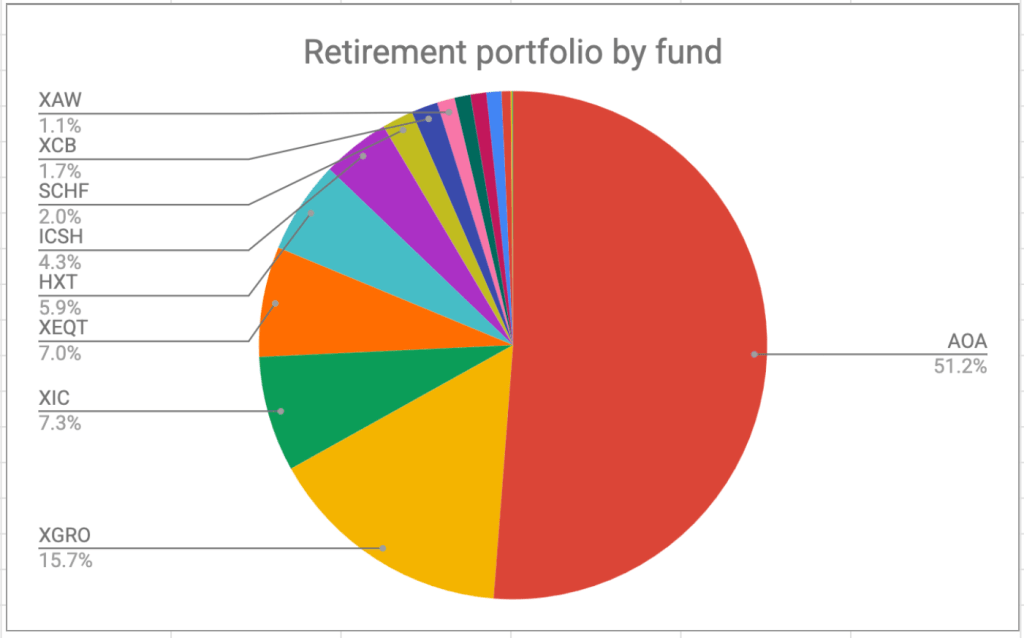
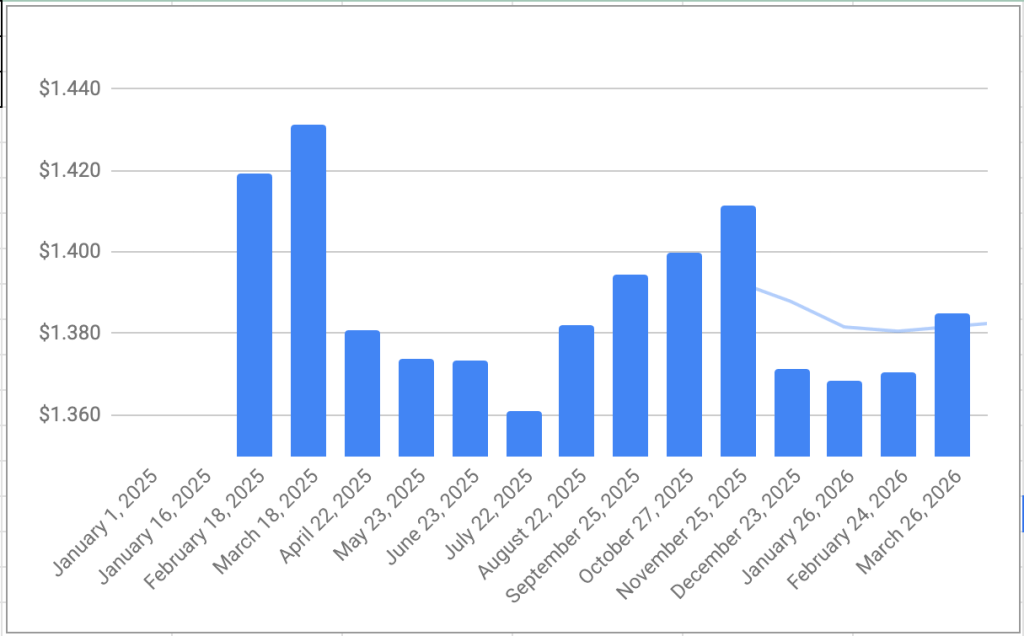
The portfolio is dominated by my ETF all-stars, (and if not an all-star, they are probably on the Magnificent Seven ETFs list). This split is before all the quarterly dividends have paid out. AOA, XGRO, XEQT, XIC all have a quarterly payment that collectively might skew the numbers a bit — I have all these investments on DRIP so I just buy more of the same. All that to say that there weren’t big changes month to month; my USD holdings got a bit of a boost this month thanks to a favourable exchange rate. (A lot of my retirement holdings are in USD, so the FX rates matter somewhat). Here’s what the USD has looked like in CAD since my retirement:
Plan for the next month

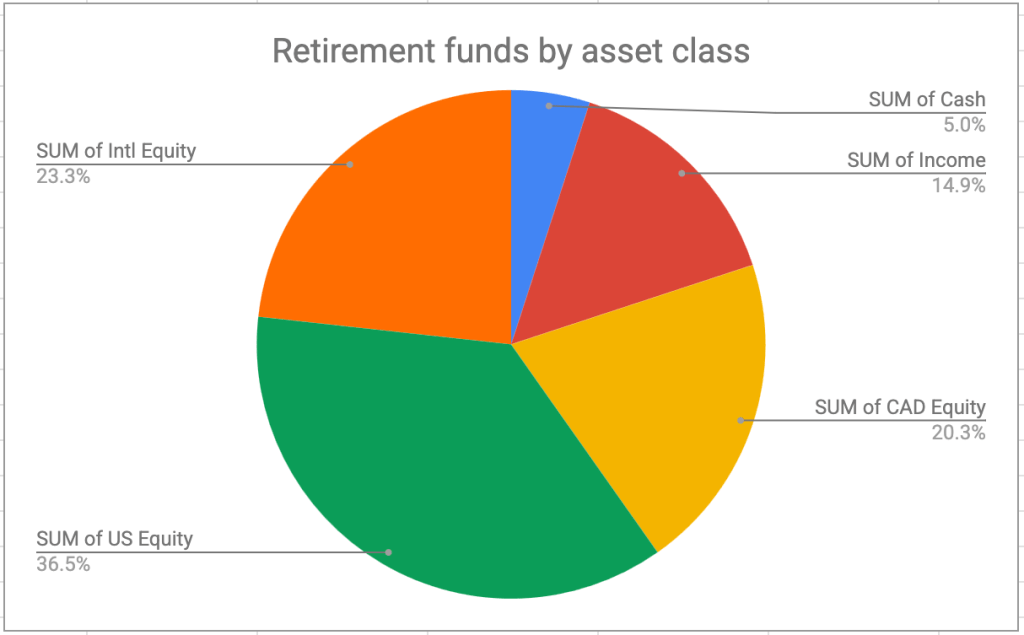
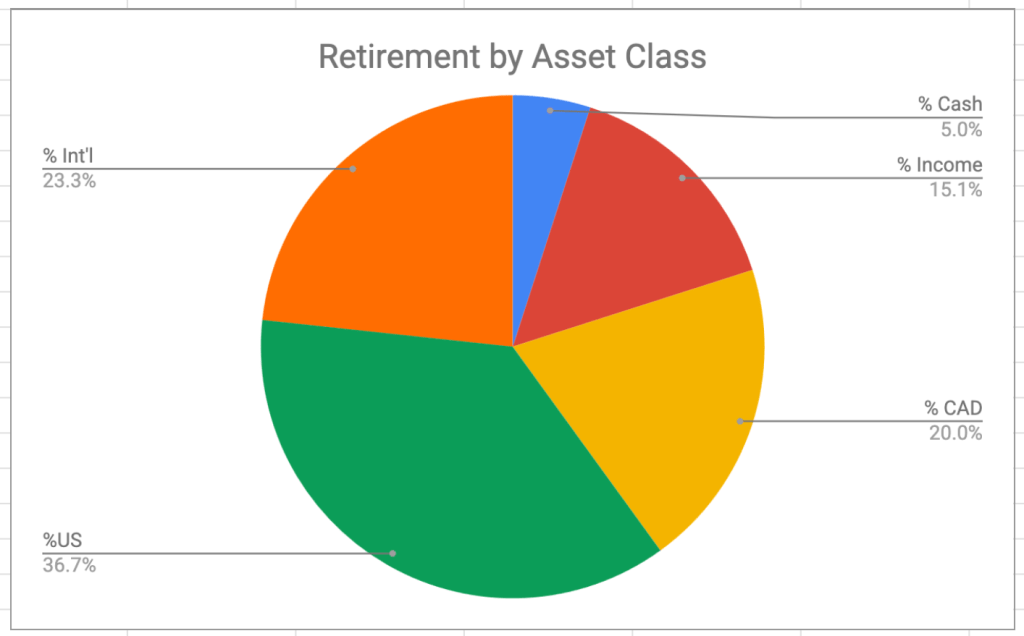
The asset-class split looks like this; you can read about my asset-allocation approach to investing over here.
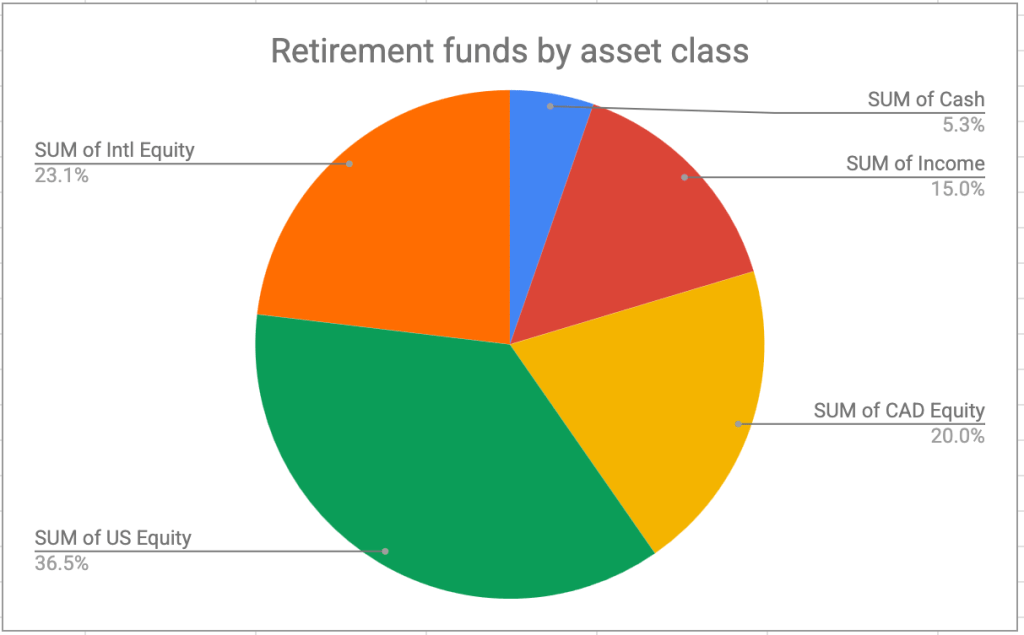
It’s looking pretty close to the targets I have, which are unchanged:

  • 5% cash or cash-like holdings like ICSH and ZMMK
  • 15% bonds/income (most are buried in XGRO and AOA, rest are in XCB)
  • 20% Canadian equity (mostly based on ETFs that mirror the S&P/TSX — HXT and XIC)
  • 36% US equity (dominated by ETFs that mirror the S&P 500)
  • 24% International equity (mostly, but not exclusively, developed markets)

The alignment with target is what drives my investment decisions; seeing the chart above tells me there’s no movements needed, which makes things simpler.

Since we’re just about in to the 2nd quarter of the year, it’s time for me to move some AOA into XGRO using Norbert’s Gambit1. The Gambit has worked out pretty well for me so far; I track my effective FX rate every time I do it, and it’s always less than relying on the instant (and relatively expensive) FX conversions offered by my broker2.

Overall

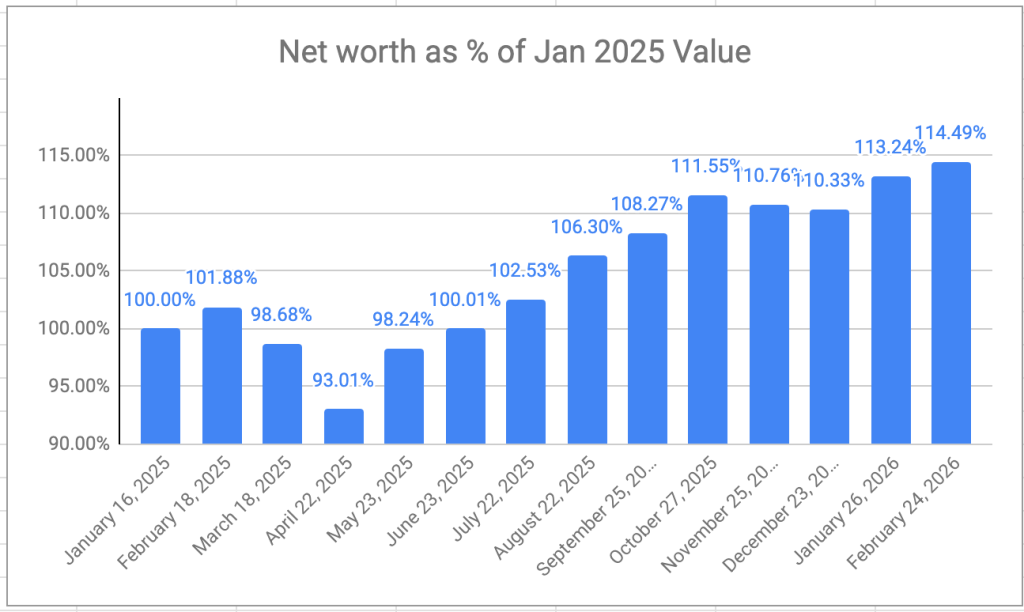
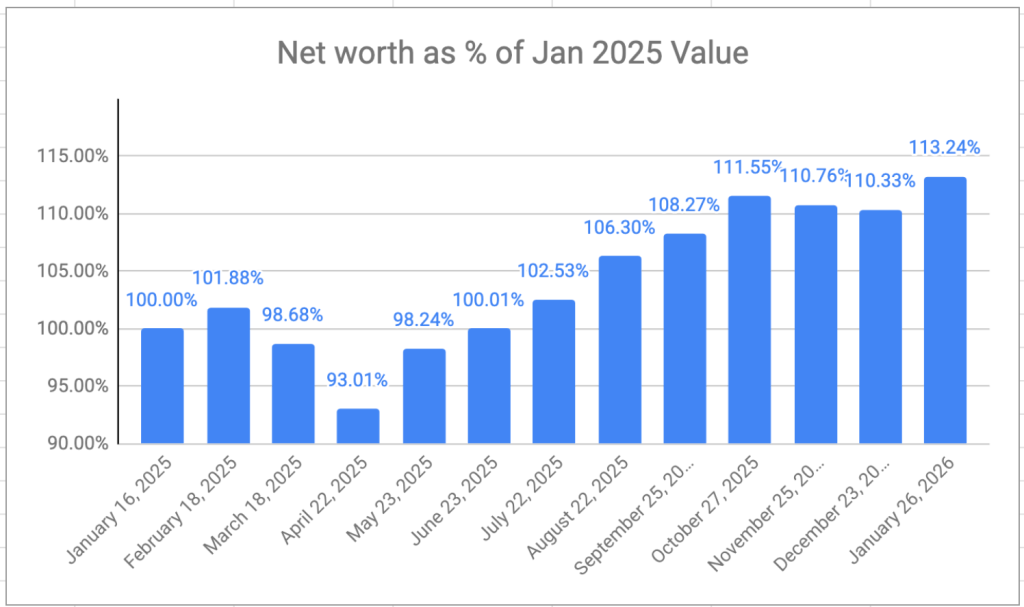
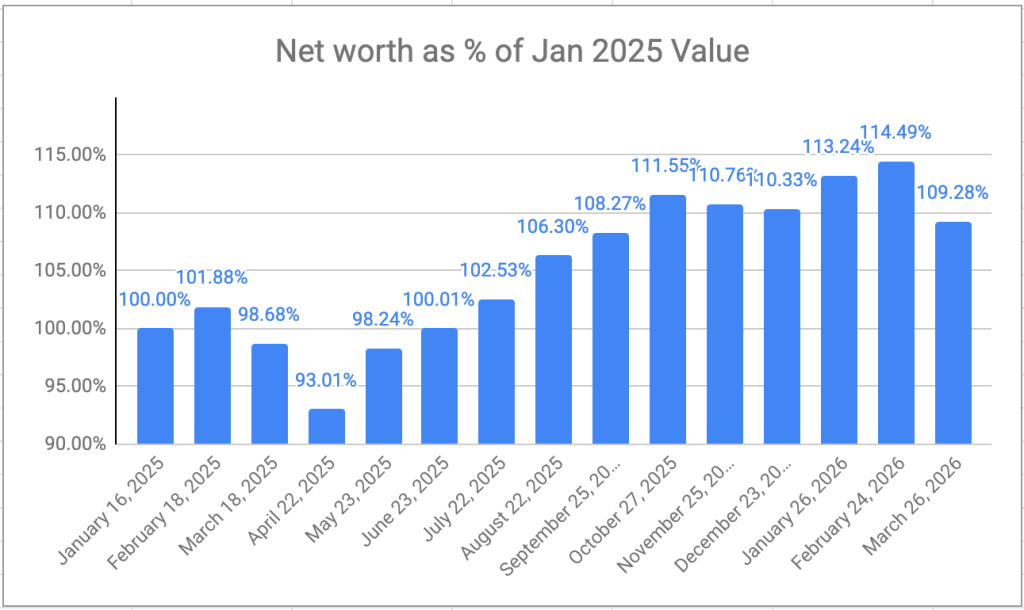
Part of using VPW3 as a strategy is the need to calculate your retirement net worth on a monthly basis. As you can see below, the most recent market gyrations have had a bit of an impact on the bottom line, taking me back to a value I haven’t seen since September last year:
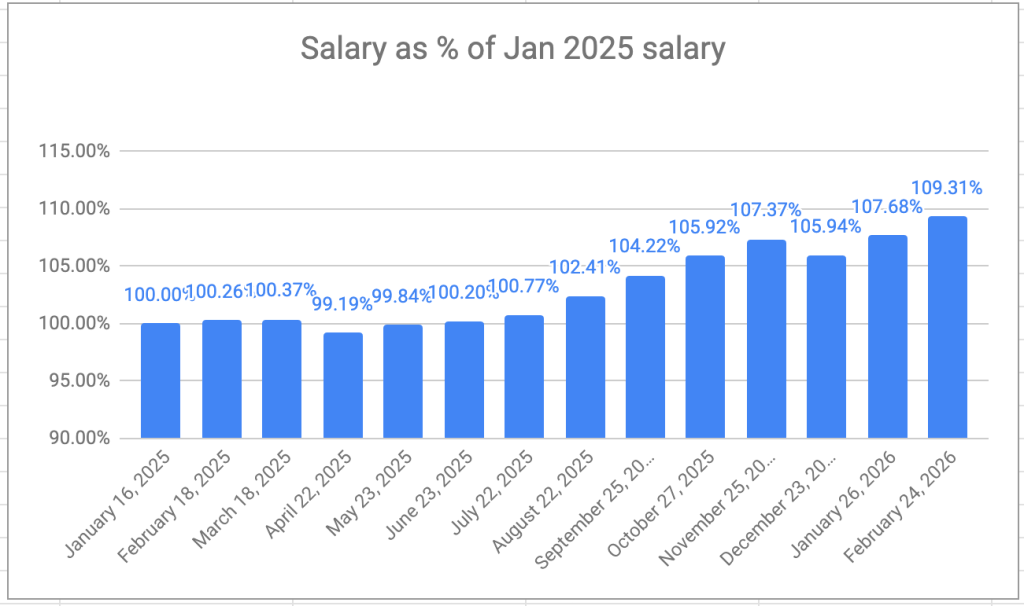
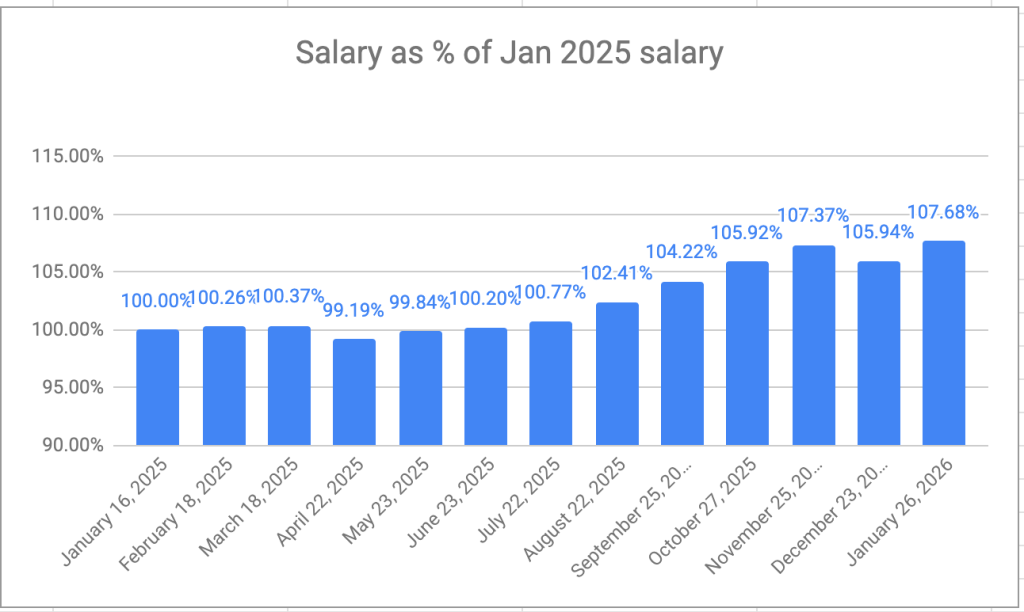
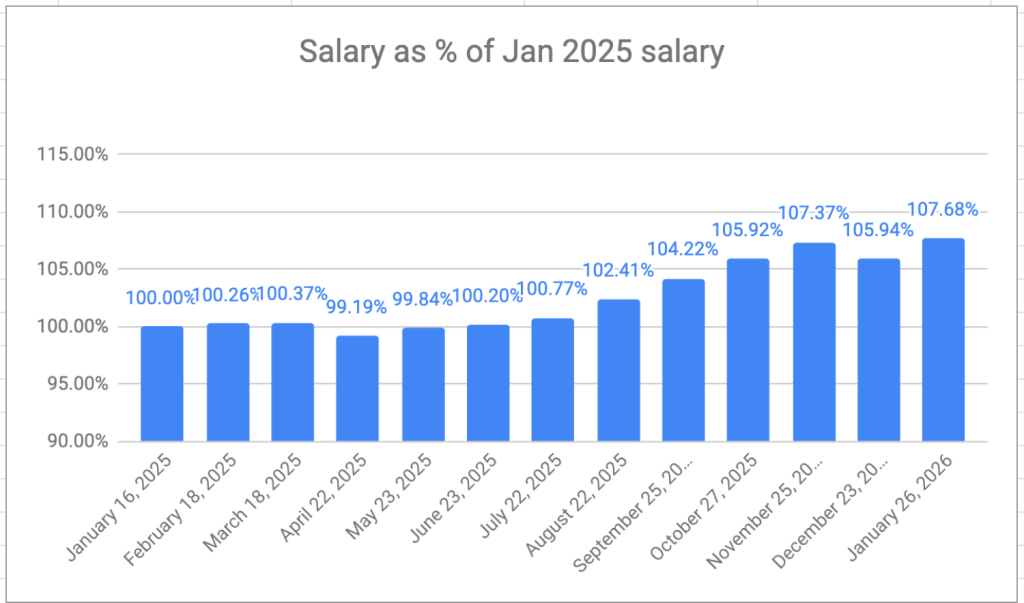
But my VPW-calculated salary, which has a built in shock absorber (aka cash cushion), continued its upward trend nonetheless:
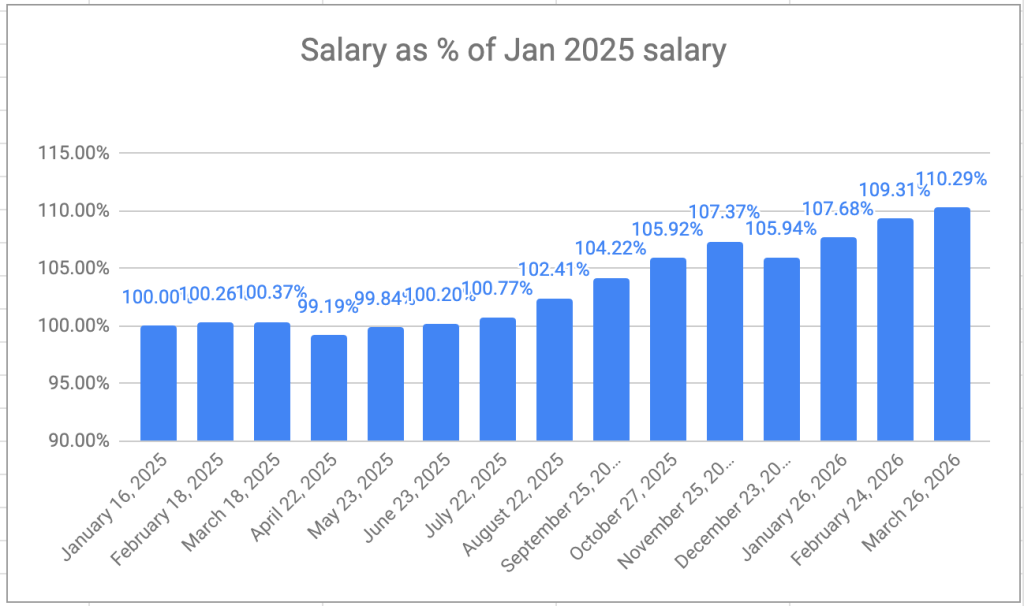
I’m expecting to take a pay cut at some point if the markets fail to recover, but pay cuts are an expected outcome of using VPW as a strategy. The “V” is for “variable”, after all. At this point, I’m still taking over 10% more than I did a year ago, so no matter how you slice it, things are more than on track.

  1. Of late, my need for spending in USD seems not so critical anymore. ↩︎
  2. Typically 1.5% of the amount converted. ↩︎
  3. Variable Percentage Withdrawal, my chosen decumulation strategy. ↩︎

What’s in my retirement portfolio (Feb 2026)?

This is a monthly look at what’s in my retirement portfolio. The original post is here.

Portfolio Construction

The retirement portfolio is spread across a bunch of accounts:

  • 5 RRIF accounts
    • 3 for me (Questrade, Wealthsimple)1
    • 2 for my spouse (Questrade)
  • 2 TFSA accounts (Questrade)
  • 4 non-registered accounts, (1 for me, 1 for my spouse, 2 joint, all at Questrade)

You will notice that QTrade is no longer in the mix. I successfully moved the last RRIF accounts during the month; I learned a lot in the process. QTrade was the victim in the chase for free money offered by Questrade last year; based on current offerings, I’d say that QTrade still has an edge in terms of user experience over Questrade. I’ll go into more detail in a future post.

The view post-payday

I pay myself monthly in retirement, so that’s a good trigger to update this post. On February 28, this is what it looks like:

The portfolio is dominated by my ETF all-stars, (and if not an all-star, they are probably on the Magnificent Seven ETFs list) but if you’ve been following along, you’ll see a few changes.

  • I dropped XAW since I realized I didn’t need it if I was smarter the ratios of holdings I already owned (XEQT/XIC/XCB). Less is more.
  • I sold XIC instead of HXT in my non-registered account this month to help pay the bills because I reasoned that eliminating its dividend payouts would be better from a tax perspective2.

Plan for the next month

The asset-class split looks like this; you can read about my asset-allocation approach to investing over here.

It’s looking pretty close to the targets I have, which are unchanged:

  • 5% cash or cash-like holdings like ICSH and ZMMK
  • 15% bonds3 (most are buried in XGRO and AOA, rest are in XCB)
  • 20% Canadian equity (mostly based on ETFs that mirror the S&P/TSX — HXT and XIC)
  • 36% US equity (dominated by ETFs that mirror the S&P 500)
  • 24% International equity (mostly, but not exclusively, developed markets)

I am mulling over making a small tweak to these percentages, increasing US equity exposure at the expense of International equity based on some calculations I’ve done4 but this is neither urgent nor will it be massively impactful to the overall picture.

Overall

There is a bit of an anomaly this month that I should mention. A number of readers have questioned my wisdom of contributing monthly to a TFSA in retirement. From a tax-free growth perspective, it would be far better to make the contribution at the beginning of the year. And many studies have shown that lump sum investing provides better returns than spacing them out. And so, I have taken their advice5 and made all my TFSA contributions for the year this month. And since my TFSA is part of my net worth, there’s a bump being caused by that contribution.

And so, net worth overall is up month over month, a two month winning streak.

My VPW-calculated salary also continues its upward trend.

  1. One spousal, one individual. One at Wealthsimple because (a) I like their user experience and may consider them as my primary broker in the future and (b) they offered me free money and a laptop to move some fees their way. I can be bought. ↩︎
  2. HXT does not pay dividends and instead uses swap contracts to convert them into capital gains, which receive better tax treatment for me ↩︎
  3. Referred to as “Income” on the chart above ↩︎
  4. I’ll share those in a future post ↩︎
  5. With thanks to Steven and Sylvain ↩︎

“How Much do You Need to Retire”?

This was the title of a recent webinar I attended via PWL. You can watch it yourself over here: https://www.youtube.com/watch?v=pQl6n4zepys. I don’t think I learned a ton from it — the short answer? “It depends”. “On what?”, you may ask. Here’s some things that influence the answer to the question:

It depends on HOW you live.

Put another way, “what’s your budget in retirement1“? This is a question that many people don’t have an answer to. There’s a few buckets to think about, it’s not intended to be exhaustive:

  • Necessities: shelter (and associated maintenance) and utilities(heat, light, water, internet, streaming services, phone), food, clothing, exercise, transportation and associated insurance/maintenance2, taxes (municipal3, federal)
  • Medical expenses (drugs, dentists, optometrists, physiotherapy)
  • Entertainment (eating out, shows, memberships/user fees)
  • Travel (transport, housing, activities)
  • Charities

One thing you don’t have to worry about is setting aside money for an RRSP, since once you’re retired, that’s no longer a thing. But don’t neglect the need for a savings fund for unexpected larger expenses. We always keep a “house fund” that gets a monthly payment that we don’t touch for anything other than home renovations or repairs.

Your bank/credit card4 statements5 might be a good place to see what your typical spending looks like.

It depends on where you live

Live in Toronto? Vancouver? Yeah, that’s not cheap. But if you were willing to move to, say, Thailand or a low cost Canadian city, you might be able to spend a lot less on housing. But since most people aren’t willing to uproot, these costs are known, or can at least be reasonably estimated. And if you’re staying put, then will you downsize? When?

It depends on whether you have a pension outside of CPP/OAS

And I’d add, “and it depends if that pension is indexed to inflation”. (The CPP and OAS are, which is why they are great).

It depends on how long you’re going to live

Not predictable, obviously. The oft-cited “4% rule” of retirement assumes a 30 year retirement. That’s living until age 95 if you retire at the “usual” age of 65. When I engaged a financial advisor in the lead-up to retirement, the charts stopped at age 95 as well.

It depends on whether you want to leave an estate to your beneficiaries

Want to die with nothing6? Then you need less money than if you want to leave assets behind. It’s a pretty fundamental question. And if you want to leave assets behind, then how much? And to who? (You do have an up to date will, right?)

It depends on what your CPP and OAS payments are likely to look like

CPP is dependent on how long you’ve been contributing to the plan, up to a maximum that is published annually7. You can take CPP as early as age 60, and as late as age 70, with penalities/bonuses accumulating every month. CPP needs to be applied for before the cheques start rolling in.

OAS is dependent on how long you’ve lived in the country. If you’ve lived here for 40 years or more, then you qualify for the maximum payment of $742.31 at age 65 and automatically starts at age 658 (for most people) unless you specifically ask for it to be deferred.

It depends on how much income you’re intending to make in retirement

The CPP isn’t designed to pay a living wage9. For this reason, many people “ease” into retirement by working part-time or on short-term contracts. This income impacts the answer to the original question — obviously, if you are earning money, then the retirement nest egg can be smaller.

It depends on what your retirement assets are invested in

This, in my view, is frequently overlooked. The fact is that retirement can be quite long, and assets invested in a retirement portfolio still have growth potential. My retirement assets are 80% equities, 15% bonds, 5% cash. This provides me with more growth potential at the risk of having to weather periods of market volatility. I’m comfortable with that degree of risk, but others may not be. Having a lower exposure to equities means your nest egg needs to be bigger.

It depends on future inflation

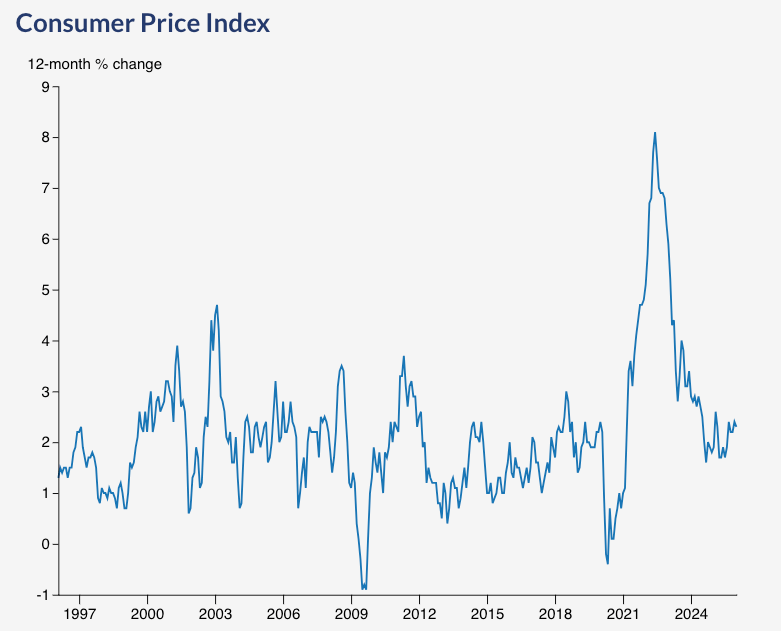
Inflation can fluctuate a lot over the course of retirement. Take the last 30 years as an example:

CPI for last 30 years, courtesy StatsCan (https://www150.statcan.gc.ca/n1/pub/71-607-x/2018016/cpilg-ipcgl-eng.htm)

Inflation is really the biggest concern in my retirement since most of my current income is not inflation-protected10.

My approach? Knowledge and a willingness to be flexible

What kind of knowledge?

  • I had a sense of what my budget desires were
  • I knew my retirement portfolio was going to stay 80% equities
  • I knew I had no pensions outside of CPP/OAS. With advice from my advisor, this lead to the current plan to defer these pensions to age 70 so I can maximize my inflation-protected income.
  • My advisor advised me that I had enough saved up that I could retire

But I gained additional, non-data-driven knowledge:

  • no realistic plan lasts 30 years11
  • that market returns are highly variable12, that inflation is highly variable, that my personal spending budget is highly variable
  • that I have always, always, always, adapted to life changes (income, expenses) by either being looser or tighter with money.

The decumulation strategy I use (VPW, Variable Percentage Withdrawal, talked about here) is deceptively simple, but requires you to be flexible, as your monthly calculated salary is based on your net worth. My salary has generally ticked upwards in the past 12 months, but it could just as easily turn in the other direction in the event of a sustained market downturn. I’ve decided I can live with that. And if you want to see a much longer test in action, check out longinvest’s VPW forward test at https://tinyurl.com/vpwForwardTest.

My final thoughts: be suspicious of a specific answer to “how much do you need to retire”? It depends on so many factors, including your own propensity to adapt to changing conditions, that a simple answer doesn’t seem possible — or reasonable.

  1. And does it change over time? I expect my budget needs are higher now than they will be in the future, when presumably I’m less able/willing to travel. ↩︎
  2. If you own a car ↩︎
  3. If you own a house ↩︎
  4. A lot of my spending takes place using my credit card so I can collect the free money offered. ↩︎
  5. A bit crude, but once in a while it flags something for me: https://www.cibc.com/en/personal-banking/ways-to-bank/mobile-services/insights.html ↩︎
  6. Doing this with 100% accuracy would imply you know the date of your own demise, so probably not a realistic objective ↩︎
  7. And is currently $1507.65/month if you’re 65 this year. ↩︎
  8. This one thing I did learn from the PWL webinar: that for most of us, unless you take action, the OAS will start when you turn 65. ↩︎
  9. Per the CPP website (emphasis mine): “The Canada Pension Plan (CPP) retirement pension is a monthly, taxable benefit that replaces part of your income when you retire” ↩︎
  10. Owning equities is a sort of imperfect inflation hedge since equity prices, like all prices, are influenced by it. ↩︎
  11. I’m reminded of the famous quote by Mike Tyson: “Everyone has a plan until they get punched in the mouth” ↩︎
  12. One year after paying for my retirement plan that informed me I was still three years from retirement, I retired. Why? My retirement savings had blown past “the number” I was advised to hit. And, after a year of retirement, my net worth is 10% higher than when I started retirement. The market sometimes works in your favour. ↩︎

What’s in my retirement portfolio (Jan 2026)?

This is a monthly look at what’s in my retirement portfolio. The original post is here.

Portfolio Construction

The retirement portfolio is spread across a bunch of accounts:

  • 6 RRIF accounts
    • 3 for me (Questrade, QTrade, Wealthsimple)
    • 3 for my spouse (Questrade, QTrade)
  • 2 TFSA accounts (Questrade)
  • 4 non-registered accounts, (1 for me, 1 for my spouse, 2 joint, all at Questrade)

The view post-payday

I pay myself monthly in retirement, so that’s a good trigger to update this post. On January 26, this is what it looks like:

The portfolio is dominated by my ETF all-stars, but if you’ve been following along, you’ll see a few changes.

  • As mentioned in a previous post, I did some shifting around and you now see XAW and XIC increasing their contribution to the portfolio at the expense of XGRO.
  • I also tidied up some extra funds that aren’t needed — VCN was replaced with XIC1, and I turfed some small holdings.
  • I sold more HXT than I needed to for my monthly paycheque, and when I discovered the mistake2, I just bought XIC instead.
  • And, I did my quarterly Norbert’s Gambit to shift some AOA to XGRO. And again, I came out ahead!

Plan for the next month

The asset-class split looks like this; you can read about my asset-allocation approach to investing over here.

It’s looking pretty close to the targets I have, which are unchanged:

  • 5% cash or cash-like holdings like ICSH and ZMMK
  • 15% bonds (most are buried in XGRO and AOA, some are in XCB)
  • 20% Canadian equity (mostly based on ETFs that mirror the S&P/TSX)
  • 36% US equity (dominated by ETFs that mirror the S&P 500)
  • 24% International equity (mostly, but not exclusively, developed markets)

Overall

Net worth overall is up month over month, reversing a 2 month losing streak and hitting a new all-time-high:

My VPW-calculated salary resumed its upward trend, also hitting an all-time high.

My QTrade RRIFs should move perhaps this week, but I’m no longer confident about that. More on that once resolved.

  1. Which, in my mind, are equivalent. This post goes in lots more detail. ↩︎
  2. I had to do some quick manual calculations because I had already updated my auto-calculating spreadsheet to reflect fewer RRIF accounts. My RRIF transfers are 2 months in progress and counting. I guess trying to move a RRIF near the end of the year was a bad idea. ↩︎

CPP and OAS as part of a retirement plan

One of the confusing questions I got from my international colleagues when I announced my retirement was “what’s the retirement age in Canada”? And, after thinking about it, said, “There isn’t one that I know of”, which is, strictly speaking, correct.

However, for many Canadians (and, I suppose, for many people around the world), “retirement age” equates to “the age where I can collect my pension”. For me, the equivalent statement was “the time when my retirement savings were sufficient1” (you can read about the steps I took here). I don’t have a private pension through my employer, so CPP, OAS and my own savings are all I have to sustain my needs throughout retirement.

CPP (Canadian Pension Plan) and (possibly2) OAS (Old Age Supplement) are two sources of income that will eventually make up part of my retirement income, but not for a while. For the time being, my retirement income comes from a mix of non-registered asset sales (about 2/3 of my 2025 household income) and RRIF payments (about 1/3 of my 2025 household income)3. My advisor suggested waiting as long as possible to collect on CPP/OAS, which is age 70 for both.

But maybe, if you haven’t retired yet, you haven’t really thought too much about these things4? Here’s a quick primer.

What’s CPP and what’s it worth to me?

CPP applies to anybody who has contributed to the plan; how much you contribute annually is captured on your T4 slips. You can see your lifetime contributions5 by logging into your My Service Canada Account. It is the history of these contributions6 that ultimately determine what your annual pension will be in the year you first start taking it.

The first year you are eligible to receive CPP is the year you turn 607; every month you wait after turning 60 increases your monthly payment. The absolute maximum CPP you could collect would be waiting until you turn 708. The Feds lay it all out here.

The absolute maximum monthly CPP you could possibly get as a 65 year old is $1507.65 in January 2026 per the Feds9. Since I retired early, and 18 year-old me worked a part-time minimum wage job, my CPP will be less than that. (The CPP calculation takes your best 32 years of earnings into account).

What’s OAS and what is it worth to me?

OAS (“Old Age Security”) applies to anybody who has lived in the country long enough10. OAS can start at age 65, and be delayed until as late as age 70. Like CPP, OAS rewards those who start payments later than age 6511. You get an OAS supplement of 10% when you hit 75.

The absolute maximum monthly OAS payment in the first quarter of 2026 is $742.31 if you’re under 75 and $816.5412 if you’re over per the Feds. (These amounts are adjusted every quarter in accordance with inflation rates.)

The wrinkle with OAS is that it’s income-tested. If you make too much money, you’re going to have to pay some of it back. If you really make too much money, you’ll have to give it all back. This is commonly known as “OAS Clawback”13.

The magic of CPP and OAS

CPP and OAS payments are both indexed to inflation, for as long as you collect it. This is key for me personally — none of my other income sources are inflation-proof, so the more I can get that is inflation-protected, the better. That’s part of the reason I’m planning on delaying collecting CPP and OAS until I’m 70 — that way, I can maximize the inflation-protected income. The other reason I’m delaying these payments is to try to avoid OAS clawback. The earlier I take RRIF money out, the lower my RRIF income will be later in retirement, when I have to start adding CPP to my income. I have no idea if I will avoid the clawback because it depends on the performance of specific elements of my portfolio. But try I will.

Estimating CPP and OAS for VPW

My decumulation strategy is based on VPW (Variable Percentage Withdrawal). I’ve talked about it previously over here and here. VPW requires, as an input, the value of a future pension. So how do I go about estimating that? Any reasonable estimate might want to ignore what the feds put on the periodic CPP summaries they send out because those estimates are assuming you’re retiring at 65, and working at a similar salary level (of course, if that’s your plan, then it’s perfectly fine — but it wasn’t mine :-))

All good estimates start from the lifetime contributions table you can find at My Service Canada. From there I’ve given a few tools a spin:

PWL Capital Tool

https://research-tools.pwlcapital.com/research/cpp

This tool has a lot of neat features, but be careful. The model bakes in both inflation estimates and wage inflation estimates that are changeable, but not immediately obvious.

CPP Calculator

https://www.cppcalculator.com/

This is one I recommended previously in Tools I Use, but the upload feature has been broken for a while now. It still works by entering it manually, but I now prefer the tool below….

Finiki CPP and QPP Calculator

https://www.finiki.org/wiki/CPP_and_QPP_calculator

The Finiki tool is now my favourite because it’s available as a worksheet (Google Sheets, Excel and Libre Office all supported), and all you need to do is enter in your pension contributions. The current version (2.3) hasn’t been updated with the latest YMPE values, but it’s a trivial exercise to update them.

  1. “sufficient” means different things for different people. You have to have a budget, and you have to have an idea what sort of estate, if any, you’re intending to leave behind. ↩︎
  2. I figure my odds are 50/50 that my combined CPP+RRIF income when I hit 70 will render me ineligible for OAS. ↩︎
  3. I am not planning on actually working for a living anymore; there are all kinds of rules concerning the interplay of CPP and employment income, but I’m not talking about them here because that scenario doesn’t apply to me. ↩︎
  4. Or, if you were a cynic like me, figured that it wouldn’t exist by the time I got to an age where I’d be collecting it. Seems like the pension plan is currently in pretty good shape. ↩︎
  5. Starting at age 18. ↩︎
  6. Mostly. If you took a leave from employment to raise a family, there is special treatment which could increase your pension. ↩︎
  7. You get 36% less of a monthly payout by starting at age 60 compared to age 65. ↩︎
  8. You get 42% more monthly compared to age 65. ↩︎
  9. You would have to be at maximum pensionable earnings for 39 years between the ages of 18 and 65 to get this amount. (47 years less the 8 worst years of earnings). ↩︎
  10. OAS can be estimated by using the Canada.ca calculator which is down at the moment: ↩︎
  11. Details at https://www.canada.ca/en/services/benefits/publicpensions/old-age-security/when-start.html ↩︎
  12. Which, if you’ve been paying attention, is 10% more than the benefit for someone under age 75. ↩︎
  13. OAS is progressively reduced if you make more than $95k in 2026. You get no OAS at all if you make more than ~$155k at ages 65-74, $160.5k for ages 75+. These numbers are modified 4 times a year based on inflation. ↩︎