What’s in my RESP portfolio?

As summer shifts into fall, I’m reminded that it’s back-to-school time. Or “Dad, I need money for tuition” time. I still have kids attending higher education, still making withdrawals from the family RESP we set up shortly after the birth of son #1, almost 25 years (!) ago now. RESP investing is a bit different from retirement investing given the (hopefully) shorter timelines of RESP investing1. Here’s how I approach it.

In the early days of the RESP, the contributions were invested in mutual funds; these were dark days, long before the rise of very cheap ETFs. Mutual funds were the ONLY way to make routine contributions (which I made, monthly, without fail — Pay Yourself First and all that). I had an 80/20 mix of equities and bonds in the first 18 years or so of its existence: 4 funds, one for US Equity, one for Canadian equity, one for international equity and one for bonds. I don’t remember the specifics of which ones and what percentages exactly. But the fund kept growing, thanks to market returns as well as CESG grant money, which I took full advantage of2!

As son #1 came close to entering post-secondary studies, I shifted the portfolio to a 60/40 mix using individual ETFs like HXS for US Equities, HXT for Canadian Equities, HXDM for International Equities, and CBO for Bonds. The GlobalX funds didn’t throw off dividends3 and so I just had to deal with the periodic (monthly) distributions of CBO, which ultimately were set to DRIP4.

I made the decision to move to 60/40 over 80/20 to preserve a bit more of the capital in the event of some kind of market meltdown5. Growth gets curtailed somewhat as a result, but there’s less volatility.

But I finally realized that all of this was completely unnecessary thanks to all-in-one ETFs. So now, the RESP has exactly ONE holding — XBAL, an all-in-one from iShares that takes care of the 60/40 split for me. And this is set to DRIP as well, so every quarter the RESP picks up a few more XBAL shares.

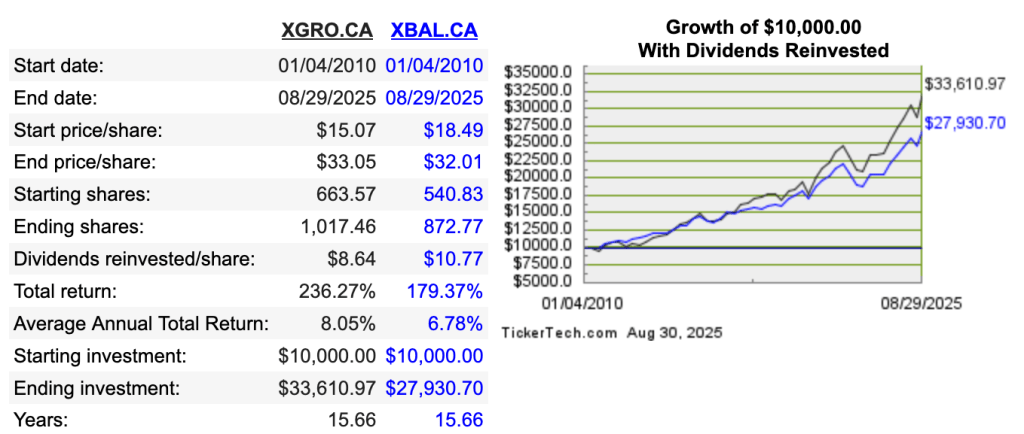
You can see how XBAL has preformed over the past 15 years or so. I’m comparing it to the 80/20 XGRO ETF from the same family, one that features prominently in my ETF All-Stars page6:

In a future post, I’ll explain how I fairly divide the RESP among my two sons — in essence, I pretended that the RESP was a mutual fund, with each son receiving the same number of units on the day the first withdrawal was made. Withdrawals are henceforth made in units, not dollars, and the unit price fluctuates with the value of the RESP.

How are you managing your RESP? Let me know at comments@moneyengineer.ca.

  1. Less time to build wealth, shorter runway for decumulation ↩︎
  2. As a certified cheapskate, it’s hard for me to resist free money of any kind. ↩︎
  3. They are “corporate class” ETFs that use a clever structure to avoid paying out dividends; all growth is buried in the increase of the ETF’s price. I still hold some of these in my non-registered accounts. ↩︎
  4. Dividend Reinvestment Plan. Instead of getting cash in the RESP account, the DRIP buys additional shares of whatever generated the dividend in the first place. ↩︎
  5. One may ask why I chose to stick with 80/20 in retirement, which is against some conventional wisdom. I figured that the RESP decumulation phase would be over a much shorter time period (say 5-10 years) and so I would be less able to wait for a market bounce-back. In retirement, I’m hopeful that decumulation will take much, much longer, and so with 80/20 I have a better chance of outliving my savings. ↩︎
  6. Chart is courtesy http://www.dividendchannel.com, featured on Tools I Use. When I rolled the comparison all the way back to 2007 the 60/40 XBAL actually OUTPERFORMED the (supposedly) more risky XGRO. Can’t explain that one. ↩︎

The Cost of Asset Allocation ETFs

Readers will know that I’m a fan of the asset-allocation ETF. In fact, the vast majority of my retirement savings are dedicated to them. (New to the concept of asset allocation ETFs? Here’s an intro.)

Owning asset-allocation ETFs means you can quite literally invest and forget. The target asset allocations are maintained automatically for you, eliminating the all-too-common desire to tinker/experiment/play and mess with your returns in the process.

As with all things investing, there’s no such thing as a free lunch. This automatic asset re-allocation is reflected in the MER1 of the asset-allocation ETFs. So what’s this automatic management actually costing the holder of the all-in-one?

To work out the answer to that question, you have to look at how the asset-allocation ETF in question is built. Some people refer to asset allocation ETFs as “funds of funds” and this is actually quite an apt description, since most asset-allocation ETFs are just constructed by buying up index ETFs issued by the same company.

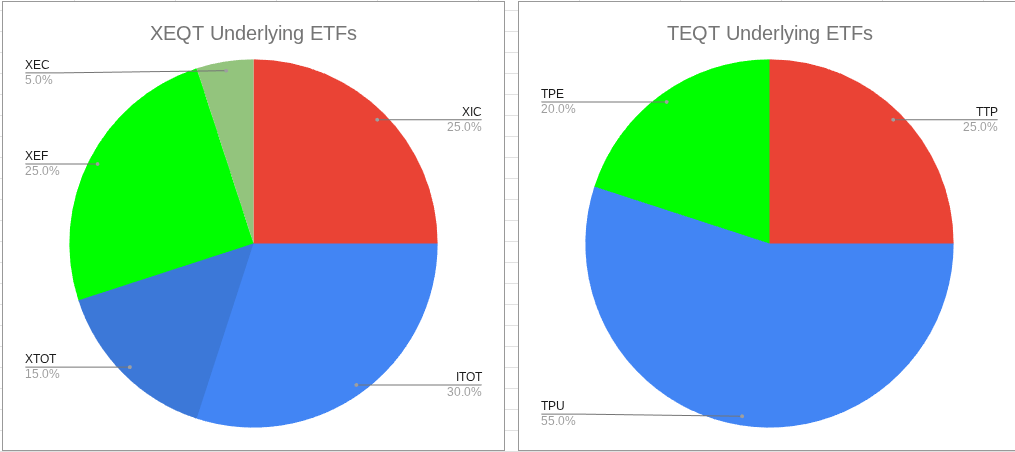
For example, iShares and TD each have an all-equity asset allocation ETF, named XEQT and TEQT2, respectively. Here’s what’s actually under the hood of each of them:

(I tried to keep the colours consistent between the two: red is Canadian equity, blue is US Equity, and other colours are international equity).

The thing about the MER of an all-in-one is that it already includes the MERs of the funds from which it is built. The tip-off is phrases like this one in iShares’ literature:


MER includes all management fees and GST/HST paid by the fund for the period, and includes the fund’s proportionate share of the MER, if any, of any underlying fund in which the fund has invested

https://www.blackrock.com/ca/investors/en/literature/product-brief/core-etf-portfolios-product-brief.pdf3

What this means is you can work out what the MER would be if you decided to simply manage the underlying funds yourself, and in so doing, figure out the premium that the all-in-one is adding to the mix.

I did this exercise, and here’s what I found:

XEQTTEQT
MER of component parts40.103%0.089%
All-in-one MER50.20%0.17%
MER premium for all-in-one60.097%0.081%
Annual premium cost per $1000 invested7$0.97$0.81

I offer a few takeaways from this analysis:

  • The MER costs I’m talking about here are lower than a factor of 10 (at least) that what’s charged by typical investment advisors and bank-backed mutual funds
  • The cost premium of the all-in-one is small, but it’s higher than I expected; even small percentage differences are greatly amplified when you work out (say) the 10 year cost of using these products.

The alternative of managing the constituent parts can be a cheapskate alternative and can save real money over time8, but one must beware of

  • The added complexity inherent in managing a portfolio of multiple ETFs. The XEQT/TEQT example is the simplest one; if you add bonds to the mix (e.g. XBAL/TBAL) you will need to add a few more ETFs to replicate the all-in-one. I used to manage my portfolio without using all-in-ones. I enjoyed it (you may have noticed I have a deep interest in investing). In retirement I have chosen to be practical and have attempted to create an environment that won’t be cognitively overwhelming as I get older.9
  • The greater likelihood of straying from the plan due to inaction or emotion kicking in. I myself didn’t put a lot of credence to this argument, but people smarter than me have pointed out that this is probably the one biggest factor that derails investment plans.
  1. The MER (Management Expense Ratio) is the cost of operating the ETF, expressed as a percentage. You don’t directly pay MER fees, but they reduce the overall returns of your investments. Lower MERs = more money for you. ↩︎
  2. No points for originality here ↩︎
  3. In teeny tiny letters at the bottom of page 1 ↩︎
  4. Weighted MER of each of the component ETFs. ↩︎
  5. You can find these on the ETF pages for XEQT and TEQT ↩︎
  6. Subtract 2 previous rows ↩︎
  7. Just multiply. Watch those decimal points, though. ↩︎
  8. I’m ignoring trading costs which aren’t zero but ought to be very small. Rebalancing assets is necessary of course but is perhaps a monthly, quarterly or annual exercise. ↩︎
  9. And even a portfolio just based on all-in-ones may prove to be too much to handle at some point. I’ve started to pay a bit more attention to the services offered by robo-advisors. ↩︎

News: BMO reduces fees on all-in-one ETFs

Summary: BMO has reduced fees on its family of asset-allocation ETFs (ZCON, ZBAL, ZGRO, ZEQT) to put its Management Expense Ratio (MER) in the same realm as competing families from GlobalX, iShares and TD.

If you’re a fan of all-in-one ETFs (as I am)1, then there is a new low-cost competitor2 to consider in BMO. BMO announced a reduction in their fees last week, and per Rob Carrick, it’s a win for everyone concerned. If you’re new to the idea of all-in-one ETFs (aka asset allocation ETFs), here’s a good place to start: https://moneyengineer.ca/2025/01/21/why-you-can-fire-your-advisor-asset-allocation-etfs/.

It’s probably worth taking a quick scan of the four lowest-cost families out there. Here’s the overview.

ProviderFund Symbols
TD3TEQT, TGRO,TBAL,TCON
BMO4ZEQT, ZGRO, ZBAL, ZCON
GlobalX5HEQT, HGRW, HBAL, HCON
iShares6XEQT, XGRO, XBAL, XCNS, XINC
Low-cost all-in-one ETF providers, and the symbols you can use to buy them

In my view, any of these families are worthy of your investment dollars. Which particular fund you pick within a family depends on your tolerance for volatility and/or your timeline for needing the money you’re investing. Each list of fund symbols in the table above is listed in order of amount of equity — so for TD, you can see that TEQT has the most equity (100%) whereas TCON has the least (40%). You might want to give https://moneyengineer.ca/2025/05/06/investment-basics-asset-allocation/ a read to get more familiar with the concepts.

  1. XGRO and XEQT are both members of the coveted “ETF All Stars” slot. ↩︎
  2. There are other all-in-one families (Vanguard, Fidelity, Mackenzie), the ones shown here are the least expensive of the lot at 0.20% MER or less. TD is the current winner of the lot with a rock-bottom 0.17% MER. ↩︎
  3. TEQT launched in April 2025. ↩︎
  4. There’s also an ESG asset allocation fund, ZESG. ↩︎
  5. There’s also a bunch of covered call variations that are of no interest to me. ↩︎
  6. iShares is the family I work within. I started with them over the others because they could be traded for free on my former provider (QTrade). My current provider (Questrade) allows free trading for any ETF. ↩︎