
Quick links for the long weekend

(Quick aside: as a retiree, I did have to make sure this coming weekend was, in fact, a long weekend 🙂 )

What’s the deal with AOA?: updated

While many Canadians are familiar with all-in-one products that trade on the Canadian exchanges (XEQT/XGRO, VEQT/VGRO, TEQT/TGRO, ZEQT/ZGRO), there is also a USD product that I use quite heavily in my retirement portfolio. That ETF is AOA. In this updated post, I break down what’s inside it. TL/DR: lots of US Equity, lots of International Equity, a tiny slice of Canadian equity, and broad coverage of the US and international bond markets.

Rob Carrick is back in (digital) print

One of my favourite ex-Globe And Mail staffers was Rob Carrick, the keyboard behind such valuable assets as the ETF Buyer’s Guide. He retired last year, but it seems he’s back doing the same job in a different way. He’s now writing on Substack, and you can find his words of wisdom over here: https://substack.com/@robcarrick1.

PWL on Retirement: “Finding and Funding a Good Life”

Not a new publication, but new to me…It’s penned by Ben Felix, a certified Canadian financial rockstar. Looks like a good read over a cup of coffee. Finding and Funding a Good Life.

The magnificent seven ETFs

Since my investment strategy is to own the market via passive index investing, I know that some of my retirement savings are tied up in those famous seven tech stocks1. But that’s not what I’m talking about.

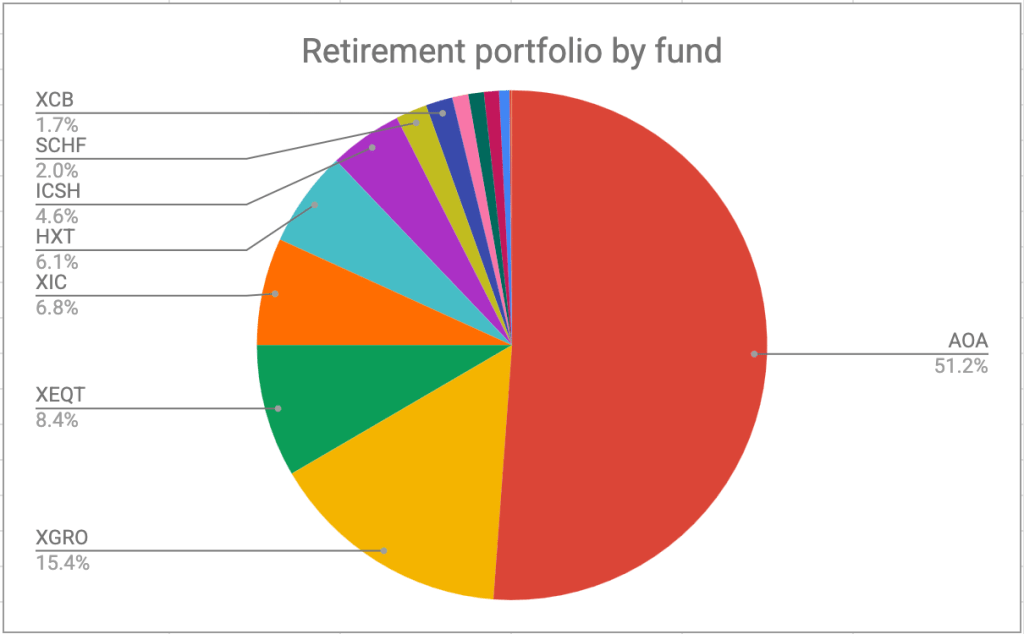
For a year or so I’ve been talking about my ETF All-Stars, but I’ve come to the realization that the list isn’t complete. I discovered that I could do better in terms of where I hold certain assets, I’ve now also realized that I need 7 total ETFs to achieve my investment objectives across non-registered, TFSA and RRIF accounts. These seven ETFs are 90% of my retirement portfolio. The other 10% are found in the non-registered account and are legacy investments. Over the next 5 years, these legacy investments will disappear altogether.

Here’s how the seven2 break down:

AOA: An all-in-one USD ETF

AOA is an 80% Equity / 20% bond ETF. It’s roughly 50% of my retirement savings, and it’s exclusively held in my RRIF accounts. I’ve invested in USD ETFs for quite a long time now, and this one holding locks up most of my USD funds. The problem with AOA is that it tilts too far into US Equities (50%) and has very little exposure to the Canadian stock market (about 2.67%). So I have to compensate elsewhere.

XGRO: An all-in-one Canadian ETF3

XGRO is an 80% Equity/ 20% bond ETF, about 15% of my retirement savings. It’s the Canadian sibling of AOA in every way. It holds 20% Canadian equity and 36% US equity, so it helps take down the US bias of AOA a bit. It’s held exclusively in my RRIF accounts.

XEQT: An all-in-one Canadian ETF

XEQT4 is from the same family as XGRO but doesn’t hold any bonds. It helps take down the bond percentage of my overall portfolio from 20% to 15%. Since equities tend to grow faster than equity/bond combinations, and since my TFSA is the last account to be touched in my retirement income planning, XEQT is held only in my TFSA accounts.

XIC: A low-cost Canadian Equity ETF

XIC5 holds only Canadian Equities and helps fix the lack of Canadian content in AOA. As a 100% equity ETF, it lives mostly in my TFSA. Historically, I also hold this in my non-registered accounts but this will be reduced as I dip into my non-registered funds to pay my bills.

ICSH: A USD money-market fund

Technically, ICSH is an ultra-short-term bond fund, but I treat it the same way as I would treat a HISA. Cash is 5% of my portfolio in retirement, and it’s mostly in ICSH since US Interest rates are much higher than Canadian ones at present. I’d switch this holding to ZMMK if the opposite was true. ICSH lives both in my RRIF and my non-registered accounts. It’s only in my non-registered accounts because my decumulation strategy (VPW) requires a “cash cushion” to smooth out my monthly salary.

XCB: A Canadian Corporate bond fund

The way the math works at present, I’m a little short in bonds, and so I have a bit of XCB sitting in the RRIF to keep my asset targets in line. XCB is a nice low-cost corporate bond fund; I chose corporate because AOA and XGRO give me plenty of exposure to government bonds.

ZMMK: A CAD money market fund

ZMMK is a small portion of the cash cushion which is mostly invested in ICSH. If Canadian interest rates exceed US rates, then my holdings here would grow accordingly.

  1. My retirement portfolio is about 36% US equity, and the mag 7 make up about 10% of the US market, so say 4% of my retirement savings. ↩︎
  2. I thought I was going to need XAW as well, but worked out a plan to eliminate it ↩︎
  3. You could also consider ZGRO, TGRO, VGRO from BMO, TD, and Vanguard respectively. They are all pretty similar. ↩︎
  4. You could also consider ZEQT, TEQT, VEQT. Tomato, Tomahto. ↩︎
  5. VCN is another good choice; it’s pretty much the same thing. ↩︎

What’s in my retirement portfolio (Jan 2026)?

This is a monthly look at what’s in my retirement portfolio. The original post is here.

Portfolio Construction

The retirement portfolio is spread across a bunch of accounts:

  • 6 RRIF accounts
    • 3 for me (Questrade, QTrade, Wealthsimple)
    • 3 for my spouse (Questrade, QTrade)
  • 2 TFSA accounts (Questrade)
  • 4 non-registered accounts, (1 for me, 1 for my spouse, 2 joint, all at Questrade)

The view post-payday

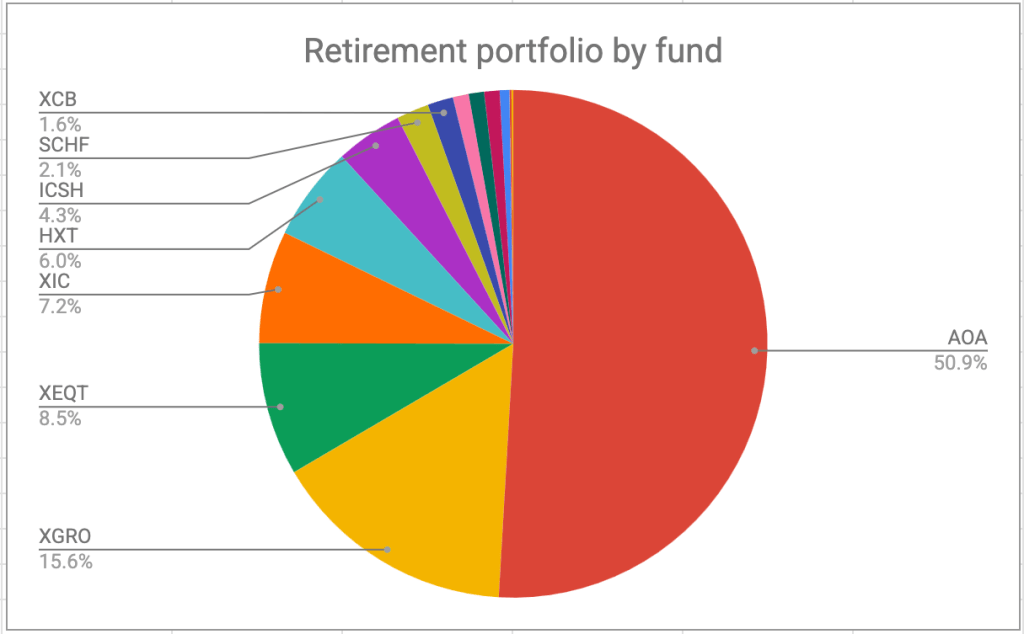
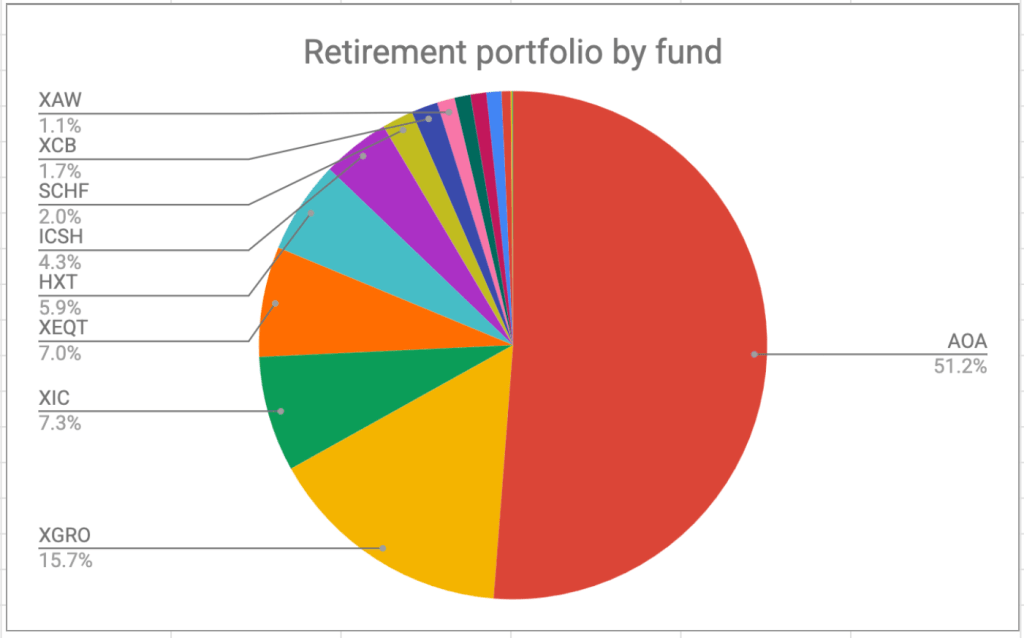
I pay myself monthly in retirement, so that’s a good trigger to update this post. On January 26, this is what it looks like:

The portfolio is dominated by my ETF all-stars, but if you’ve been following along, you’ll see a few changes.

  • As mentioned in a previous post, I did some shifting around and you now see XAW and XIC increasing their contribution to the portfolio at the expense of XGRO.
  • I also tidied up some extra funds that aren’t needed — VCN was replaced with XIC1, and I turfed some small holdings.
  • I sold more HXT than I needed to for my monthly paycheque, and when I discovered the mistake2, I just bought XIC instead.
  • And, I did my quarterly Norbert’s Gambit to shift some AOA to XGRO. And again, I came out ahead!

Plan for the next month

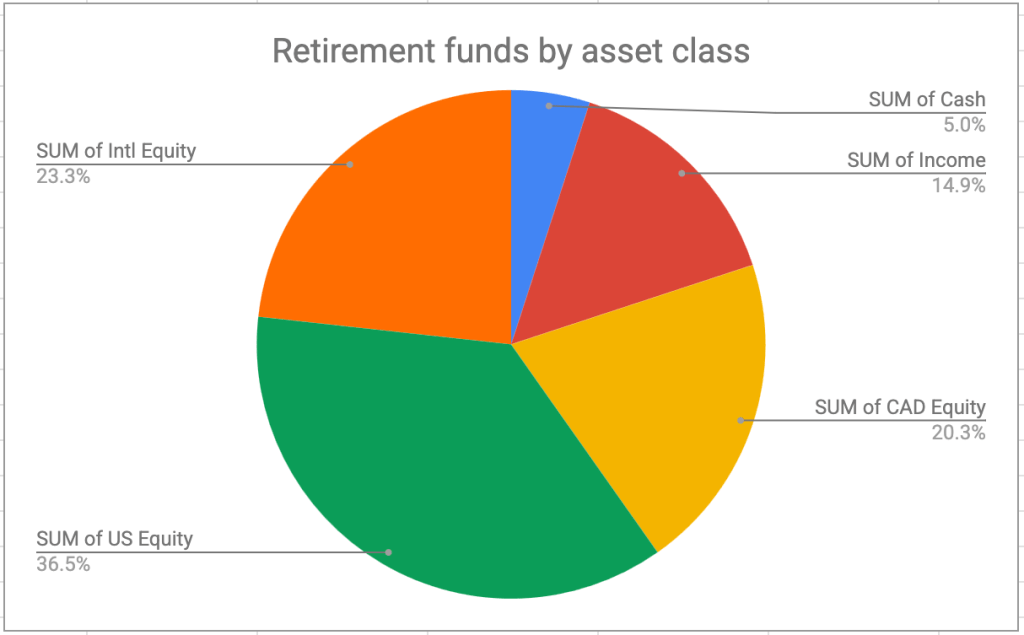
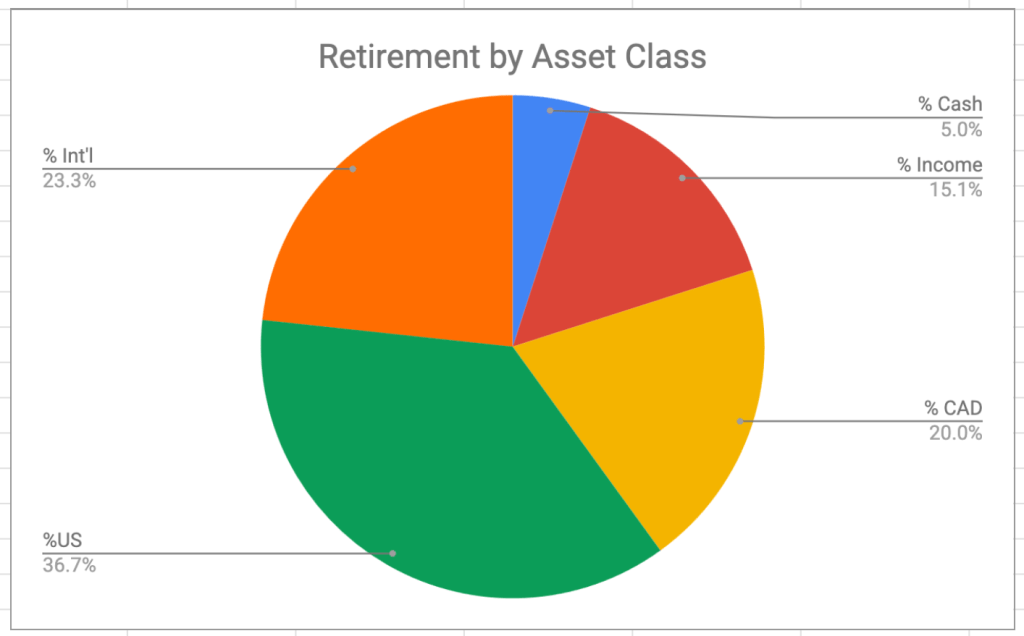
The asset-class split looks like this; you can read about my asset-allocation approach to investing over here.
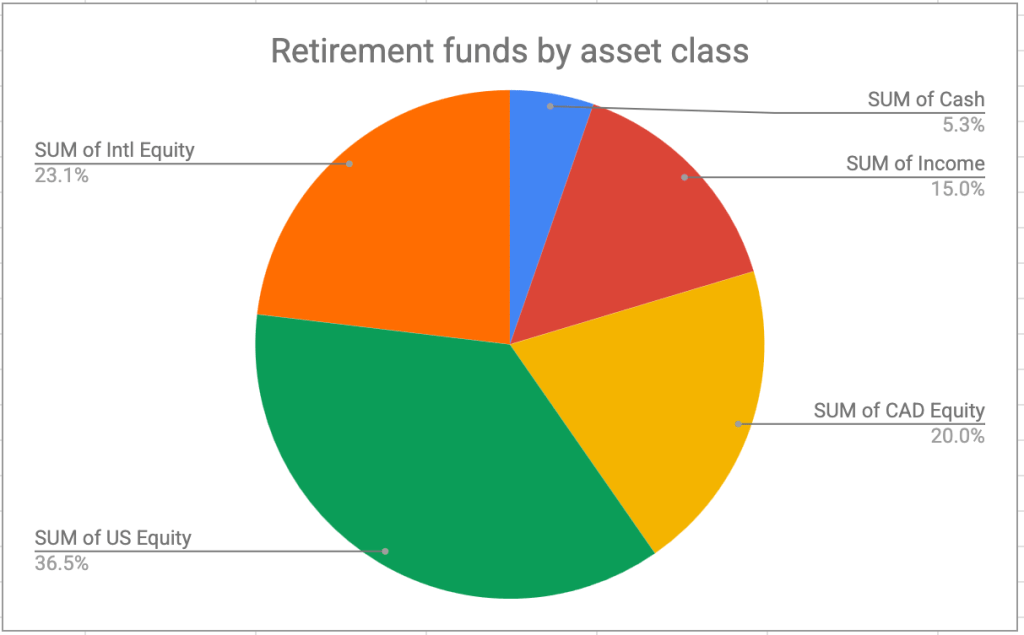
It’s looking pretty close to the targets I have, which are unchanged:

  • 5% cash or cash-like holdings like ICSH and ZMMK
  • 15% bonds (most are buried in XGRO and AOA, some are in XCB)
  • 20% Canadian equity (mostly based on ETFs that mirror the S&P/TSX)
  • 36% US equity (dominated by ETFs that mirror the S&P 500)
  • 24% International equity (mostly, but not exclusively, developed markets)

Overall

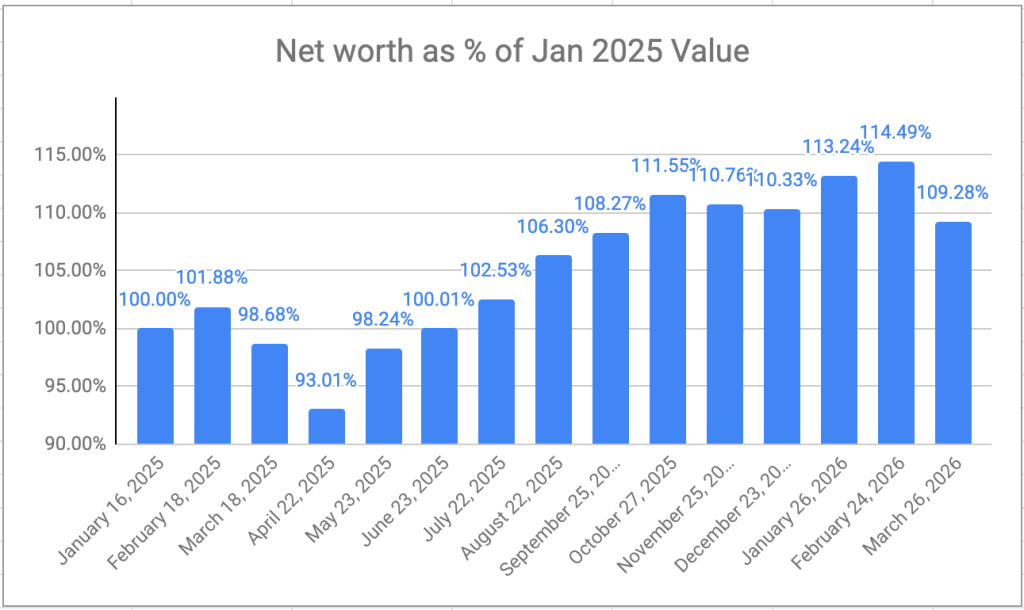
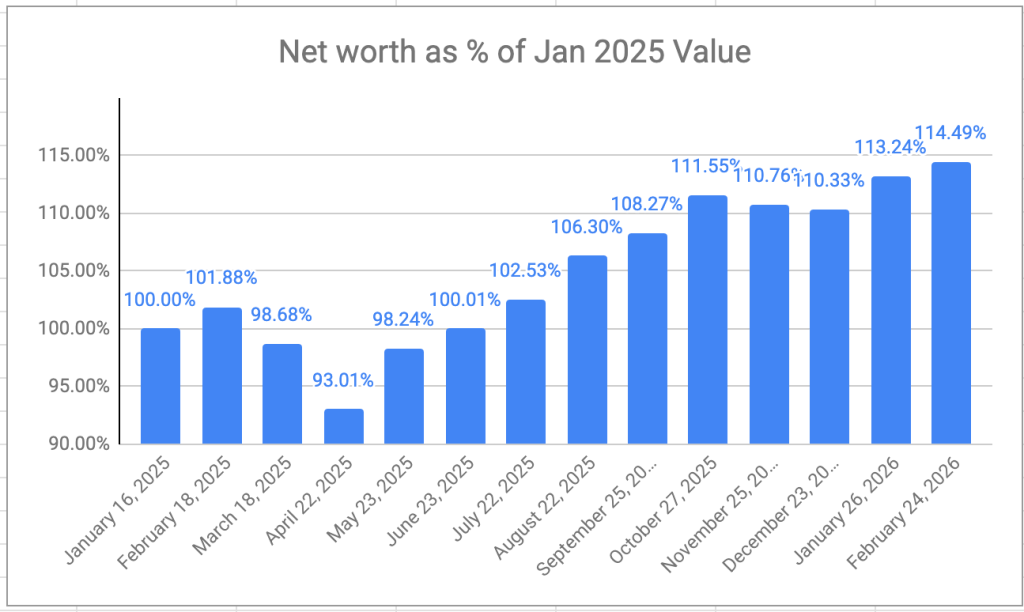
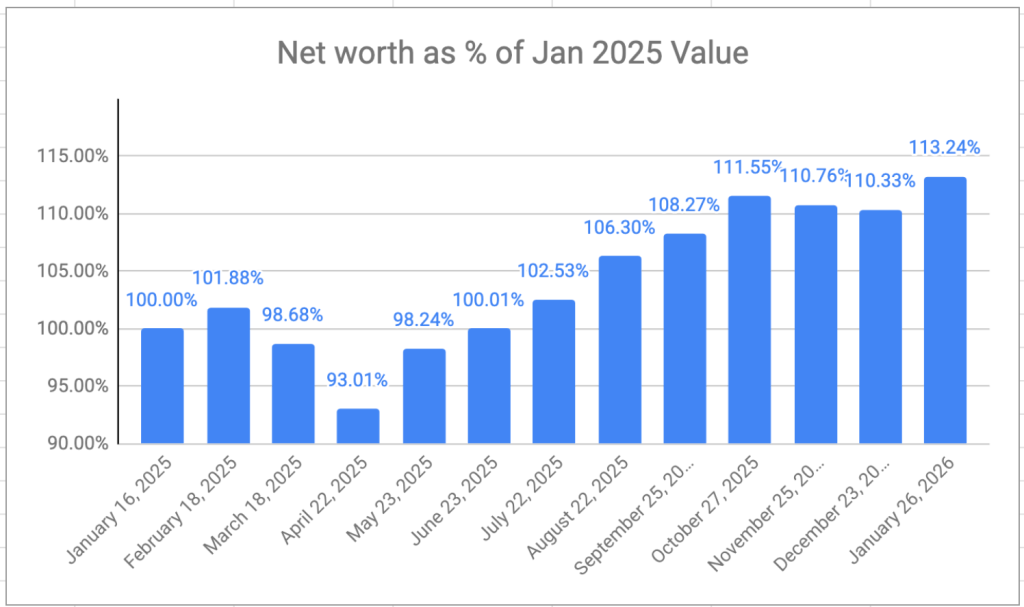
Net worth overall is up month over month, reversing a 2 month losing streak and hitting a new all-time-high:

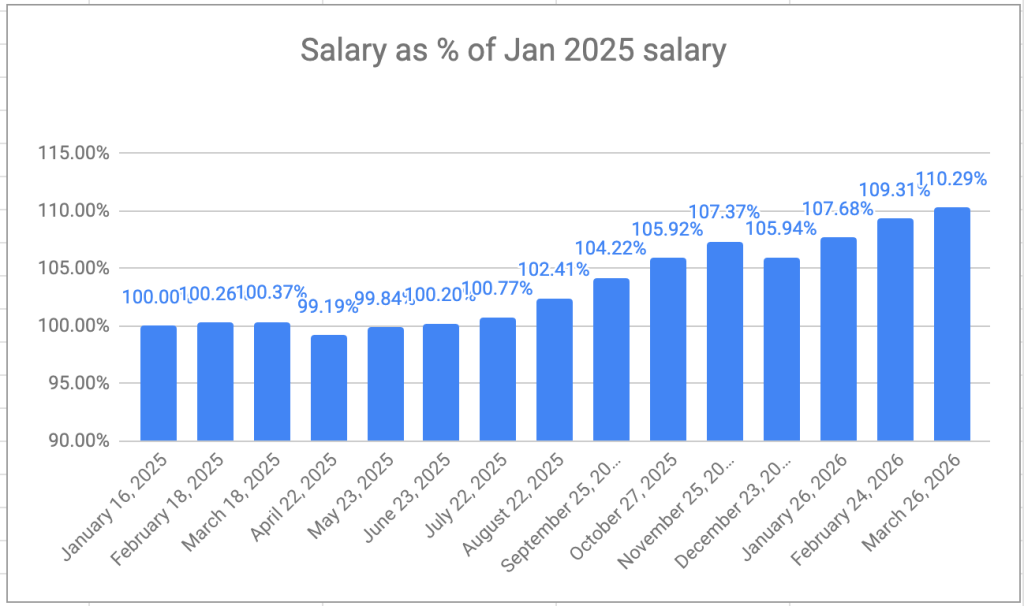
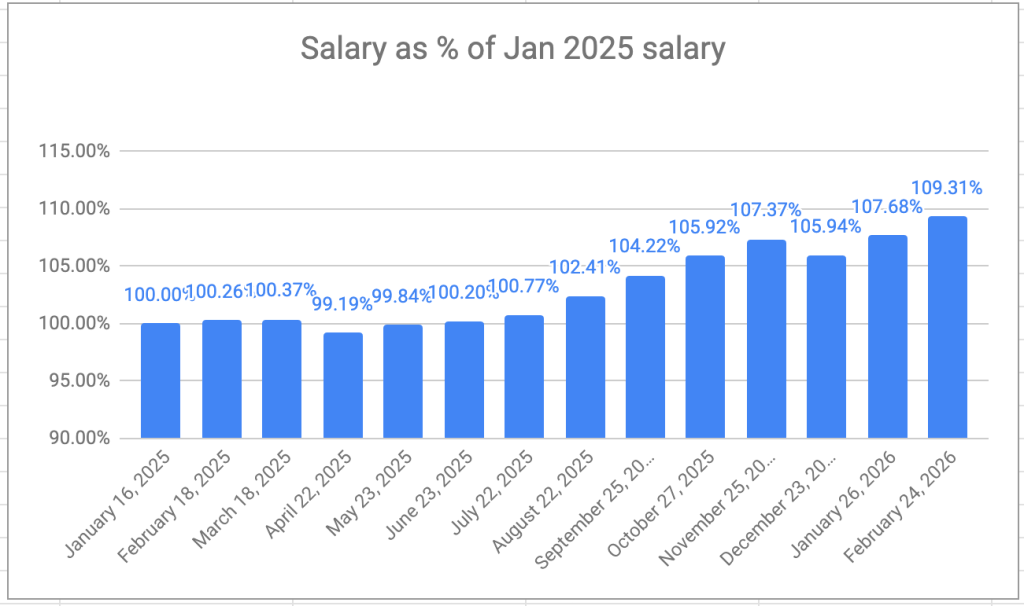
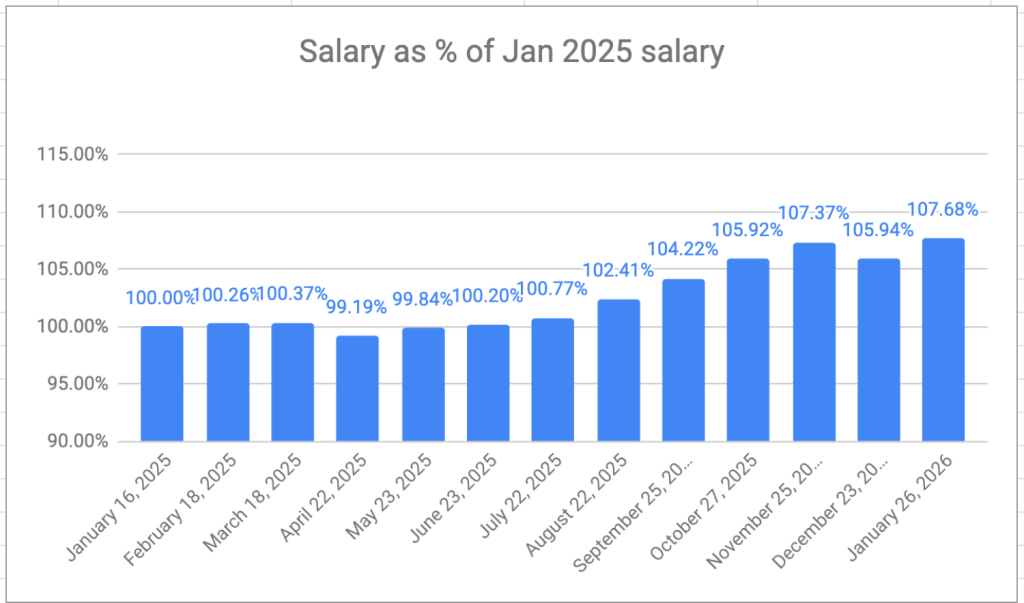
My VPW-calculated salary resumed its upward trend, also hitting an all-time high.

My QTrade RRIFs should move perhaps this week, but I’m no longer confident about that. More on that once resolved.

  1. Which, in my mind, are equivalent. This post goes in lots more detail. ↩︎
  2. I had to do some quick manual calculations because I had already updated my auto-calculating spreadsheet to reflect fewer RRIF accounts. My RRIF transfers are 2 months in progress and counting. I guess trying to move a RRIF near the end of the year was a bad idea. ↩︎

Portfolio Optimization In Practice

My retirement portfolio is spread across multiple brokers and multiple accounts. And although I treat the portfolio as a unified entity when it comes to asset allocation (the concept is discussed here), different accounts have different allocations. The reasons are varied, but I would rank inertia as one of the big contributors — sticking with what’s there seems like a lot less effort than the other options.

What I think in important to point out is that the portfolio is still dealing with inflows and outflows every single month:

  • I pay myself RRIF minimum from my RRIF accounts, and this usually means selling some shares of XGRO
  • If RRIF minimum isn’t sufficient for my expenses (and it hasn’t been), then I have to liquidate shares from my non-registered account.
  • I contribute to our TFSAs every month
  • Questrade gives me free money every month as a reward for shifting assets their way (see how I did it here). This money shows up in my non-registered accounts1.
  • Dividends show up every month2; every quarter there is an even bigger distribution
  • And quarterly I convert some of my AOA holdings to XGRO within my RRIF using Norbert’s Gambit3. When I do this, it reduces my US and international equity holdings and replaces it with Canadian equity4.

So given all these ins and outs, there are always opportunities to tweak the asset allocations so that they remain close to my targets.

The targets, as always, are unchanged:

  • 5% Cash (mostly ultra short-term bonds)
  • 15% bonds
  • 20% Canadian Equity
  • 36% US Equity
  • 24% International Equity

Last week, a reader’s question (please send questions or comments to comments@moneyengineer.ca) led me to take a different look at what was in each of my retirement accounts (RRIFs, TFSAs, non-registered), and this week I acted on correcting a flaw in the way the accounts were structured.

The reader was actually asking about foreign withholding tax implications since the rules are different depending on whether the asset is held in non-registered, TFSA or RRIF but after spending a lot of time looking at it, I decided that, from a tax perspective, the portfolio was actually in reasonable shape. (If you want to dive into this yourself5, you can read https://www.finiki.org/wiki/Foreign_withholding_taxes and https://pwlcapital.com/wp-content/uploads/2024/08/2017-12_Ben-Felix_WP_Asset-Location-Uncertainty.pdf).

But this study did make me realize that the small allocation I had of bonds in my TFSA was wrong-headed. Since in my planning the TFSA is the LAST place I’ll head to fund my retirement, it follows that it should have the longest-timeline investments. So, for me, that means 100% equity is the correct allocation for the TFSA accounts. So what did I do?

  • I sold the bonds in my TFSA (XSH was the ETF), and put them in my RRIF (choosing instead to use XCB, a longer-duration corporate bond fund)
  • Of course, since you can’t add money to a RRIF, something had to be sold there. XGRO was plentiful, so that’s how I funded the bond purchase. From an asset allocation perspective, selling XGRO meant that I reduced my Canadian, International and US Equity exposure at the same time.
  • To compensate, the cash I generated in my TFSA by selling XSH was used to buy a combination of XIC (Canadian Equity) and XAW (US and International equity combined). XIC was already in the TFSA6. XAW is new but gives back the US Equity and International Equity I lost by selling XGRO7.

This is how the two accounts break down now, both from an ETF and an asset-allocation perspective. (In the asset allocation charts “Income” is the nomenclature I use for “bonds” and “Cash” means actual money as well as ultra-short-term bond funds like ICSH and ZMMK).

The result is my TFSA is now 100% equity, and the lower-growth cash-generating bonds are now all in my RRIF accounts. More efficient all around!

  1. Leaving the free money as part of the retirement portfolio was a conscious decision. I could have just as easily decided to withdraw the money every month. ↩︎
  2. Both ZMMK and ICSH pay monthly. They are both featured in my ETF all-stars. ↩︎
  3. You can read about it here. ↩︎
  4. AOA is 50% US equity, 28% International equity. XGRO is 36% US Equity, 24% International Equity. ↩︎
  5. It’s not a straightforward topic. In the end, the foreign withholding tax isn’t huge but as a cheapskate, it’s noticeable and can be higher than MERs of the ETFs you hold. ↩︎
  6. XIC helps tilt the overall Canadian equity allocations in the right direction. AOA tilts it in the wrong direction. ↩︎
  7. The current numbers don’t allow me to use an XEQT/XIC combination. Over time, this will change. ↩︎

Top Five Money Engineer posts of 2025

The Money Engineer launched in January 2025 and according to the WordPress stats, I made 144 posts last year. What were the most viewed posts of 2025?

5th-ranked post of 2025: ZGRO versus ZGRO.T

I got wind of ZGRO.T through Reddit, specifically r/CanadianInvestor. ZGRO and ZGRO.T are both all-in-one asset allocation ETFs from BMO, but with vastly different yield characteristics. I was confused, but in the end, decided that ZGRO.T was probably not a bad pick for use in a RRIF account as it might save you the hassle of selling shares. Their TOTAL returns (assuming all dividends are invested) are effectively identical.

4th-ranked post of 2025: Spousal RRIF Attribution Rules

I think I was first warned about this nuance of spousal RRSPs/RRIFs by my DIY neighbour (thanks, Steve) and is the main reason I’m only drawing RRIF minimum for the next two years1. I think most of the visits to this article were search-driven. Either that, or people came to admire what might be my favourite article thumbnail2 I’ve posted thus far.

3rd-ranked post of 2025: Norbert’s Gambit with Questrade

As someone who holds more USD-denominated assets than might be wise, I do very much appreciate the existence of a cheapskate way of converting between USD and CAD assets. I think I first learned about this trick via The Loonie Doctor’s blog. The #3 blog entry explains how it works if Questrade is your broker. I would also recommend https://moneyengineer.ca/2025/08/21/tracking-norberts-gambit-costs-with-questrade/ for a very clear picture of what it actually costs (in time and fees) to execute the Gambit: in three of four instances, the time delay of executing the gambit has worked in my favor as the FX rate has drifted a bit to my advantage.

2nd-ranked post of 2025: TD versus iShares all-in-ones

I’m a fan of all-in-ones (and am a little sad https://moneyengineer.ca/2025/01/21/why-you-can-fire-your-advisor-asset-allocation-etfs/ didn’t crack the top five last year). I am genuinely puzzled why people seem to get so wound up about which family of all-in-ones to choose3. I examined TD’s only because their cost to own is a bit cheaper than iShares (who I use primarily), and I’m a cheapskate. (I studied the cost of owning an all-in-one here.) Anyway, in the end, the biggest difference is visible in TGRO versus XGRO because TGRO, unlike any other GRO ETF, uses 10% bond allocation and not 20%. This gooses its return a bit, at the cost of additional volatility. Otherwise, it’s a case of tomato/tomahto. Pick one, or pick them all, it doesn’t matter much.

Top ranked post of 2025: Mini-Review of Optiml.ca

This was, as the title implied, a quick review of a made-in-Canada tool to help craft a retirement plan. And again, my DIY neighbour gave me a heads-up about it4. It got a lot of interest, probably because the kind folks at Optiml linked to my review from their website ;-). I was impressed by the completeness of the tool during my test drive, and it seems like a good and fairly priced way for a DIYer to do some validation of their retirement plan. Having validation of my plan was one of the ways I knew I could retire.

Looking forward to seeing what the 2026 list might look like! Got a topic or question? Send it along to comments@moneyengineer.ca, or comment below!

  1. RRIF minimum withdrawals are never subject to spousal attribution ↩︎
  2. Courtesy Pexels free photos, built into WordPress’ editor. ↩︎
  3. iShares, TD, BMO, Vanguard, Global X…. ↩︎
  4. Thinking he should write his own blog, maybe. ↩︎