
RRIF, TFSA, non-Registered…what do you do with each?

My retirement fund is divided amongst a bunch of different accounts: RRIFs, TFSAs, non-registered. And although I present them as a monolith in my monthly updates (latest one here), I don’t treat them the same way and they have rather different things inside them.

I don’t claim to have a fully optimized portfolio; a thoughtful reader was asking me questions about tax implications of my current holdings, and I admittedly haven’t given a ton of thought to that. But I will in a future post 🙂 .

So, in other words, you’re getting my current thinking for what I hold where. It may not be ideal. But at least you see why things are the way they are.

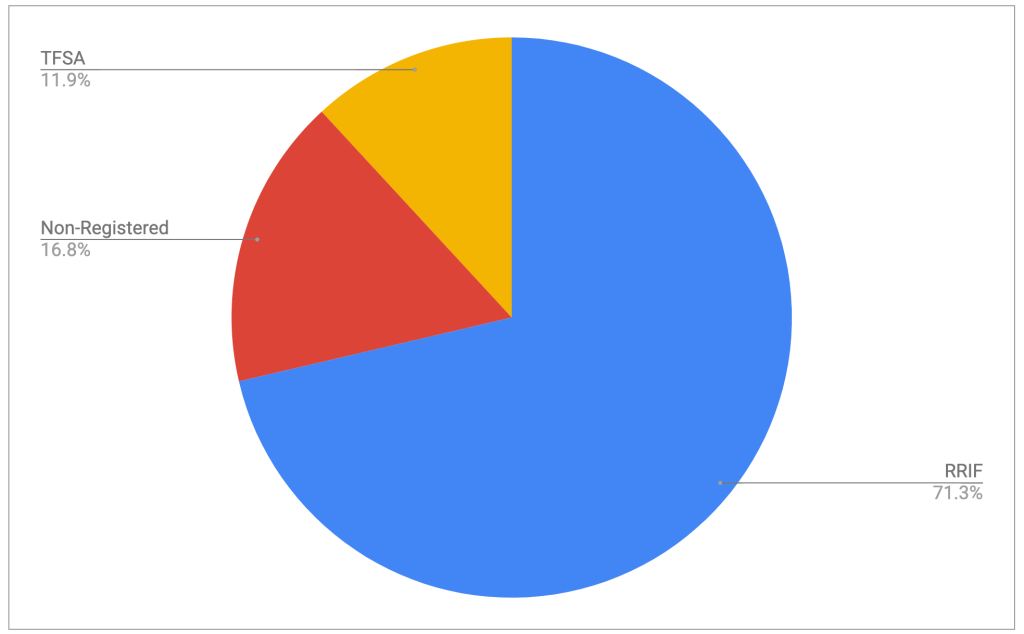
Below you can see how my retirement funds are divided amongst my various investment vehicles. This one is accurate as of January 8, 2026, and is greatly facilitated by tracking my stuff in Google Sheets. There’s a basic template of what I use over here1.

Retirement portfolio, divided by account type, January 2026

So that’s where it’s at. How do I treat the three main segments of the pie?

RRIF

So the RRIF is clearly the largest piece of the retirement pie and will be around for some time, possibly for the rest of my life. At this point in time, I’m only taking RRIF minimum payments which are recalculated every year and are based on my age and the value of my RRIF on December 31 of the previous year.

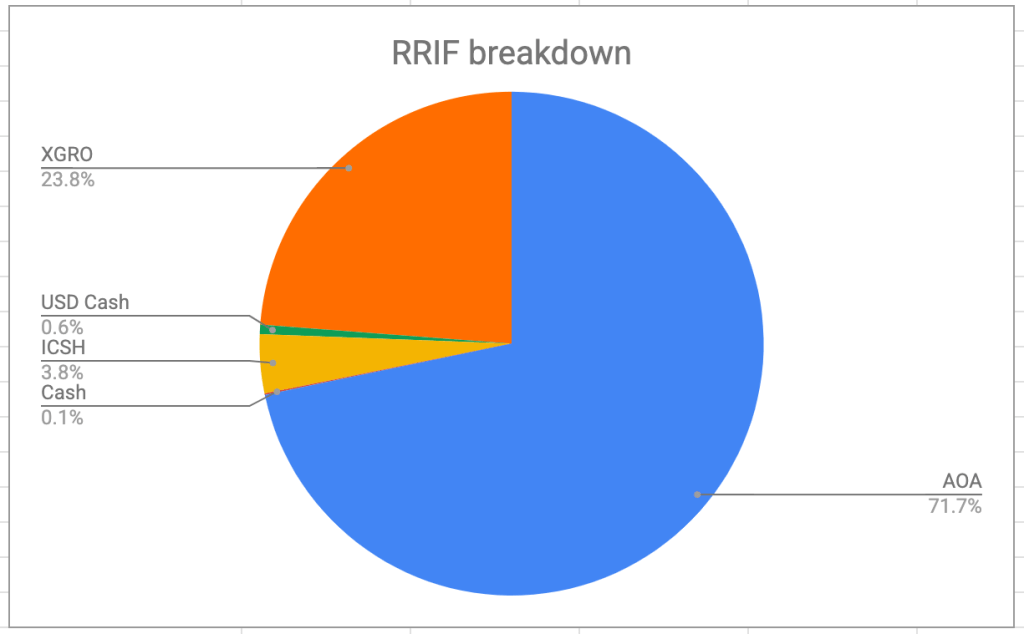
I am taking RRIF minimum primarily because I want to avoid the hassle of spousal RRSP/RRIF attribution that I talk about here. RRIF minimum is quite a bit less than the expected return of this account given the holdings therein, mostly AOA and XGRO:

I periodically (once a quarter) shift funds from AOA to XGRO using Norbert’s Gambit2. How much? Well, at the beginning of the year, I see how much of my RRIF is in USD. I then multiply that by my RRIF age factor3, divide by four, and presto, I have a quarterly amount I should move.

All of my many RRIF accounts4 have XGRO, and on the day I make my payday calculations, I have a spreadsheet that calculates how many shares of XGRO I need to sell in each account given the current price of XGRO and the amount of CAD happens to be kicking around in a given account. In very rare circumstances, I might (as well/instead) sell AOA if I had a need for US cash5.

The small contribution of ICSH here is because I have a 5% “cash” asset allocation in my portfolio, and I needed someplace to keep this monthly income. RRIF seems as good a place as any, especially since all those monthly dividends are completely tax-free as a result.

In the coming years, the RRIF will take on more and more of my monthly spending needs. Once the attribution time period has lapsed, I’ll probably take more than RRIF minimum from here in an effort to reduce taxes for older me — once I start collecting CPP/OAS as well as RRIF payments, I could find myself in a taxation world of hurt. Making my RRIF smaller will help, but there is no free lunch. You either pay taxes while you’re alive, or your estate will pay them when you’re not.

Non-Registered Accounts

I really have two kinds of non-registered accounts in my retirement calculations, and they have very distinct usages. Let’s see the difference:

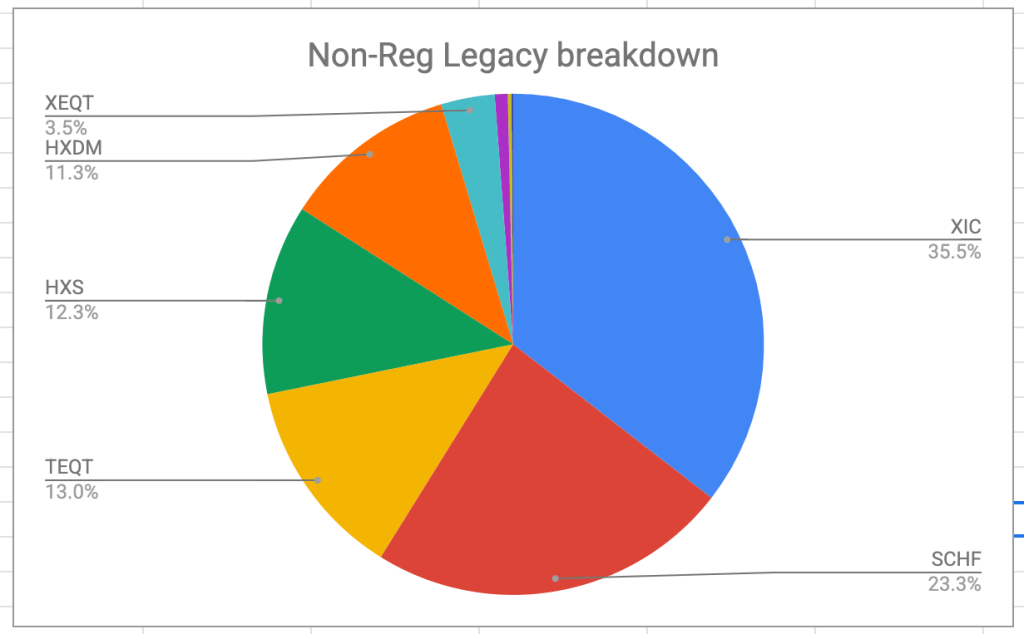
The “legacy” non-registered accounts are long-standing accounts that have grown over the years of accumulation. They are held in my name and my spouse’s name and taxed accordingly. These accounts, specifically the one in my name, account for probably 2/3 of my current income. Every time I withdraw from these accounts, I have to account for capital gains, which is fine, since the taxation treatment of capital gains is generous. You’ll also notice that this account is 100% equity. And as previously noted, the dividends thrown off these investments is not particularly noteworthy (not zero, but nothing a dividend-focused investor would get excited about). That’s why you see funds like HXDM and HXS here, to explicitly avoid dividends. This portion of my non-registered funds is targeted to eventually go to zero in the next few years, probably before I start collecting CPP. That’s a tax avoidance strategy, no idea if it will work out in my favour.

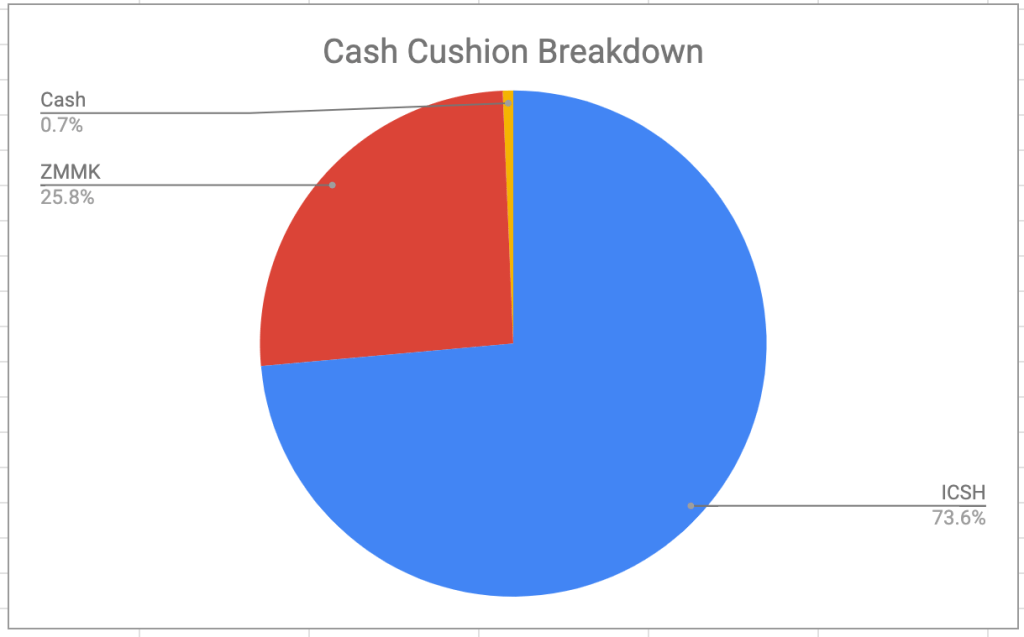
The “cash cushion” non-registered holdings are 100% in ultra-short term bond funds, which to my way of thinking, is equivalent to cash. This account exists because I use VPW as a decumulation strategy, and the cash cushion helps smooth out my monthly salary. Sometimes I add to the cash cushion (directly from my other non-registered account) and sometimes I pay myself from the cash cushion. You can read all about how it works at The Mechanics of Getting Paid in Retirement. Here I keep a bit of uninvested cash floating around in an effort to reduce the number of buys/sells I have to do here. The capital gains are quite minimal in these funds since both ICSH and ZMMK stay close to $50/share6 but it’s possible to make minor gains/losses7 depending on the exchange rate and day of month I make the purchase/sale.

TFSA

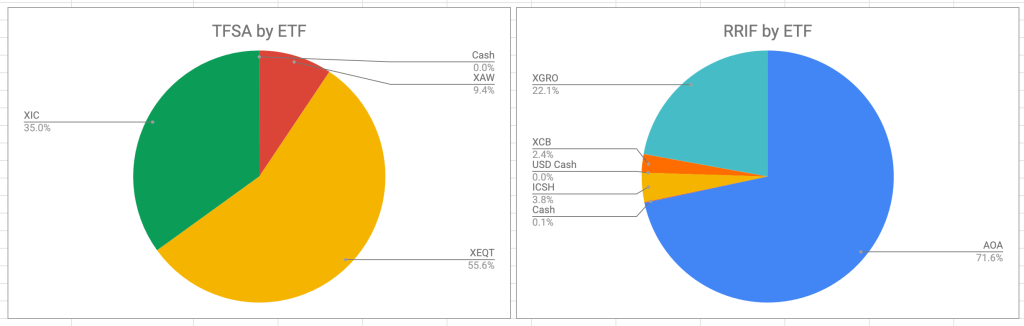
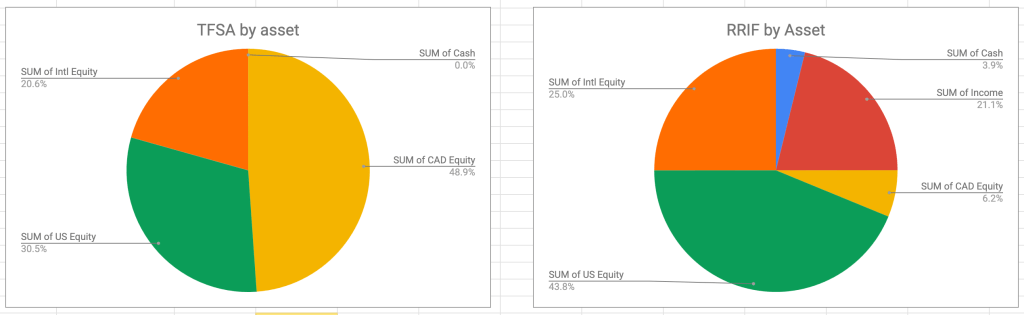
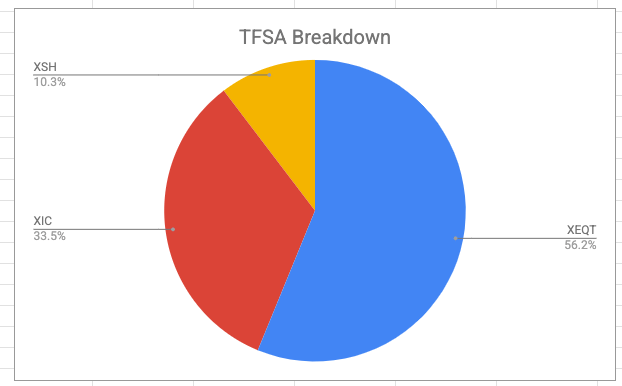
The TFSA, per the plan prepared for me by my fee-based advisor, (part of the steps I took to figure out that I had enough to retire) is the last account to decumulate. I continue to contribute to my TFSA monthly, like I have ever since TFSAs were a thing. That would be an “expense” I could cut if needed, I suppose. It tilts heavily towards equities8:

Besides XEQT, you currently see XSH, a bond fund9. This exists in order to keep my target asset allocations in line, and because I don’t really want the monthly distributions landing in a taxable account. Perhaps that holding would be better in my RRIF? There’s also XIC here, which is a Canadian equity fund, necessary to offset the heavy US equity contribution made by AOA.

  1. Over the holidays I’ve started on a new template that makes heavy use of pivot tables, which I do like quite a bit. â†Šī¸Ž
  2. You can track my progress over at Tracking Norbert’s Gambit Costs with Questrade â†Šī¸Ž
  3. Per https://www.canada.ca/en/revenue-agency/services/tax/businesses/topics/completing-slips-summaries/t4rsp-t4rif-information-returns/payments/chart-prescribed-factors.html, it’s “1 divided by (90 minus my age)” until I turn 70. â†Šī¸Ž
  4. Hopefully in a week or two it will be down to five. â†Šī¸Ž
  5. I do have a USD bank account (via CIBC) and a US credit card (ditto) to avoid FX charges, but my shiny new Rogers Red card also provides sufficient cashback on USD transactions to wipe out the extortionate FX rates charged by credit card companies. â†Šī¸Ž
  6. Reverts to around $50 on its ex-dividend date, late in the calendar month. Except January, where ICSH doesn’t distribute at all, instead distributing twice in December. â†Šī¸Ž
  7. Losses are unlikely because I trade frequently enough to fall under superficial loss rules. Best explanation of how this works at https://www.adjustedcostbase.ca/blog/what-is-the-superficial-loss-rule/ â†Šī¸Ž
  8. Longer timeframe = higher risk acceptable = more equities â†Šī¸Ž
  9. Here is a bit of problem. XSH is a short term bond fund; by rights, this should be a long term bond fund since the timeline of the investment is longer. Sigh. I picked this one because (a) it had corporate bonds and (b) it had a very low MER. â†Šī¸Ž

Isn’t Yield Important in Retirement?

I had an email from a reader this week (via comments@moneyengineer.ca, I read all the email I get) who was curious about the yield of my retirement portfolio. It occurred to me I haven’t really talked much about this topic, so thanks for the inspiration 🙂

A very common approach for retirement investing is to build a portfolio based on high-quality dividend-paying companies. The best example I can think of is the long-standing “Yield Hog” portfolio written about by the Globe and Mail’s John Heinzl. He updated readers at the end of 2025.

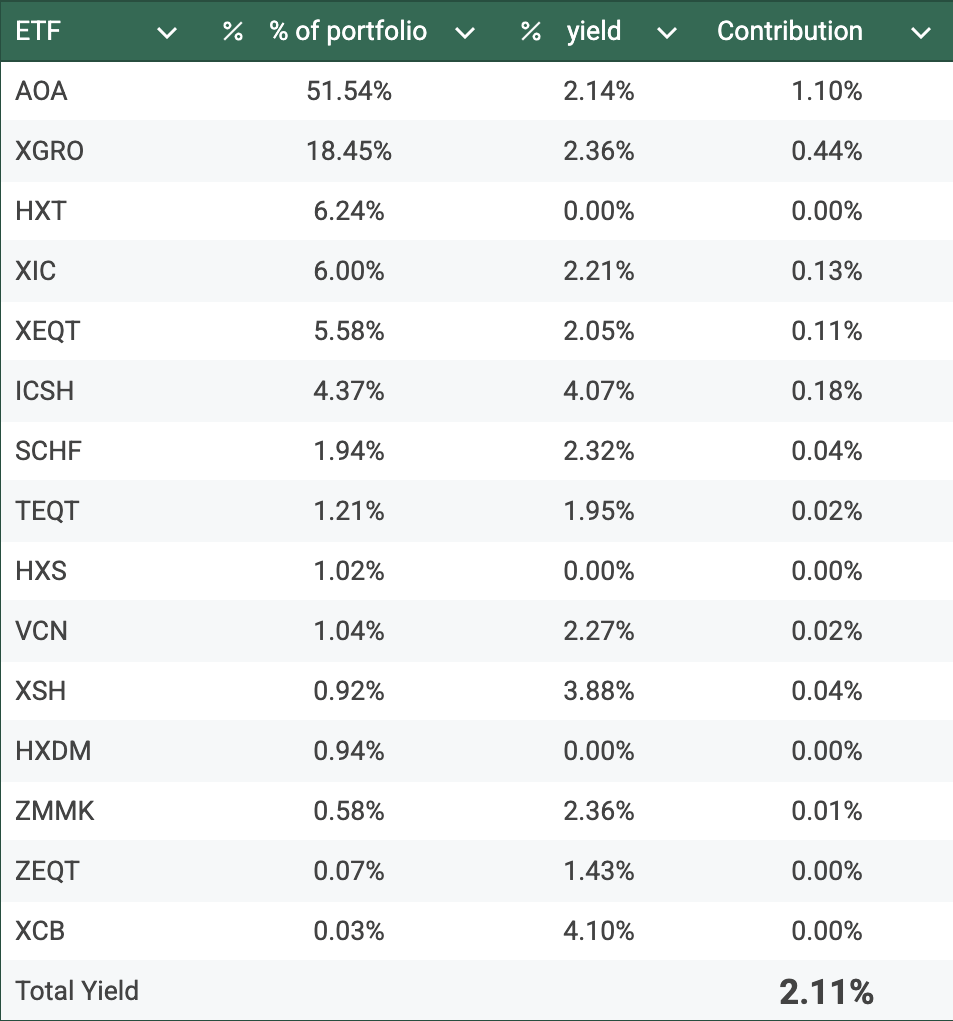
So, using the ETF fact sheets1 and my current holdings, I give you the overall yield2 of my retirement portfolio:

    So the overall yield is just a little north of 2%. For a divided investor, this would seem alarmingly tiny.

    If building an income stream from this portfolio was your objective, you’d either have to have a lot of capital, or very modest income needs, as this portfolio is only generating about $20k in dividends for every $1M invested.

    For me, I’m perfectly happy to dip into capital (i.e. sell ETF units) to fund my retirement. The overall growth of the portfolio is my only consideration, and whether that is in the form of dividends (which, in my portfolio, are always reinvested3) or capital appreciation (i.e. the price of the ETF increases) is irrelevant to me.

    Is it possible to build a dividend-focused portfolio just based on ETFs? Sure. But here I do offer a word of caution. The ETF providers out there have learned how to structure products with spectacular-looking yields that either use leverage (and are hence inherently more risky) or boost their yields by using RoC and giving you back some of your own money. So looking at yield numbers alone without understanding what’s inside the ETF is not a good idea. I took a look at one reasonable product (ZGRO.T) in a previous article.

    The Globe has been my go-to trusted source for such things for a long time; they have annually updated ETF lists in various categories, including dividend ETFs. One that jumps out for me on this list due to its very low cost to own4 (which is something I’m a bit fanatical about, admittedly) is XDIV.

    XDIV’s current yield is 3.93%, and holds large Canadian companies like TD, Royal Bank, Manulife, Sun Life, Suncor Energy, Power Corp…In total it holds only 21 companies, with never more than 10% invested in any one company5.

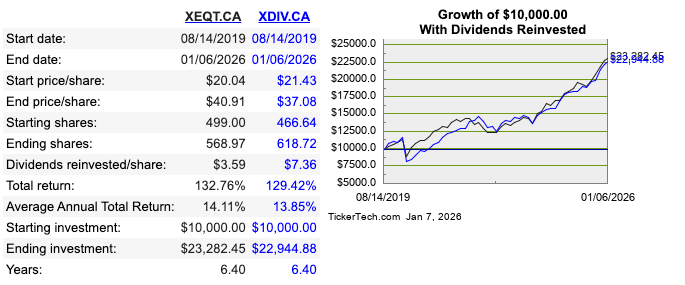
    Just for fun, I did a head-to-head comparison of XDIV versus XEQT using this calculator that is featured in Tools I Use. I chose XEQT even though it’s a smaller portion of my portfolio than XGRO, but is a better stand-in since XGRO holds bonds.

    So here it’s practically a tie. If you reinvested all the dividends for both ETFs, XEQT would have generated about $300 more on an initial investment of $10000 in August 2019.

    But is that really a good comparison? XEQT and XDIV are pretty different:

    • XEQT adds extra fees because it rebalances automatically between its different geographical holdings
    • XEQT invests globally; XDIV is limited to Canada only.

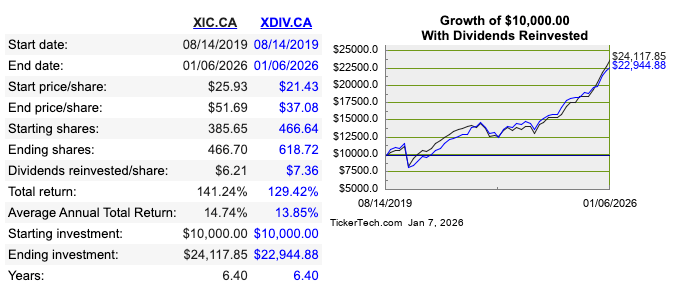
    What if I instead chose to compare the Canadian portion of XEQT to XDIV? (I broke down what’s inside these all-in-ones in a previous article: Under the hood of XEQT et al). XEQT’s Canadian portion is XIC, an ETF that tracks the entire TSX (219 stocks), so let’s run the numbers again over the same time period:

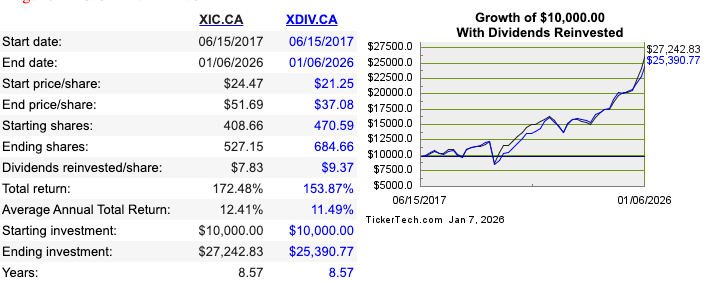
    Here the gap is more noticeable: XIC outperforms by about $1200 in the same time period, assuming all dividends are reinvested. Now, of course, you can see that sometimes XDIV was ahead during this period. I cranked up the timeframe to as far back as I could to see what the results were:

    Adding two more years of retrospective increased the gap by another $800, which is about a 1% per year return advantage to XIC.

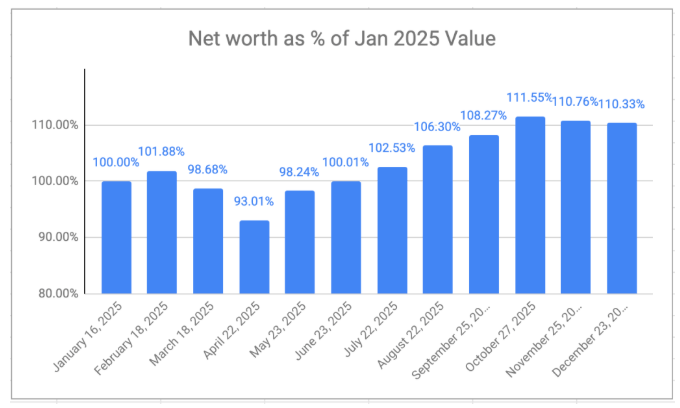
    Now of course, you could find counter examples I suppose. But if capital preservation isn’t a concern6, then these results tell me that dividends needn’t be a concern in retirement. Even with my anemic yield stats, my net worth increased in 2025 even accounting for getting paid every month (chart from my latest What’s in My Retirement Portfolio):

    Every month, I sell XGRO shares to fund my RRIF payments. Every month, I sell some non-registered assets to cover the rest of my salary. The TFSA gets a monthly contribution. Selling shares isn’t bad — as long as those that remain keep growing, I can keep spending7!

    1. TEQT isn’t publishing a yield, so I made an attempt to calculate it based on the Dec 31 distribution. This seems a bit lazy on TD’s part: I get that it’s a new ETF, and 12 months of data isn’t available yet, so you can’t show a trailing yield, but you CAN show the forward looking yield based on the most recent distribution. Banks. Sigh. â†Šī¸Ž
    2. A weighted average. You may wonder about HXS/HXDM — these are “corporate class” ETFs that by design do not make distributions and instead use accounting tricks to bury that growth inside the ETF price. It’s something I use in my non-registered accounts. â†Šī¸Ž
    3. Either automatically via DRIP or through my own purchases; it’s a bit of a mix at the moment. â†Šī¸Ž
    4. A MER of 0.11%, a bargain for this sort of ETF. â†Šī¸Ž
    5. Otherwise, its tracking index (MSCI Canada High Dividend Yield 10% Security Capped Index) has a TERRIBLE name. â†Šī¸Ž
    6. For me, it isn’t. I’m not looking to leave a large estate. Die with zero! â†Šī¸Ž
    7. And if they shrink, so does my spending. That’s the VPW way. â†Šī¸Ž

    Retirement Portfolio Annual Review

    Happy New Year! A new year means it’s a good time to take a look at what went on in the retirement portfolio.

    Let’s start by comparing the makeup of my portfolio at the beginning of the year versus my last update:

    PositionJanuary 2025December 2025Notes
    AOA: USD 80/2052.2%51.3%Used for RRIF payments1
    XGRO: CAD 80/2020.2%18.6%Used for RRIF payments
    ICSH: USD short term bond0%4.4%Cash cushion, plus additional “cash” inside RRIF2
    ZMMK: CAD short term bond0%0.6%Cash cushion CAD funds
    SCHF: International Equity2.8%1.9%Used for monthly salary; held only in non-registered
    XEQT: CAD 100% Equity0%6.5%Mostly in TFSA
    HXT: CAD Equity7.4%6.3%Used for monthly salary; held only in non-registered
    XIC: CAD Equity5.3%6.1%Did not add or subtract from this holding this year
    DYN6005: USD HISA3.7%0%Replaced by ICSH
    DYN6004: CAD HISA2.6%0%Replaced by ZMMK
    HXS: USD Equity2%0%Sold off from non-registered accounts to fund monthly expenses
    VCN: CAD Equity1.8%1.1%In TFSA; reduced in favour of XEQT

    What didn’t change much

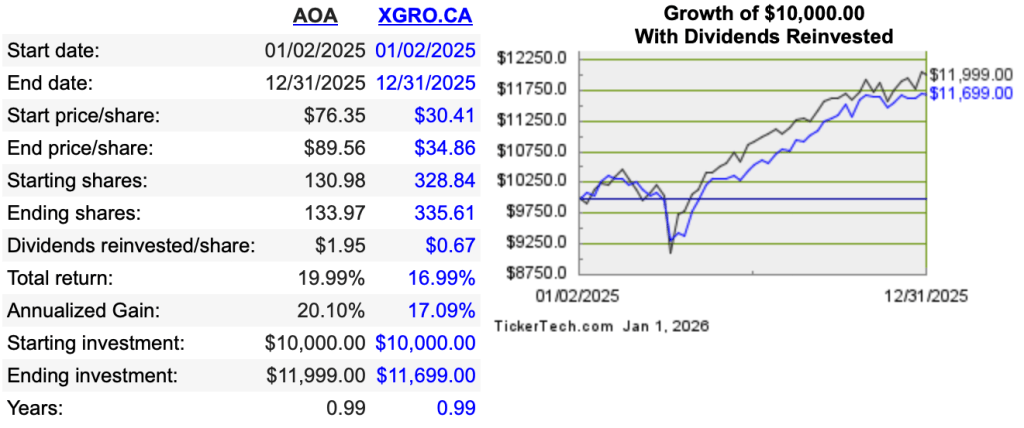
    The portfolio is still dominated by XGRO and AOA (not coincidentally, these are two of my ETF All-Stars) and they both had excellent years, as shown by this tool:

    What also didn’t change is my overall approach: decisions for shifting funds is totally dependent on maintaining my asset allocations that haven’t changed either:

    • 5% in cash or “cash like” holdings
    • 15% in bonds
    • 20% in Canadian Equity
    • 36% in US Equity
    • 24% in International Equity

    This approach meant that what I sold off in my non-registered portfolio to fund my day to day expenses changed throughout the year; as the year progressed I sold HXDM, then HXS (reducing this to zero), and then finally HXT, all in the service of keeping my assets in line with my targets.

    What did change

    As a result of changing brokers (QTrade to Questrade), I lost the ability to cheaply hold HISAs. And so I had to change tactics and hold “HISA-like” ETFs instead. (which, on Questrade, like all ETFs, can be bought and sold at no charge). At the same time, I realized that I could increase my returns by shifting more to the US market. Significantly higher interest rates in the US means that I can get more for my “safe” funds, with the small annoyance that I have to deal with USD. You can see the latest rates on my frequently updated page.

    As I sold off “pure” equity funds from my non-registered accounts, I had to make changes to keep my bond percentages aligned with my targets3. This is the reason XEQT (a global 100% equity fund) now makes an appearance in the overall picture. The nice side-effect of adding XEQT is that my portfolio is now 76% held in all-in-one funds, up about 4% from the beginning of the year. All-in-ones do the rebalancing for you, which is a good way to avoid bad behaviours.

    Behind the scenes I also tried to better focus each of the account types to make things simpler and clearer:

    • TFSAs are now 90% equity, with the rest held in bonds. The rationale here is that TFSAs will be the last things I touch to fund retirement, and hence have the longest time horizon. There are still too many individual ETFs here, and my January resolution is to simplify this further.
    • RRIFs now have only three funds: AOA, XGRO and ICSH.
    • Investment accounts will remain a bit chaotic as most of my retirement expenses are coming out of these. It also happens to be the place where my “free money” payments end up and so there is a small amount of inbound cash to purchase things with. The 2026 plan is to continue to draw down my non-registered funds since my spouse is still working and would be taxed higher on her capital gains.

    What’s ahead in 2026: RRIF

    My own calculations4 show that my household RRIF-minimum income will be up 19% YoY, a result of good returns in the RRIF (roughly 11% YoY by my calculation) and being a year older. Selling XGRO every month will cover the required payments, and quarterly I will shift a portion of AOA into XGRO, converting the USD to CAD using Norbert’s Gambit.

    What’s ahead in 2026: TFSA

    January will see an effort to reduce the number of ETFs here. There are multiple CAD equity ETFs which I should consolidate into one, for instance.

    We continue to contribute monthly to the TFSAs. The goal is to maximize equity percentage while minimizing the number of funds held. Once the cleanup is done, I expect to purchase XEQT monthly. Questrade introduced automated investing which I’ll likely set up to accomplish this.

    What’s ahead in 2026: Non-Registered Accounts

    The same strategy as 2025 will continue. Shortfalls in my monthly salary will be covered by selling assets in the non-registered accounts. I ended last year up 2% YoY in my non-registered accounts; I don’t really expect a repeat there. All things being equal, I should be down in my non-registered accounts at this time next year.

    1. Indirectly. I haven’t tried to do a USD withdrawal for a RRIF payment, but in theory it should be possible. Instead I convert my AOA into XGRO a little at a time using Norbert’s Gambit. â†Šī¸Ž
    2. My VPW cash cushion is about 50% of my cash position in the retirement portfolio. The other 50% of my cash position is inside the RRIF in order to avoid taxation on those monthly distributions. â†Šī¸Ž
    3. AOA and XGRO are both 20% bonds, not 15%, and so mathematically this has to be offset with 100% equity somewhere in the portfolio. â†Šī¸Ž
    4. My providers will give me the real numbers sometime in the coming weeks. How much hassle this will be is TBD. â†Šī¸Ž

    What’s in my retirement portfolio (Dec 2025)?

    This is a monthly look at what’s in my retirement portfolio. The original post is here.

    Portfolio Construction

    The retirement portfolio is spread across a bunch of accounts:

    • 6 RRIF accounts (2 for me, 3 for my spouse, 1 for me at an alternative provider as a test)
    • 2 TFSA accounts
    • 4 non-registered accounts, (1 for me, 1 for my spouse, 2 joint)

    The target for the overall portfolio is unchanged:

    • 80% equity, spread across Canadian, US and global markets for maximum diversification
    • 15% Bond funds, from a variety of Canadian, US and global markets
    • 5% cash, held in savings-like ETFs.

    You can read about my asset-allocation approach to investing over here.

    The view post-payday

    I pay myself monthly in retirement, so that’s a good trigger to update this post. On December 23, this is what it looks like:

    Retirement holdings, December 2025

    The portfolio is dominated by my ETF all-stars; anything not on that page is held in a non-registered account and won’t be fiddled with unless it’s part of my monthly decumulation. Otherwise I’ll rack up capital gains for no real benefit.

    There aren’t really any notable changes this month — AOA’s contribution was down a bit this month, largely due to an unfavourable change in the USD/CAD exchange rate (down about 3% month over month, back down to a level not seen since around May this year). I recalculate the FX rate every month1 since I track my net worth in CAD so I always have an apples-to-apples comparison. I don’t stress too much about the FX rate as it tends to cut both ways. Sometimes it’s a lift to my numbers, sometimes not. In the end, I suppose it all evens out. I tracked my snapshot FX rates starting in February2, just for illustration:

    Monthly USD/CAD rates on payday day

    Plan for the next month

    The asset-class split looks like this

    Retirement portfolio by asset class, December 2025

    It’s looking pretty close to the targets I have, which are unchanged:

    • 5% cash or cash-like holdings like ICSH and ZMMK
    • 15% bonds (almost all are buried in XGRO and AOA)
    • 20% Canadian equity (mostly based on ETFs that mirror the S&P/TSX)
    • 36% US equity (dominated by ETFs that mirror the S&P 500)
    • 24% International equity (mostly, but not exclusively, developed markets)

    The end of the year will mean more distributions from my holdings; in my RRIF accounts they are set to DRIP since I only hold AOA/XGRO/ICSH in these accounts. The rest I redeploy to the asset classes that are short funds; typically this means investing in one of the *EQT funds since the bond complement of the portfolio frequently moves above the 15% target.

    Overall

    Net worth overall is down slightly month over month, but up a little over 10% from the start of the year. Hard to be unhappy about that.

    My VPW-calculated salary took a slight decline, breaking the 7 month growth streak. It ends the year a shade under 6% larger than my first paycheque. Not bad. I don’t recall many years where I got a 6% raise 😉

    Next month will end my relationship with QTrade as I move the final 3 RRIF accounts to Questrade; I had thought December would be the final month, but as you’ll see in my next post, a (hopefully) small wrinkle has delayed this.

    1. Using =googlefinance(“USDCAD”) of course â†Šī¸Ž
    2. February because I only thought to start tracking that a month in. January’s rate will be lost to the sands of time. Or I could add it back using the official FX rates, I suppose. â†Šī¸Ž

    XEQT, TEQT, VEQT, ZEQT, HEQT Fee Showdown

    Summary: Although iShares(XEQT/XGRO) and Vanguard(VEQT/VGRO) get all the love, the all-in-ones from BMO and TD are actually the current winners in the “lowest all-in-one fee award”. Given how similar they are to their competitors, I see no reason not to park money there.

    I’m a fan of all-in-one1 ETFs in my retirement portfolio. If you’re new to the world of all-in-ones, you might want to start here. There’s at least five competing families of products out there, courtesy of iShares (XEQT, XGRO, XBAL et al), TD (TEQT, TGRO, TBAL et al), Vanguard(VEQT, VGRO, VBAL et al) BMO(ZEQT, ZGRO, ZBAL et al) and GlobalX2 (HEQT, HGRO, HBAL et al). We’ve taken a look at some of them “under the hood”, so to speak, but didn’t really find super-significant differences.

    One facet I haven’t looked at yet is the fees each of these companies charge. As I’ve shown elsewhere, small differences can add up if you have significant investments or are holding them for a significant time.

    With the news that iShares is reducing their management fees, (BMO did earlier this year) I figured it was time to do a head-to-head fee comparison for the four major families.

    Here you have it:

    CompanyRelevant TickersManagement Fee3
    iSharesXEQT, XGRO, XBAL et al0.17%, effective Dec 18, 2025
    VanguardVEQT, VGRO, VBAL et al0.17%
    TDTEQT, TGRO,TBAL et al0.15%
    BMOZEQT, ZGRO, ZBAL et al0.15%
    Global XHEQT, HGRO, HBAL et al0.18%

    TD and BMO are the low fee winners at the moment, but the gap has narrowed significantly from earlier in the year. I like low fees, and so I’ve started to invest in these families.

    1. Technically called “asset allocation” ETFs, which is good, since asset allocation is how I view my own portfolio. â†Šī¸Ž
    2. Formerly known as Horizons, which explains the stock tickers used here. â†Šī¸Ž
    3. Most of the time I use MER (Management Expense Ratio) to report on fees, but since a few of these companies have lowered their Management fees this year, and since MER is only calculated annually, the MER values only become relevant again on Jan 1. They are a few basis points higher than the management fee, but just a few. Most of the cost is buried in the management fee. â†Šī¸Ž