
What’s in my retirement portfolio (May 2025)

This is a (hopefully monthly) look at what’s in my retirement portfolio. The original post is here. Last month’s is here.

Portfolio Construction

The retirement portfolio is spread across a bunch of accounts:

  • 7 RRIF accounts (3 for me, 3 for my spouse, 1 at an alternative provider as a test)
  • 2 TFSA accounts
  • 4 non-registered accounts1, (1 for me, 1 for my spouse, 2 joint)

The target for the overall portfolio is unchanged:

  • 80% equity, spread across Canadian, US and global markets for maximum diversification
  • 15% Bond funds, from a variety of Canadian, US and global markets
  • 5% cash, held in savings-like ETFs.

The view as of this morning

As of this morning, this is what the overall portfolio looks like:

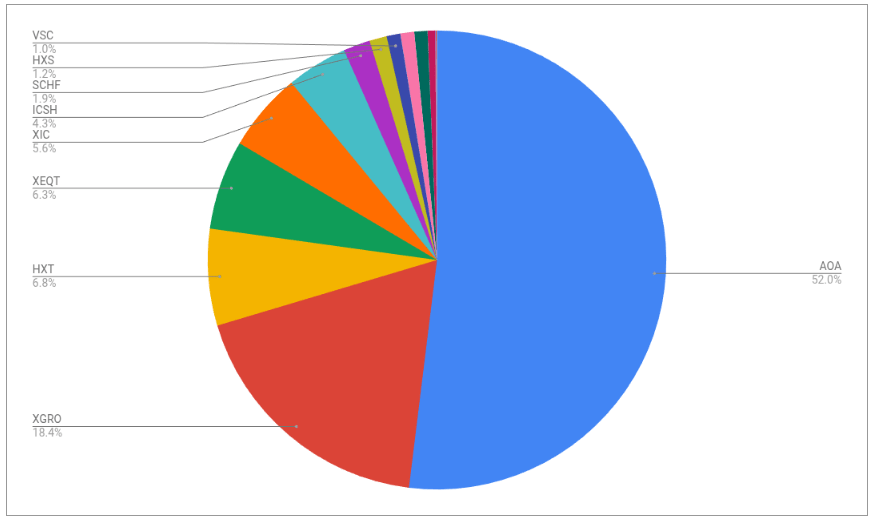
Retirement holdings by ETF, May 2025

The portfolio is dominated by my ETF all-stars; anything not on that page is held in a non-registered account and won’t be fiddled with unless it’s part of my monthly decumulation. Otherwise I’ll rack up capital gains for no real benefit.

The biggest changes were caused by two events that happened over the past 30 days:

  • I did a small rebalancing exercise to reduce my exposure to the Canadian equity market, selling VCN in favor of XEQT. (XEQT is only 23% Canadian equity per dollar invested; VCN was 100%). This sort of rebalancing happens whenever I drift more than 1% off of my target allocations.
  • I took some cash from a HISA and invested it in ZMMK; for reasons too boring to report here, that money was effectively not being tracked in these pages until this month — that anomaly won’t be repeated in subsequent months since ZMMK and ICSH are where I park the “cash” position of my portfolio.

Plan for the next month

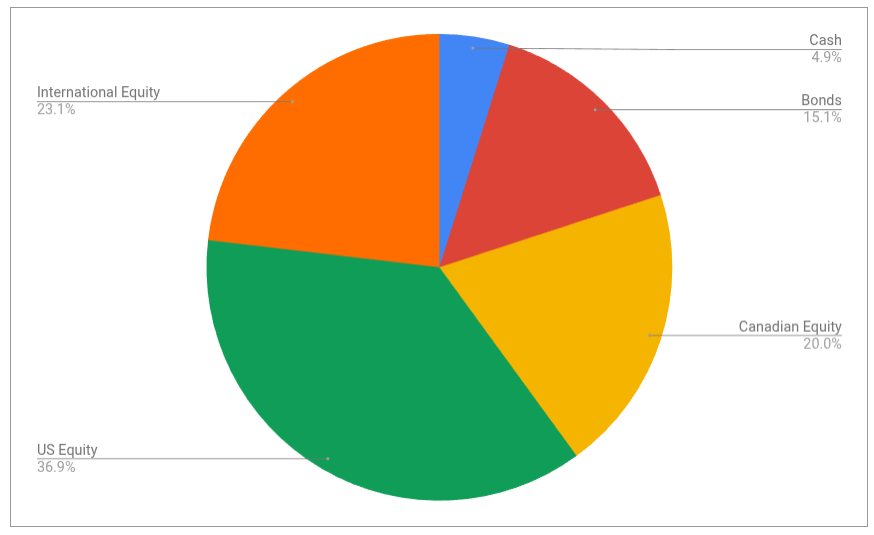
The asset-class split looks like this

This looks to be pretty close to my target percentages which haven’t changed:

  • 5% cash or cash-like holdings like ICSH and ZMMK
  • 15% bonds (almost all are buried in XGRO and AOA)
  • 20% Canadian equity (mostly based on ETFs that mirror the S&P/TSX 60)
  • 36% US equity (dominated by ETFs that mirror the S&P 500, with a small sprinkling of Russell 2000)
  • 24% International equity (mostly, but not exclusively, developed markets)

So, the plan for next month is, do nothing out of the ordinary. Reinvest cash (dividends, TFSA contributions) in one of AOA, XEQT/XGRO, ICSH or ZMMK depending on the asset category most in need on the day of the reinvestment. All these ETFs are covered on my ETF All-Stars page.

One thing I may do is to try to make shifts2 to get a little more return out of my cash position. US interest rates are quite a bit higher than Canadian rates, and so if my cash position is held in USD, I stand to eke a few more points of return there. TBD.

Overall

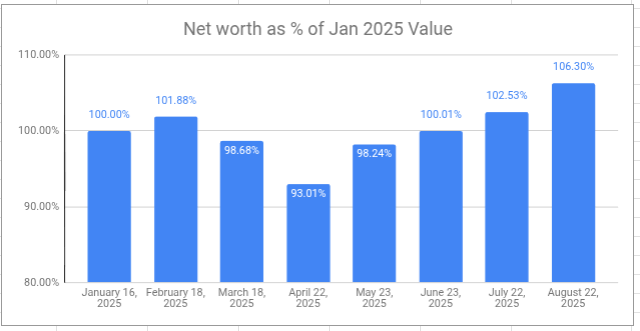
My retirement savings had a nice bounce-back this month, looks like I can cancel the mega-pack of pot noodles I had on order.

Monthly retirement savings, as percentage of Jan 2025 value

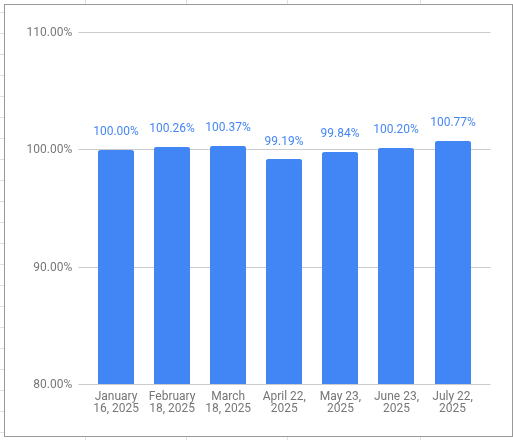
The salary I collect month to month recovered a bit, too, although not as quickly. That’s the magic of using VPW’s cash cushion — neither boom nor bust months translate into large changes in the take-home pay.

Monthly salary, as percentage of Jan 2025 salary

  1. That’s up one from the previous month. In order to collect on Questrade’s transfer bonus, (which they have yet to pay me, they are apparently in a world of hurt on the IT front) you have to have a non-registered account to get paid into. The other 3 are “normal” — one non-registered account for me, one for my spouse, and jointly held one that serves as a cash cushion to smooth out month to month variations in my retirement salary. Read more about that over at https://moneyengineer.ca/2025/01/31/im-retired-now-how-do-i-get-paid/ ↩︎
  2. With Questrade, all ETF trades are free to make, so I don’t have any real reason not to make such changes. ↩︎

What’s the deal with XEQT?

***updated this post to reflect the fact that XEQT has dropped XUS from its portfolio as of July 2, 2025***

This post is inspired by my original on the topic, “What’s the deal with XGRO“? XGRO is great, but since my target asset allocation is only 15% bonds, and XGRO’s bond target is 20%, there’s some tweaking I have to do in order to reduce the bond exposure. That tweak is increasingly being provided by XEQT, part of the same iShares family that produced XGRO.

(As mentioned elsewhere, I rely heavily on all-in-one ETFs in my retirement portolio. New to all-in-ones? Read a bit about them here.)

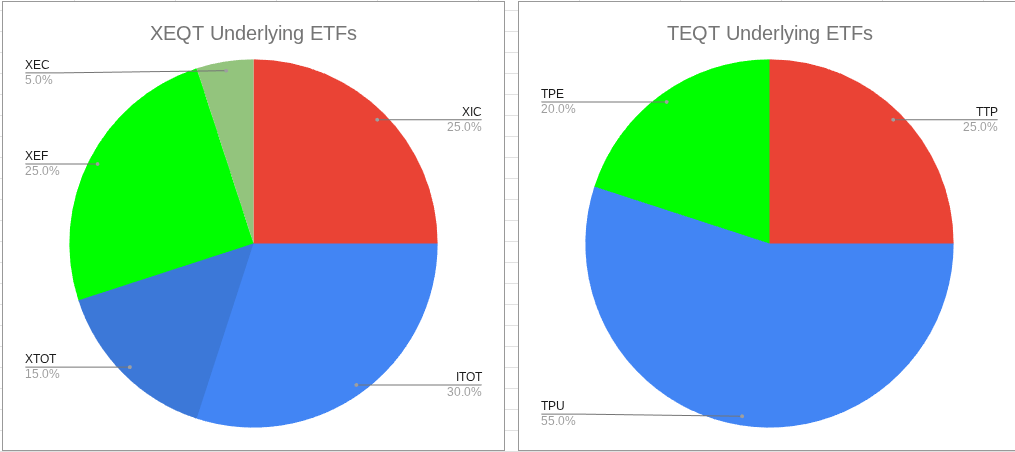
XEQT, like XGRO, is actually investing in thousands1 of different stocks. Unlike XGRO, it does not hold any bonds at all. I thought it would be interesting to see what, exactly, is underneath every $100 you invest in XEQT. See the results below:

FundWhat is it?How much?Compare with XGRO23
ITOT/ XTOT4Broad US stock coverage that tracks the S&P Total Market Index, about 2529 companies (top holdings: Apple, Nvidia, Microsoft, Amazon, Meta)$43.62 of your $100 investment$36.32 of your $100 investment
XEFBroad international (Europe, Asia, Australia) stock coverage that tracks the MSCI EAFE Investable Market Index, about 2500 holdings$25.25 of your $100 investment
$19.76 of your $100 investment
XICBroad Canadian stock coverage that tracks the S&P/TSX Capped Composite Index, about 223 companies (top holdings: RBC, Shopify, TD, Enbridge, Brookfield)$25.71 of your $100 investment
$20.09 of your $100 investment
XEC3000+ emerging market stocks that track the MSCI Emerging Markets Investable Market Index$5.04 of your $100 investment$4.07 of your $100 investment

The top 10 stocks of XEQT as of today looks like this:

TickerCompanyInvestment for every $100
NVDANvidia$2.99
MSFTMicrosoft$2.70
AAPLApple$2.26
RYRoyal Bank$1.67
AMZNAmazon$1.54
SHOPShopify$1.35
TDTD Bank$1.15
METAMeta$1.09
AVGOBroadcom$0.96
ENBEnbridge$0.88
Total$16.59
Top 10 holdings of XEQT as of July 25, 20255

The top stock holding outside North America belongs to Taiwan Semiconductor, at 46 cents for every $100 invested. Additionally, the geographic exposure looks like this:

Geographic exposure of XEQT as of July 25, 2025

One other little tidbit that might be interesting: the distribution yield of XEQT is 2.94% compared with 2.91% for XGRO. This I find a bit surprising, since I would have expected XGRO’s yield to be quite a bit better.

  1. 8,550 to be precise, as of today ↩︎
  2. As of today, might be different from when I wrote https://moneyengineer.ca/2025/01/30/whats-the-deal-with-xgro/ ↩︎
  3. And, if you’re really paying attention, you’ll see that the dollar amounts of this column add up to roughly $80, in keeping with the 80/20 philosophy of XGRO. ↩︎
  4. i lump these together because they hold exactly the same thing. Some loophole that iShares needs to exploit, I gather. ↩︎
  5. On the date I pulled these numbers, cash cracked the top 10 for a holding of $1.34, which is not usual, so I just dropped it. Not sure why that is…perhaps by the end of the month it will resolve itself. ↩︎

Is XEQT shift a reason to be concerned?

Quite a lot of my portfolio is tied up in all-in-ones. My Canadian holdings are dominated by XGRO. (If you’re new to the concept of all-in-ones, you may want to give this a read.) I noted with interest a post this week about how XEQT was shifting investments from ITOT to XUS. In plain English, the post was concerned about XEQT’s US holdings moving from the “total” US stock market (ITOT is a mix of small, medium and large companies) versus the S&P 500 (XUS holds the largest 500 companies in the US.)

Now, I don’t hold a ton of XEQT1 (which is 100% stocks); instead, I prefer to hold XGRO, which up until now, I figured was (in my simple way of thinking about such things) “XEQT, except with 20% in bonds”.

The post made me look to see if the report was accurate2. Sure enough, referring to the “Holdings” section of both ETFs, you can see the difference easily.

TickerNameXEQT WeightXGRO weightXGRO Adjusted Weight
ITOTIShares Core S&P Total US Stock34.35%35.16%43.73%
XEFIShares MSCI EAFE IMI26.33%20.76%25.82%
XICIShares S&P/TSX Capped Composite25.88%20.55%25.56%
XECIShares MSCI Emerging4.97%3.93%4.89%
XUSIShares S&P 5008.28%0%0%

“XGRO adjusted weight” takes into consideration that you can’t just compare the weight of a given equity component since XGRO is roughly 20% bonds. “XGRO Adjusted weight” can be read as “the % contribution of this stock to the equity portion of XGRO”. This allows an apples to apples comparison between XEQT and XGRO.

Clearly, there’s 8.28% that XEQT is investing in the S&P that isn’t in the XGRO portion. So this means that XEQT has a slight bias towards the larger portion of the US stock market over XGRO. I like diversification, so I was mildly concerned that perhaps this wasn’t a good idea. So I did some number crunching by downloading the detailed assets from both of these ETFs.

And this is what I found

Comparing % contribution of the largest US holdings of XGRO and XEQT, April 2025

So while there are some differences in the largest stocks I looked at, there wasn’t a consistent bias towards the large stocks. In fact, the sum of the “difference” column shown here is precisely zero.

But why? Shouldn’t XEQT’s double purchasing of large US stocks (via both ITOT and XUS) result in a bias towards the large US stocks at the expense of smaller US stocks? It should, but right now, at the moment, it doesn’t.

This is because XGRO, at the moment, actually has a slightly larger US bias than XEQT, and both of them are actually below target (as per their reference guide):

Current XEQT US equity weightTarget XEQT US Equity WeightCurrent Adjusted XGRO US equity weightTarget Adjusted XGRO US Equity Weight
42.63%45%43.73%45%

This, I suppose, will wash out in the coming weeks/months as both XGRO and XEQT buy up more US stocks to get closer to their targets. In short, there isn’t anything to worry about in the near term; in the longer term, owning XEQT will probably tilt the US equity bias a bit towards larger stocks, which I’m not too fussed about.

  1. I do have a growing amount here because otherwise I’d have a hard time keeping my bond allocation to the desired 15% of my portfolio. ↩︎
  2. I believe this is called “doing the research”. ↩︎

The Money Engineer now on YouTube

Early on when I first launched this blog, one of my friends suggested that video content would be ideal for the topics I wanted to cover. “I’m a visual learner” was her pitch1. I did hesitate because I wasn’t sure what I would post there.

But the hesitation is over, and I’ve launched a YouTube channel which you can find in the top menu (“Videos”) or you can go to it directly: https://www.youtube.com/@MoneyEngineerCA.

The first video2 is a quick intro to the Multi-Asset Tracker, a Google Sheets template that’s based on my personal spreadsheet that I’ve developed over the years.

Today’s video is a quick look at BlackRock’s family of asset-allocation ETFs (XEQT, XGRO, XBAL, XCNS and XINC) and what makes the members of the family different.

My philosophy is to keep the videos short with no window dressing. There’s no big intro, no sponsor plugs3, no big plea to “Like and Subscribe”, and no theme music. We get going right from the opening frame. I reserve the right to jazz things up later, but with 2 views thus far I’m not too worried about going viral anytime soon.

If you have thoughts/comments/ideas about the videos, feel free to drop me a line at comments@moneyengineer.ca.

  1. Although I do love an elegant diagram or chart, as my kids will tell you, I have very little patience for a 3 minute YouTube video telling me how to change a setting on my iPhone. ↩︎
  2. Recorded on April 1st, but it’s no joke ↩︎
  3. At least, none coming from me — YouTube ad insertion is not something I can control, at least as far as I can figure out. ↩︎

What’s the deal with AOA?

As mentioned elsewhere, I rely heavily on all-in-one ETFs in my retirement portfolio. New to all-in-ones? Read a bit about them here.

Previously, I covered what’s in XGRO, which is an all-in-one you can purchase on the Canadian market. Because I also happen to have a lot of US dollar-based retirement savings, I have the majority of those funds invested in AOA. AOA is an 80/20 fund 1 offered by BlackRock. It seems that this sort of all-in-one is not as popular in the US as Canada, not sure why2. I see offerings from State Street that sound similar. BlackRock has other members of their asset allocation family with different equity percentages — there’s something for everyone!3

I thought it would be interesting to see what, exactly, is underneath every $100 you invest in AOA. So by reading AOA’s ETF description, following the ETF descriptions of what’s inside AOA, and doing a little math, I came up with the following breakdown4:

FundWhat is it?How much?Colour Commentary
IVV US stock coverage that tracks the S&P 500 Index, 500 of the largest US companies $46.44 of your $100 investment

(of which ~3$ is in each of Apple, Nvidia, and Microsoft, another $2 is in Amazon and Alphabet and $1 in each of Meta and Broadcom)
The Magnificent 7 and 493 other companies
IDEVBroad international (ex-US) developed market stock coverage that tracks the MSCI WORLD ex USA IMI Index, about 2250 companies $21.90 of your $100 investment

(of which SAP gets 29 cents ASML gets 28 cents…)
This also includes a tiny slice of Canada…top holding is RBC at 16 cents of your $100
IUSBBroad US Bond market exposure, about 16,000 bonds from government and corporate entities$16.37 of your $100 investment

(of which $6.29 is in US Treasury, $1.42 is in the Federal National Mortgage Association…)
12 month trailing yield is 4.07%, not too shabby
IEMG3500 or so international companies from emerging markets, following the MSCI Emerging Markets Investable Market Index $8.37 of your $100 investment

(of which 72 cents is in Taiwan Semi, 36 cents is in TenCent..)
27% China, 19% Taiwan, 18% India, 10% South Korea…
IAGGAbout 5800 international bonds tracking the Bloomberg Global Aggregate ex USD 10% Issuer Capped (Hedged) Index5$2.83 of your $100 investment

(of which 5 cents is Chinese T-Bills)
Trailing 12 month yield = 4.27%, even less shbby
IJHUS Midmarket stocks that track the S&P MidCap 400 Index$2.67 of your $100 investment (of which 2 cents is in Williams Sonoma)21% Industrials, 18% Financials…
IJRUS Small Cap stocks that track the S&P SmallCap 600 Index $1.87 of your $100 investment
(largest holding is Hims Hers Health — 2 cents)
IJH+IJR+IVV is sort of similar to ITOT
Main components of AOA as of February 2025

Like XGRO, investing in an all-in-one like AOA provides you with exposure to a bunch of different asset types across many different geographies in one product, including all of the “hot” stocks you read about ad nauseam. Diversification under one banner.

The big difference from XGRO is the very tiny representation of Canada overall. I worked it out to about 2.5% of the overall number, which makes sense given the size of Canada on a global scale.

I came across the “Three Fund Portfolio” popularized by Bogleheads over 15 years ago. AOA and its family members is more or less that concept.

  1. Shorthand for “80% equity, 20% bonds”. There remains a lot of disagreement about the appropriate asset allocation, e.g. https://www.bogleheads.org/forum/viewtopic.php?t=210178 ↩︎
  2. Instead, I see a lot of “target date” retirement ETFs, which are in some ways similar, but lower the equity percentages as you get closer to the target date. ↩︎
  3. There’s also AOR (60% equity), AOM (40% Equity) and AOK (30% Equity) ↩︎
  4. Compare with the XGRO breakdown at https://moneyengineer.ca/2025/01/30/whats-the-deal-with-xgro/ ↩︎
  5. That’s a mouthful. ↩︎