
Is XEQT shift a reason to be concerned?

Quite a lot of my portfolio is tied up in all-in-ones. My Canadian holdings are dominated by XGRO. (If you’re new to the concept of all-in-ones, you may want to give this a read.) I noted with interest a post this week about how XEQT was shifting investments from ITOT to XUS. In plain English, the post was concerned about XEQT’s US holdings moving from the “total” US stock market (ITOT is a mix of small, medium and large companies) versus the S&P 500 (XUS holds the largest 500 companies in the US.)

Now, I don’t hold a ton of XEQT1 (which is 100% stocks); instead, I prefer to hold XGRO, which up until now, I figured was (in my simple way of thinking about such things) “XEQT, except with 20% in bonds”.

The post made me look to see if the report was accurate2. Sure enough, referring to the “Holdings” section of both ETFs, you can see the difference easily.

TickerNameXEQT WeightXGRO weightXGRO Adjusted Weight
ITOTIShares Core S&P Total US Stock34.35%35.16%43.73%
XEFIShares MSCI EAFE IMI26.33%20.76%25.82%
XICIShares S&P/TSX Capped Composite25.88%20.55%25.56%
XECIShares MSCI Emerging4.97%3.93%4.89%
XUSIShares S&P 5008.28%0%0%

“XGRO adjusted weight” takes into consideration that you can’t just compare the weight of a given equity component since XGRO is roughly 20% bonds. “XGRO Adjusted weight” can be read as “the % contribution of this stock to the equity portion of XGRO”. This allows an apples to apples comparison between XEQT and XGRO.

Clearly, there’s 8.28% that XEQT is investing in the S&P that isn’t in the XGRO portion. So this means that XEQT has a slight bias towards the larger portion of the US stock market over XGRO. I like diversification, so I was mildly concerned that perhaps this wasn’t a good idea. So I did some number crunching by downloading the detailed assets from both of these ETFs.

And this is what I found

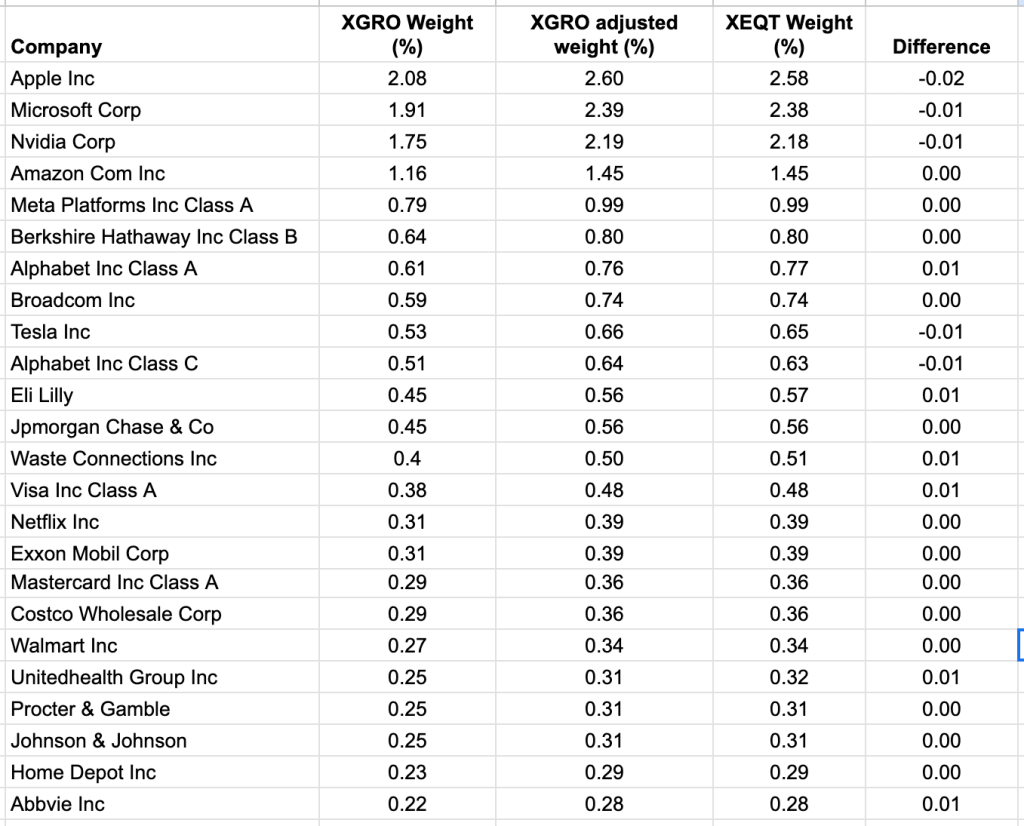
Comparing % contribution of the largest US holdings of XGRO and XEQT, April 2025

So while there are some differences in the largest stocks I looked at, there wasn’t a consistent bias towards the large stocks. In fact, the sum of the “difference” column shown here is precisely zero.

But why? Shouldn’t XEQT’s double purchasing of large US stocks (via both ITOT and XUS) result in a bias towards the large US stocks at the expense of smaller US stocks? It should, but right now, at the moment, it doesn’t.

This is because XGRO, at the moment, actually has a slightly larger US bias than XEQT, and both of them are actually below target (as per their reference guide):

Current XEQT US equity weightTarget XEQT US Equity WeightCurrent Adjusted XGRO US equity weightTarget Adjusted XGRO US Equity Weight
42.63%45%43.73%45%

This, I suppose, will wash out in the coming weeks/months as both XGRO and XEQT buy up more US stocks to get closer to their targets. In short, there isn’t anything to worry about in the near term; in the longer term, owning XEQT will probably tilt the US equity bias a bit towards larger stocks, which I’m not too fussed about.

  1. I do have a growing amount here because otherwise I’d have a hard time keeping my bond allocation to the desired 15% of my portfolio. ↩︎
  2. I believe this is called “doing the research”. ↩︎

The Money Engineer now on YouTube

Early on when I first launched this blog, one of my friends suggested that video content would be ideal for the topics I wanted to cover. “I’m a visual learner” was her pitch1. I did hesitate because I wasn’t sure what I would post there.

But the hesitation is over, and I’ve launched a YouTube channel which you can find in the top menu (“Videos”) or you can go to it directly: https://www.youtube.com/@MoneyEngineerCA.

The first video2 is a quick intro to the Multi-Asset Tracker, a Google Sheets template that’s based on my personal spreadsheet that I’ve developed over the years.

Today’s video is a quick look at BlackRock’s family of asset-allocation ETFs (XEQT, XGRO, XBAL, XCNS and XINC) and what makes the members of the family different.

My philosophy is to keep the videos short with no window dressing. There’s no big intro, no sponsor plugs3, no big plea to “Like and Subscribe”, and no theme music. We get going right from the opening frame. I reserve the right to jazz things up later, but with 2 views thus far I’m not too worried about going viral anytime soon.

If you have thoughts/comments/ideas about the videos, feel free to drop me a line at comments@moneyengineer.ca.

  1. Although I do love an elegant diagram or chart, as my kids will tell you, I have very little patience for a 3 minute YouTube video telling me how to change a setting on my iPhone. ↩︎
  2. Recorded on April 1st, but it’s no joke ↩︎
  3. At least, none coming from me — YouTube ad insertion is not something I can control, at least as far as I can figure out. ↩︎

What’s the deal with AOA?

***Updated numbers February 2026***

As mentioned elsewhere, I rely heavily on all-in-one ETFs in my retirement portfolio. New to all-in-ones? Read a bit about them here.

Previously ,I covered what’s in XGRO, which is an all-in-one you can purchase on the Canadian market. Because I also happen to have a lot of US dollar-based retirement savings, I have the majority of those funds invested in AOA. AOA is an 80/20 fund 1 offered by BlackRock. It seems that this sort of all-in-one is not as popular in the US as Canada, not sure why2. I see offerings from State Street that sound similar. BlackRock has other members of their asset allocation family with different equity percentages — there’s something for everyone!3

I thought it would be interesting to see what, exactly, is underneath every $100 you invest in AOA. So by reading AOA’s ETF description, following the ETF descriptions of what’s inside AOA, and doing a little math, I came up with the following breakdown4:

FundWhat is it?How much?Colour Commentary
IVV US stock coverage that tracks the S&P 500 Index, 500 of the largest US companies $44.53 of your $100 investment

(of which ~3.50$ is in Nvidia, ~$3 in Apple, and ~$2 in Microsoft, with ~$1 in Amazon, Alphabet, Meta, Broadcom and Tesla)
The Magnificent 7 and 493 other companies
IDEVBroad international (ex-US) developed market stock coverage that tracks the MSCI WORLD ex USA IMI Index, about 2250 companies $23.02 of your $100 investment

(of which ASML gets 42 cents, Roche gets 26 cents…)
This also includes a tiny slice of Canada…top holding is RBC at 18 cents of your $100
IUSBBroad US Bond market exposure, about 16,000 bonds from government and corporate entities$16.36 of your $100 investment

(of which $6.45 is in US Treasury, $1.44 is in the Federal National Mortgage Association…)
12 month trailing yield is 4.18%, not too shabby
IEMG3500 or so international companies from emerging markets, following the MSCI Emerging Markets Investable Market Index $9.29 of your $100 investment

(of which $1.06 is in Taiwan Semi, 42 cents is in Samsung..)
23% China, 22% Taiwan, 16% South Korea, 14% India,
IAGGAbout 5800 international bonds tracking the Bloomberg Global Aggregate ex USD 10% Issuer Capped (Hedged) Index5$2.83 of your $100 investment

(of which 30 cents is Japanese T-Bills)
Trailing 12 month yield = 3.27%, has lost a full point in the last year
IJHUS Midmarket stocks that track the S&P MidCap 400 Index$2.59 of your $100 investment (of which 2 cents is in Lumentum, who I’ve never heard of)25% Industrials, 15% Financials…
IJRUS Small Cap stocks that track the S&P SmallCap 600 Index $1.22 of your $100 investment
(largest holding is Solstice Advanced Materials)
IJH+IJR+IVV is sort of similar to ITOT
Main components of AOA as of February 2025

Like XGRO, investing in an all-in-one like AOA provides you with exposure to a bunch of different asset types across many different geographies in one product, including all of the “hot” stocks you read about ad nauseam. Diversification under one banner.

The big difference from XGRO is the very tiny representation of Canada overall. I worked it out to about 2.5% of the overall number, which makes sense given the size of Canada on a global scale.

I came across the “Three Fund Portfolio” popularized by Bogleheads over 15 years ago. AOA and its family members is more or less that concept.

  1. Shorthand for “80% equity, 20% bonds”. There remains a lot of disagreement about the appropriate asset allocation, e.g. https://www.bogleheads.org/forum/viewtopic.php?t=210178 ↩︎
  2. Instead, I see a lot of “target date” retirement ETFs, which are in some ways similar, but lower the equity percentages as you get closer to the target date. ↩︎
  3. There’s also AOR (60% equity), AOM (40% Equity) and AOK (30% Equity) ↩︎
  4. Compare with the XGRO breakdown at https://moneyengineer.ca/2025/01/30/whats-the-deal-with-xgro/ ↩︎
  5. That’s a mouthful. ↩︎

What’s the deal with XGRO?

***Numbers updated November 30, 2025****

As mentioned elsewhere, I rely heavily on all-in-one ETFs in my retirement portolio. New to all-in-ones? Read a bit about them here. While it may seem unwise to have (seemingly) so little diversification, when you buy an all-in-one like XGRO, you are actually getting a piece of THOUSANDS of different assets.

The main all-in-one Canadian ETF that I hold is an 80/20 fund1 called XGRO. There’s nothing special about XGRO other than it being free to trade on the platform I use — there are other 80/20 funds out there (e.g. ZGRO, HGRW). There’s also other all-in-ones with different equity percentages; there’s something for everyone!2

I thought it would be interesting to see what, exactly, is underneath every $100 you invest in XGRO. So by reading XGRO’s ETF description, following the ETF descriptions of what’s inside XGRO, and doing a little math, I came up with the following breakdown:

FundWhat is it?How much?Colour Commentary
ITOTBroad US stock coverage that tracks the S&P Total Market Index, about 2508 companies (top holdings: Alphabet, Apple, Nvidia, Microsoft, Amazon, Broadcom)$36.42 of your $100 investment

(of which ~2$ is in each of Alphabet, Apple, Nvidia, and Microsoft, and another $1 is in each of Amazon and Broadcom)
The Magnificent 7 and 2501 other companies
XICBroad Canadian stock coverage that tracks the S&P/TSX Capped Composite Index, about 223 companies (top holdings: RBC, Shopify, TD, Enbridge, Brookfield)$20.68 of your $100 investment

(of which RBC gets $1.40, Shopify gets $1.26, TD gets 93 cents)
You want banks? We got banks!
XEFBroad international (Europe, Asia, Australia) stock coverage that tracks the MSCI EAFE Investable Market Index, about 2500 holdings$19.49 of your $100 investment
(of which 24 cents goes to AstraZeneca, 34 cents goes to ASML…)
One of these years, MSCI EAFE is going to have another year like 2017…
XBB1400 or so investment-grade Canadian bonds that comprise the FTSE Canada Universe Bond Index$12.26 of your $100 investment (of which $3.89 is in federal bonds, $1.50 is in Ontario bonds, 91 cents is in Canada Housing Trust #, 85 cents is in Quebec bondsBonds got a lot of hate in 2023/4, but staying the course has been nice of late
XEC3000+ emerging market stocks that track the MSCI Emerging Markets Investable Market Index$4.18 of your $100 investment (of which 41 cents is in Taiwan Semi, 18 cents is in Tencent3…)“But honey, buying a case of power banks from Alibaba is helping our retirement portfolio”
XSHAbout 540 short term Canadian Corporate Bonds that track the FTSE Canada Universe + Maple Short Term Corporate Bond Index$2.96 of your $100 investment (of which 24 cents is in Royal Bank debt, 23 cents is in TD debt, 18 cents is in BMO debt)You want bank debt? We got bank debt!
USIGOver 10000 (!) US corporate bonds$1.95 of your $100 investment (of which 4 cents is JP Morgan debt, 3 cents is BoA debt)No idea how they track 10,000 bonds, but look at the yield4!
GOVTExposure to 191 US T-Bills$1.94 of your $100 investmentThey say “No pain, no gain”. I guess there’s only minuscule pain in T-Bills5.

If you were so inclined to run the numbers yourself, I’m pretty sure you’d get something similar to my numbers. It does change daily, mind you. And the percentages are routinely rebalanced, of course.

The big takeaway is that investing in an all-in-one like XGRO provides you with exposure to a bunch of different asset types across many different geographies in one product, including all of the “hot” stocks you read about ad nauseam. No FOMO here!

  1. A spirited discussion on the wisdom of 80/20 over here: https://www.bogleheads.org/forum/viewtopic.php?t=210178 ↩︎
  2. More equity=more risk=higher returns. No free lunch. ↩︎
  3. I desperately wanted the math to work out to “10 cents in Tencent”, but alas ↩︎
  4. https://stockanalysis.com/etf/usig/dividend/ ↩︎
  5. No gain. I feel much pain: https://www.google.com/finance/quote/GOVT:BATS?sa=X&window=MAX ↩︎