
Just the (ETF) Facts, Ma’am

Do you ever wonder about the differences between, say, XEQT and VEQT? Or XGRO and TGRO? Of course, you could ask Reddit1, read an article from a trusted source (ahem), or you could investigate it yourself.

How?

Well, my usual starting point is to google “<trading symbol> ETF”, for example “XEQT ETF”. For popular ETFs, this often generates hits for competitive products, so do be careful of that minefield.

But really, there’s a better way. You can instead google “<trading symbol> fact sheet”, for example “XGRO fact sheet”. In my unscientific tests, this search yield the actual fact sheet for the ETF in question as either the 1st or 2nd result — it’s a pdf file in all the cases i tried.

So what’s the fact sheet, and what’s it all about? Let’s hand it over to the pros:

The ETF Facts is a four-page document that summarizes key information about an ETF in a simple, accessible and easily comparable format. It is designed to help you make an informed decision about your investment by including information such as a fund’s investments, risk rating, past performance and the costs associated with owning it.

https://www.securities-administrators.ca/investor-tools/understanding-your-investments/etf-facts/#:~:text=What%20is%20the%20ETF%20Facts%3F

The highlights for me about the ETF fact sheet are:

  • It’s short. 4 pages, and generally the most interesting bits are on pages 1 and 2
  • It’s “easily comparable”. The format is always the same, allowing for an easier side-by-side looksee.
  • It’s got information about what the fund invests in. If you hold multiple ETFs, knowing what’s behind each one will help you avoid inadvertently piling on to one segment of the market2.

The fact sheet isn’t just helpful; it’s the law of the land34.

So let’s take a quick look at my number one Canadian holding, XGRO, to see what it’s about.

Recording the above video taught me that XGRO changed significantly back in 2018, so looking at its performance prior to that is no longer an apples-to-apples comparison. After a bit of searching, I found that XGRO used to be called CBN, which had a MER of about 0.75%. You can read a bit more about that at Canadian Couch Potato, an excellent resource, by the way.

  1. And, inexplicably, people reliably ask this question week after week after week… ↩︎
  2. I don’t make segment bets; maintaining my asset allocation percentages (36% US Equity, 24% International Equity, 20% Canadian Equity, 15% Bonds, 5% cash) is the only metric that matters to me. ↩︎
  3. This is the Ontario regulation; because we like bureaucracy in this country, every province has a securities regulator 😦 ↩︎
  4. And I assume this is also the case in the USA since all the US-based ETFs I own have fact sheets. But I couldn’t find a specific regulation about that. ↩︎

What’s in my retirement portfolio (Oct 2025)

This is a monthly look at what’s in my retirement portfolio. The original post is here. Last month’s is here.

Portfolio Construction

The retirement portfolio is spread across a bunch of accounts:

  • 7 RRIF accounts (3 for me, 3 for my spouse, 1 at an alternative provider as a test)
  • 2 TFSA accounts
  • 4 non-registered accounts, (1 for me, 1 for my spouse, 2 joint)

The target for the overall portfolio is unchanged:

  • 80% equity, spread across Canadian, US and global markets for maximum diversification
  • 15% Bond funds, from a variety of Canadian, US and global markets
  • 5% cash, held in savings-like ETFs.

You can read about my asset-allocation approach to investing over here.

The view post-payday

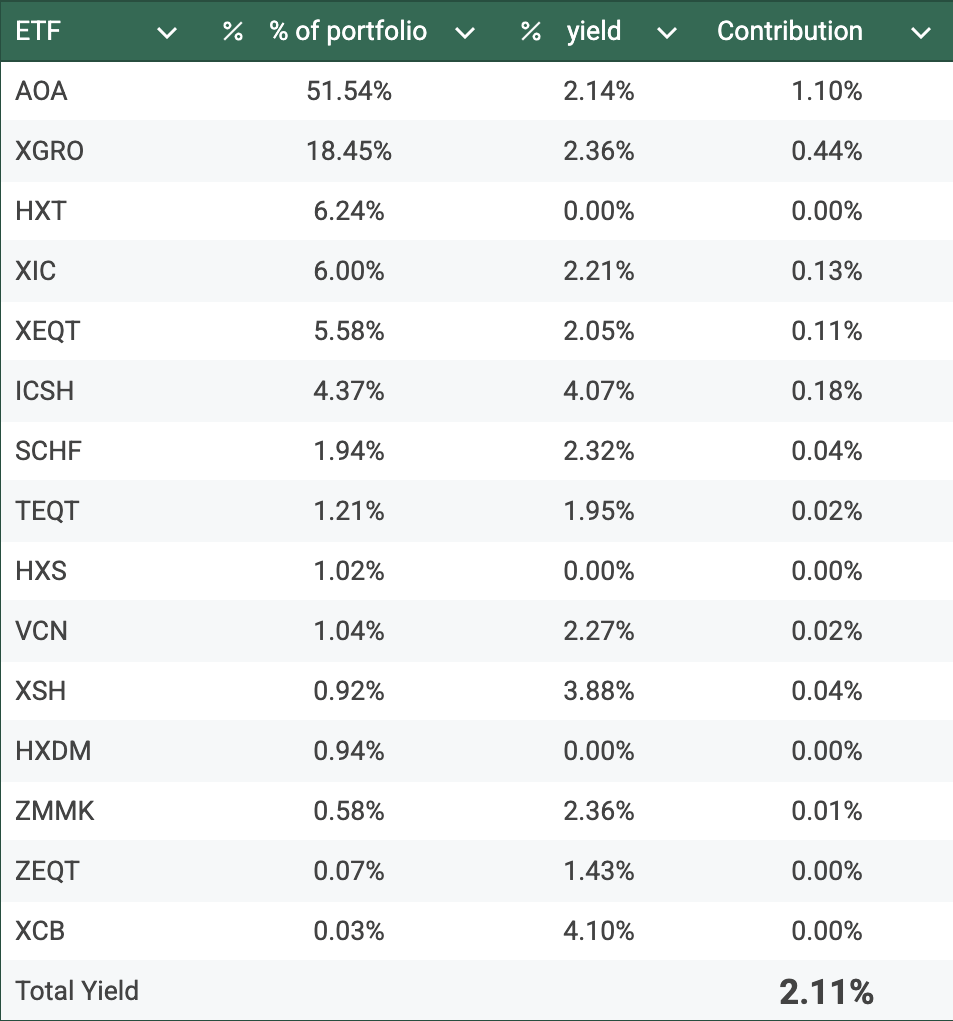
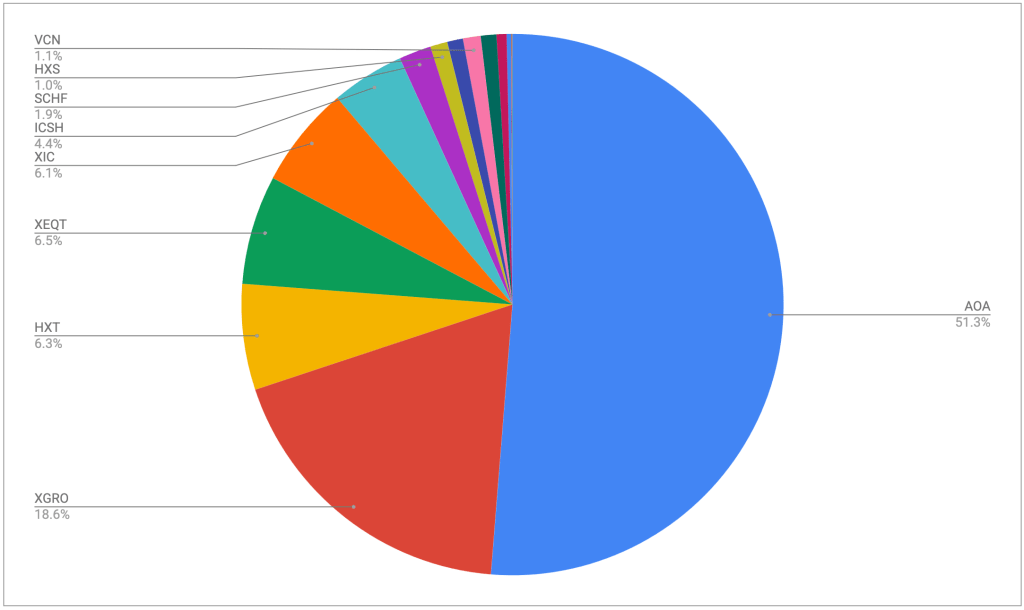
I pay myself monthly in retirement, so that’s a good trigger to update this post. On October 27th, this is what it looks like:

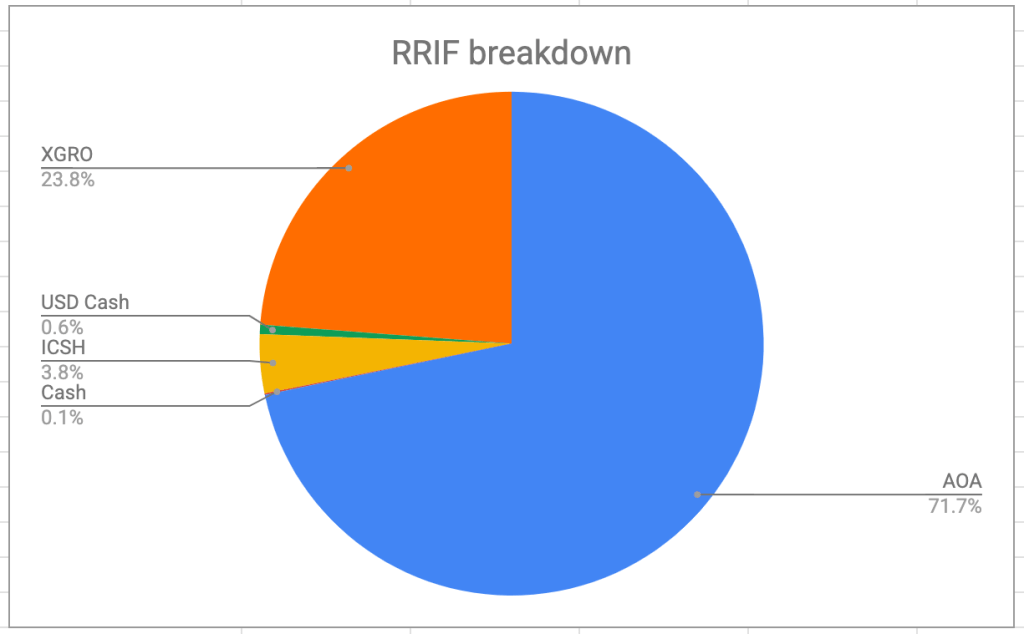
The portfolio is dominated by my ETF all-stars; anything not on that page is held in a non-registered account and won’t be fiddled with unless it’s part of my monthly decumulation. Otherwise I’ll rack up capital gains for no real benefit.

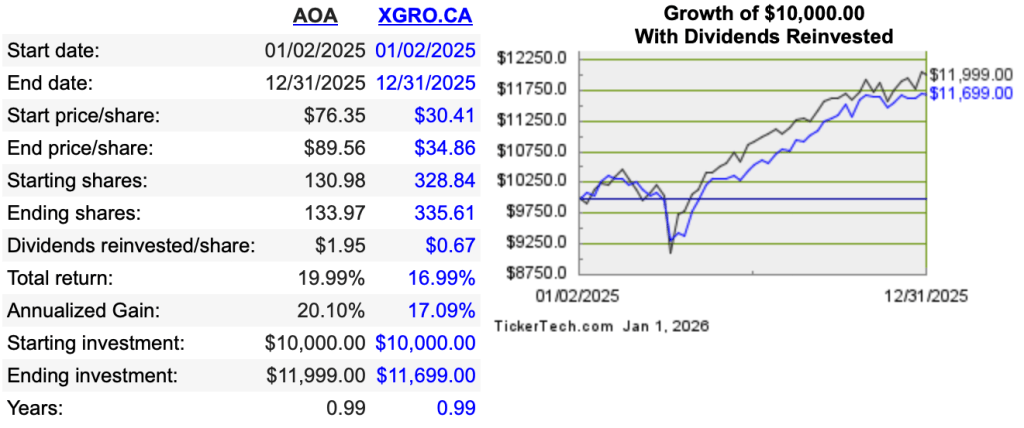
No massive changes this month; the one you might notice is a slight shift from AOA to XGRO. I move some of my USD holdings into CAD every quarter, and last month was when I did it. The majority of my spending is in CAD, so I use Norbert’s Gambit to move funds around.

Plan for the next month

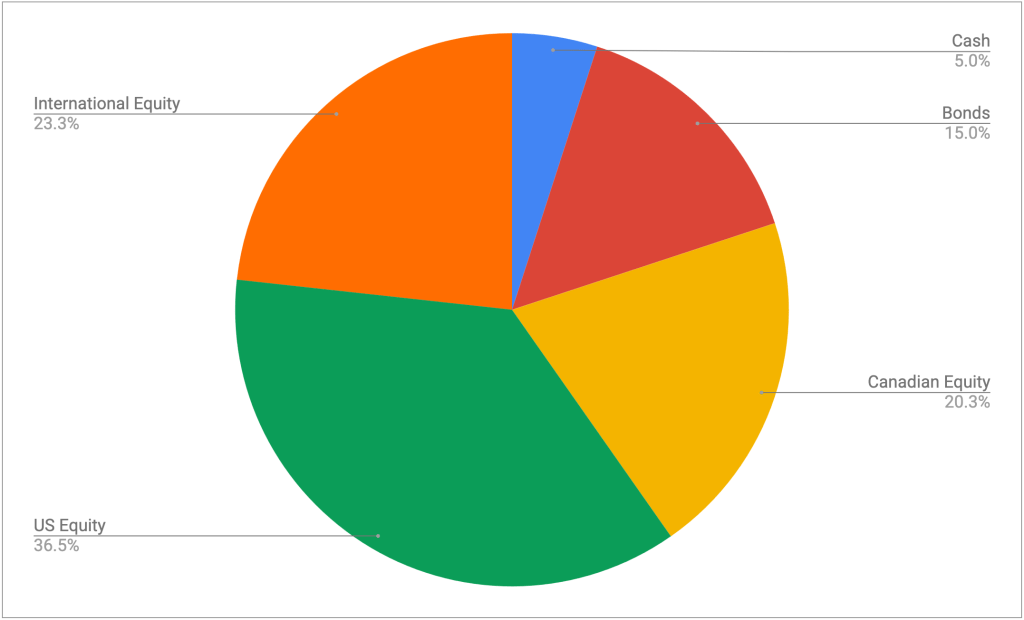
The asset-class split looks like this

It’s looking pretty close to the targets I have, which are unchanged:

  • 5% cash or cash-like holdings like ICSH and ZMMK
  • 15% bonds (almost all are buried in XGRO and AOA)
  • 20% Canadian equity (mostly based on ETFs that mirror the S&P/TSX 60)
  • 36% US equity (dominated by ETFs that mirror the S&P 500, with a small sprinkling of Russell 2000)
  • 24% International equity (mostly, but not exclusively, developed markets)

All looks to be in order from an asset allocation perspective, no need to do anything here.

Overall

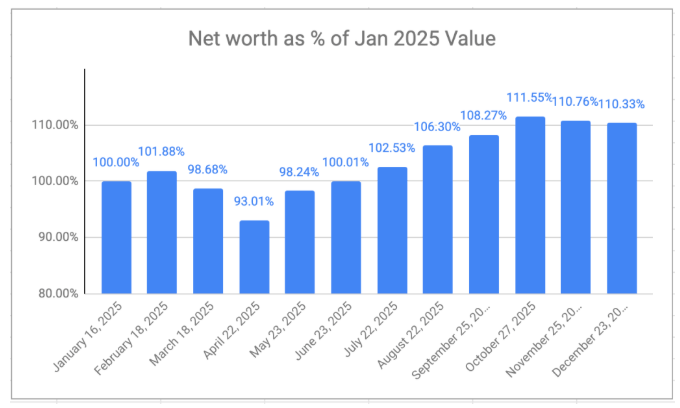
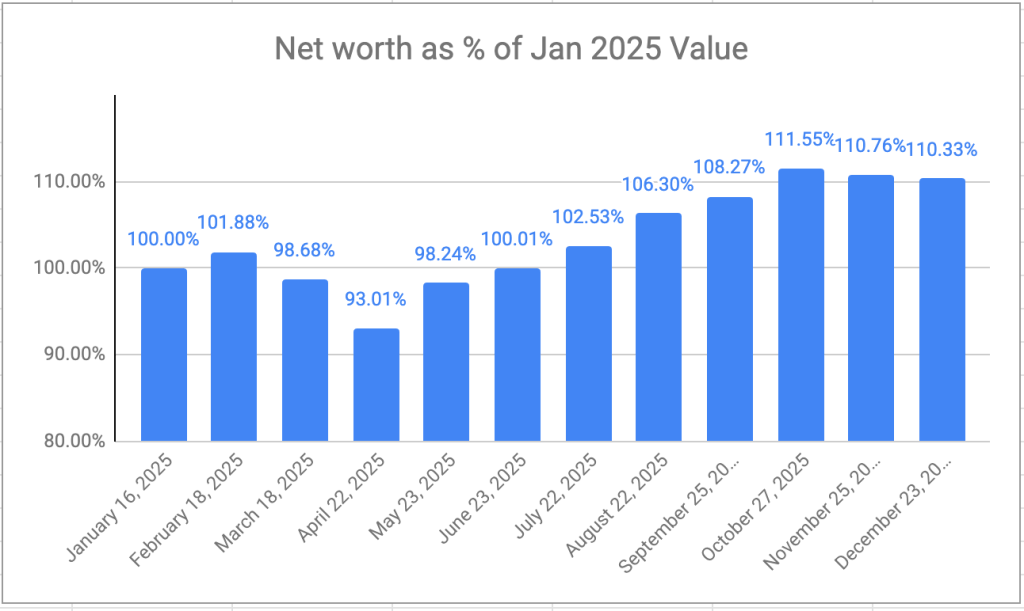
The retirement savings had a great month, again — a 6-month growth streak at this point. Overall, I’m now 11.5% ahead of where I started even though I’ve been drawing a monthly salary since the beginning of the year. I don’t really expect the winning streak to continue, but VPW allows me to take some benefit from the frothy stock markets at moment.

Net Worth as a percentage of starting point

My VPW-calculated salary has hit a new high this year, 5.92% higher than my first draw in January. The monthly salary is also on a 6-month growth streak.

Monthly Salary as a Percentage of Jan 2025 salary

The months ahead will see the final “goodbye” to QTrade1 as the last of my RRIF investments will move to (mostly) Questrade2.

  1. I didn’t have a great deal of issue with QTrade as a provider, but their support (lack thereof) was beginning to become irritating. ↩︎
  2. My own QTrade RRIF will join the RRIF holdings I already have with Wealthsimple. They remain a potential backup provider of my retirement savings. I would have moved more to take advantage of their cashback promotion, but they still, inexplicably, do not support self-directed spousal RRIF accounts. ↩︎

News: Norbert’s Gambit Tracking Update

If you have no idea what Norbert’s Gambit is, it’s a way to cheaply convert USD/CAD in your online brokerage account. Most brokers support it1.

Because I hold a lot of USD assets in my retirement savings, and since I live and spend most of my money in Canada, I need a way cheaply convert to Canadian funds in my RRIF. So last week, I had to convert some of my AOA holdings into XGRO holdings and so I updated the log I’m keeping. So far, I’ve done the Gambit three times this year, and twice I’ve lucked out on the FX rate changes and actually made money2 on the transaction.

  1. And many people expect Wealthsimple to join this club soon. ↩︎
  2. What I mean: if the funds had converted instantaneously with no fees rather than waiting around for the 3-5 business days for the Gambit to complete, I would have received LESS money than by using the Gambit. Over time, I expect this will even out, but right now I’m about $55 CAD ahead. ↩︎

What’s in my non-registered portfolio? (Oct 2025)

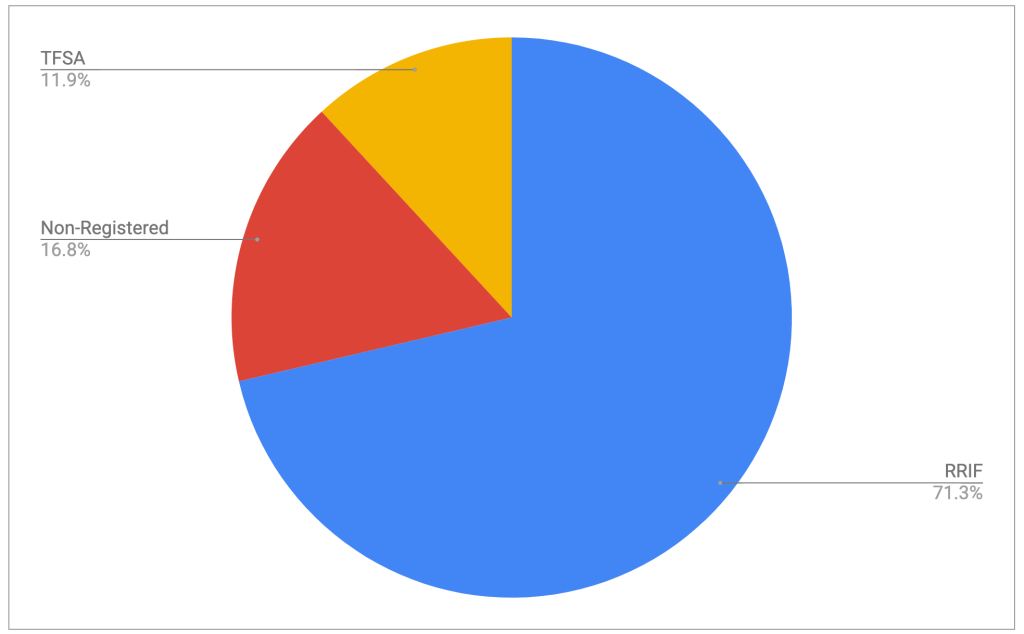
Every month, I try to share with you what’s in my overall retirement portfolio (September 2025 post is here). That retirement portfolio is actually distributed over a bunch of accounts held by me and my spouse and includes RRIFs, TFSAs and non-registered accounts. This is what it looks like at the moment:

Retirement savings as of October 1, 2025 by account type

(My multi-asset tracker is a handy tool to help you quickly create charts that look like the above one).

My current strategy for these three account types looks like this:

  • RRIF: This is 100% invested in my ETF all-stars. I’m currently withdrawing RRIF minimum payments for two main reasons:
    • To avoid problems with attribution. I cover that topic over here.
    • To avoid withholding tax. RRIF minimum payments don’t attract withholding tax, but I am setting aside some of my payments to deal with the unavoidable tax bill come April 2026. I talked about that topic over here.
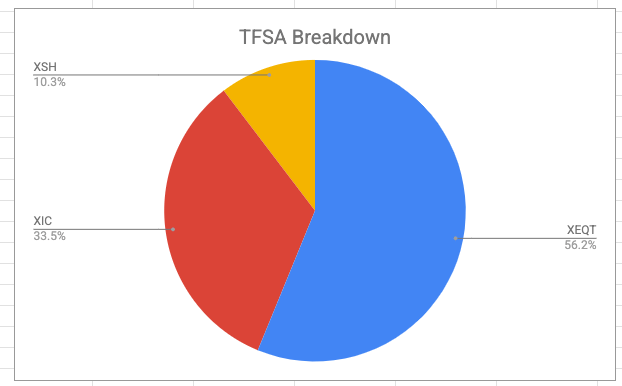
  • TFSA: This is mostly invested in the ETF all-stars, but there’s a few stragglers in here1 that I really ought to get rid of. Nothing wrong with the funds in there, but it’s a needless complexity. The TFSA continues to get new funds since it’s hard to beat tax-free growth, and I only buy all-stars with those funds. It will get drawn down last in my retirement planning.
  • Non-registered accounts: Here it’s a bit of a dog’s breakfast, with very little invested in the all-stars, mostly because most of the equity found here was bought long ago, and changing what I hold would attract capital gains that I would prefer to take on my own terms. It’s where the majority of my early-retirement decumulation takes place.

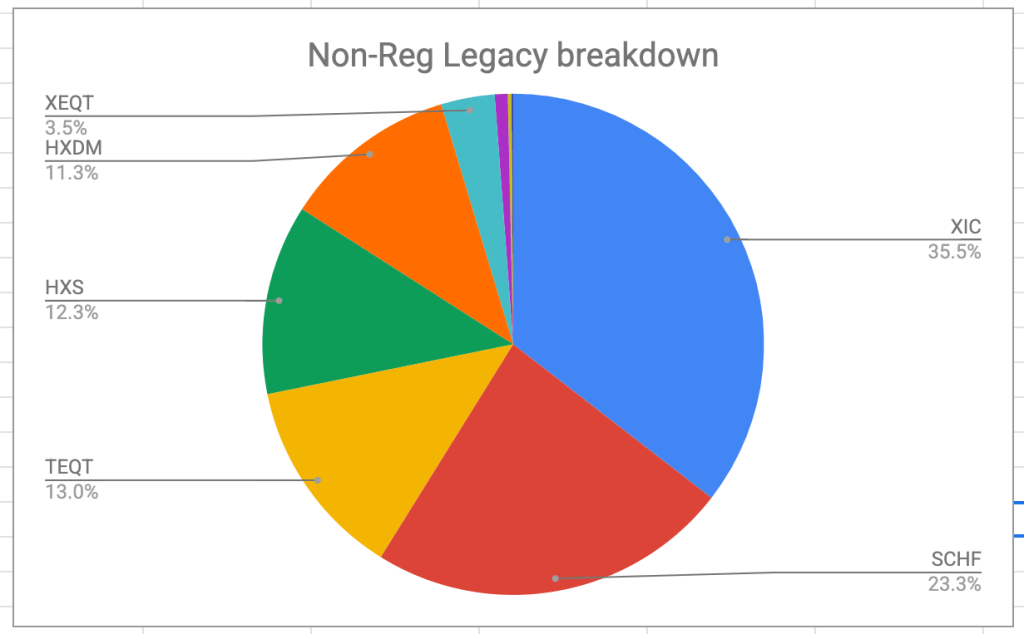
Here’s what that breakfast looks like:

What’s in my non-registered portfolio, October 2025

Here’s a look at each holding, from highest to lowest percentage.

HXT: This is a Canadian equity ETF that does not pay dividends, instead using some wizardry to bury it all in the per-unit price of the ETF. This simplifies taxes, and I have held this fund for a long time. Due to increasing costs of this ETF, it’s among the first to get liquidated as I need funds.

XIC: Canadian equity fund, very popular. I think I bought it to create a bit of dividend income. It will get liquidated after the Horizons funds go (HXS, HXT, HXDM).

SCHF: A very low-cost international equity2 fund in USD that I’ve held for a very long time. It’s funds like SCHF that attracted me to investing in USD, which, at present, adds a lot of complexity.

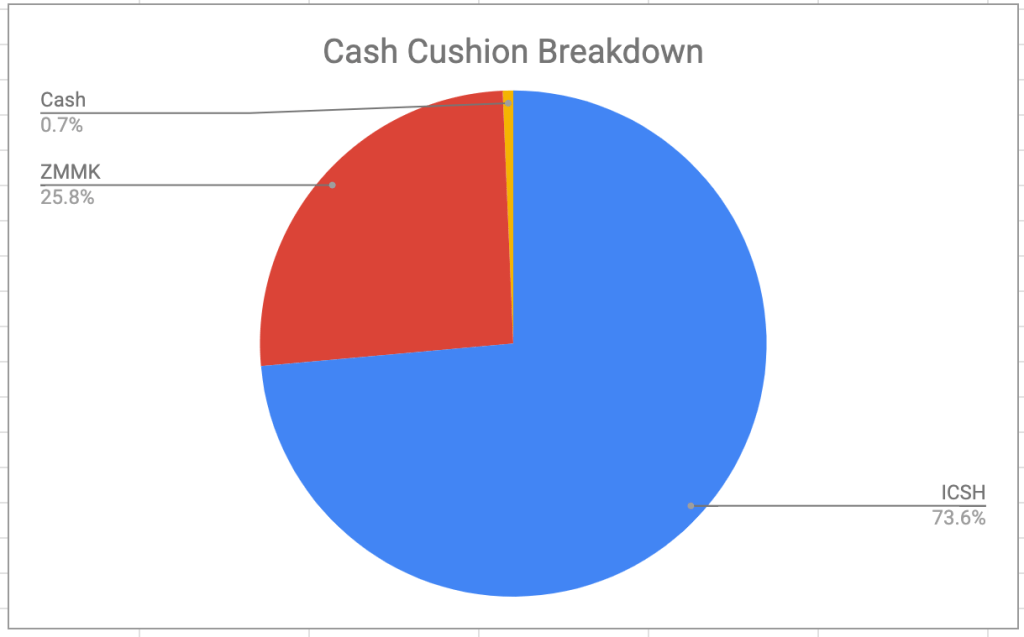
ICSH: This is one of the all-stars. It is what my VPW cash cushion is invested in3. I use ICSH more than ZMMK in the cash cushion because US interest rates are quite a bit higher than Canadian rates at the moment. I talked about that here.

HXS: Same idea as HXT, except it invests in the S&P 500. This one is held only by my spouse who is still working for a living, so this will just stick around a while, until she stops working and can take on the capital gains.

VSC: A bond fund held by my spouse. I may sell this to harvest some capital gains losses.

HXDM: Same idea as HXT, except international equity. It is on the list to liquidate.

ZMMK: An all-star, held in the same account as ICSH.

The rest (XEQT, TEQT, XGRO) are all new arrivals in the portfolio, purchased using dividends4 from the other funds as well as the bonus payments I keep collecting from Questrade for switching to them.

My non-registered accounts are only a small portion of my retirement holdings, but there’s a fair bit of complexity there. Over time, these accounts will go to zero other than the cash cushion portion (ZMMK, ICSH or whatever replacements I discover) which will remain as long as VPW is my decumulation strategy.

  1. Mostly pure Canadian equity funds. This is to offset AOA that has next-to-no Canadian equity component. ↩︎
  2. 0.03% MER. Cheap! ↩︎
  3. VPW = Variable Percentage Withdrawal, an absolutely brilliant strategy for making sure you don’t run out of money in retirement and don’t leave a lot on the table. Read all about it here. ↩︎
  4. With all ETF trades being free, I hold very little actual cash in any of my accounts. ↩︎

What’s in my retirement portfolio (Sept 2025)

This is a monthly look at what’s in my retirement portfolio. The original post is here. Last month’s is here.

Portfolio Construction

The retirement portfolio is spread across a bunch of accounts:

  • 7 RRIF accounts (3 for me, 3 for my spouse, 1 at an alternative provider as a test)
  • 2 TFSA accounts
  • 4 non-registered accounts, (1 for me, 1 for my spouse, 2 joint)

The target for the overall portfolio is unchanged:

  • 80% equity, spread across Canadian, US and global markets for maximum diversification
  • 15% Bond funds, from a variety of Canadian, US and global markets
  • 5% cash, held in savings-like ETFs.

You can read about my asset-allocation approach to investing over here.

The view post-payday

I pay myself monthly in retirement, so that’s a good trigger to update this post. At market close, September 25, this is what it looks like:

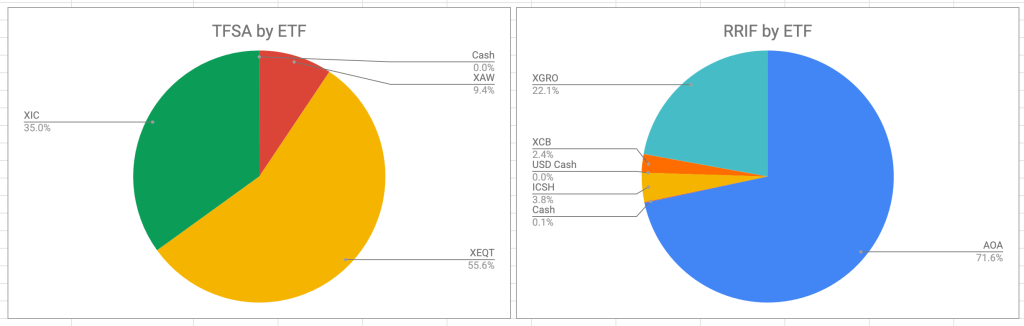
Retirement holdings by ETF, September 2025

The portfolio is dominated by my ETF all-stars; anything not on that page is held in a non-registered account and won’t be fiddled with unless it’s part of my monthly decumulation. Otherwise I’ll rack up capital gains for no real benefit.

No massive changes this month; the one you might notice is a reduction in HXS, which holds US stocks exclusively. I picked this one to sell out of my non-registered accounts as my US equity allocation was a bit high.

Plan for the next month

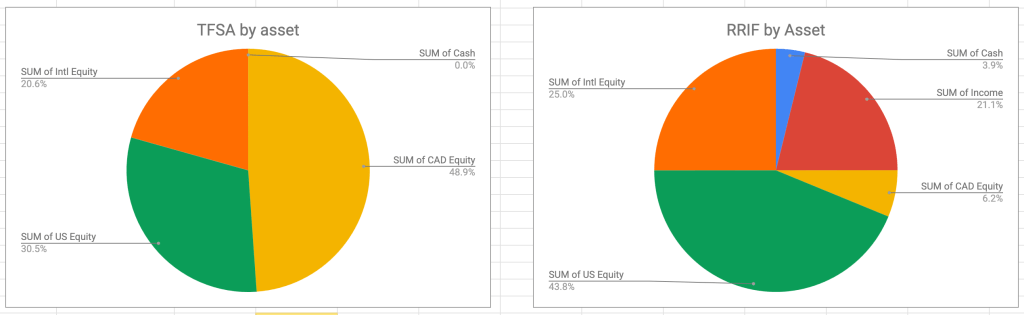
The asset-class split looks like this

It’s looking pretty close to the targets I have, which are unchanged:

  • 5% cash or cash-like holdings like ICSH and ZMMK
  • 15% bonds (almost all are buried in XGRO and AOA)
  • 20% Canadian equity (mostly based on ETFs that mirror the S&P/TSX 60)
  • 36% US equity (dominated by ETFs that mirror the S&P 500, with a small sprinkling of Russell 2000)
  • 24% International equity (mostly, but not exclusively, developed markets)

I don’t need to make serious changes at this juncture, but there will be some need to make some noticeable tweaks in the coming month:

  • Q3 dividends will flow in to the account which will make for some movement, especially in XGRO and AOA. (Payout date for XGRO is September 29th , AOA is estimated to be October 8th.
  • I will need to convert some of my US RRIF holdings into CAD. I do this quarterly. Why quarterly? It allows me to smooth out any big swings in the FX rate over the course of the year. This will show up as a reduction in AOA and an increase in XGRO next month.
  • And, at the very end of October, AOA will rebalance. This is not foreseen to be a big deal.
  • All these moves will be tracked through my multi-asset tracker; it may be I have to buy a bit more foreign equity as I see I’m a touch light in that category.

Overall

The retirement savings had a great month, again. Overall, I’m now 8% ahead of where I started even though I’ve been drawing a monthly salary since the beginning of the year. This is aligned with what my retirement planner told me to expect, but as you can see, the journey has had some interesting ups and downs already.

Monthly retirement savings, as percentage of Jan 2025 value

My VPW-calculated salary has hit a new high this year, 4.22% higher than my first draw in January1. This is also expected, since it tracks the value of the retirement portfolio, albeit in a much more controlled way. The VPW “cash cushion” smooths out the ups and downs of the monthly returns. I suppose I really should see an increase in my salary on par with inflation so that I maintain my spending power. I’ll have to think about how to track that2.

Monthly salary, as percentage of Jan 2025 salary