Dealing with Drift in Asset Allocation ETFs

I rely a lot on asset-allocation ETFs in my retirement portfolio, mostly XGRO in the CAD side of the portfolio and AOA on the USD side1. These ETFs (about 70% of my overall retirement portfolio, as you can see here), like all asset-allocation ETFs, rebalance their holdings periodically in order to stick to their asset allocation targets. This aligns perfectly with my way of investing; I’ve always tried to stick to my asset allocation targets portfolio-wide, assisted by tools like my multi-asset tracker spreadsheet. (If you aren’t familiar with asset-allocation as an investment strategy, you could give this article a read.)

XGRO’s asset allocation targets are written right in the prospectus2:

  • 80% Equity, with 36% US equity, 20% Canadian Equity, 20% International Developed Market Equity, 4% Emerging Market Equity.
  • 20% Bonds, 16% being held in Canadian bonds. The other 4% are designated “non-Canadian” but seems like it’s always US bonds.

Anyway, XGRO’s approach to making changes to the portfolio in order to maintain this target percentage is written in the prospectus too:

XGRO’s portfolio will be monitored relative to the asset class target weights and will be rebalanced back to asset class target weights from time to time …XGRO’s portfolio is not expected to deviate from the asset class target weights by more than one-tenth of the target weight for a given asset class

Page 419 of the iShares Prospectus (June 2025)

Now “from time to time” isn’t terribly precise. I thought I’d take a closer look at the history of XGRO’s asset allocations. So I dug through annual and semi-annual reports as well as the website. I focused on the Fixed Income (aka Bond) proportion of XGRO over time because that’s the asset class that’s most likely to drift lower3…equities typically outperform fixed income historically. So this is what I found:
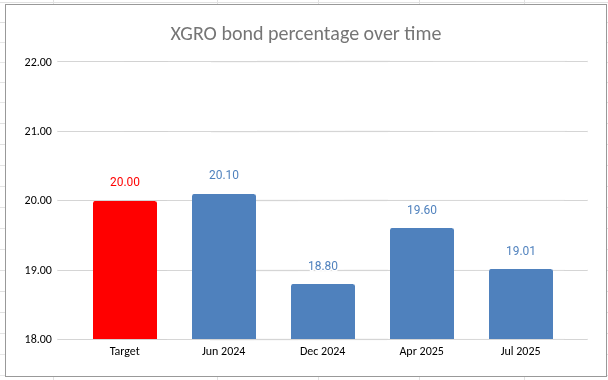
So there is a bit of drift in the fixed income portion of XGRO, but in the past year I haven’t seen it off by more than 1.2%, meaning that the promise made in XGRO’s prospectus is being adhered to.4

Turning now to AOA, the fixed income proportion is clearly stated to be 20%, and rebalancing is stated to happen twice annually, in April and October. After that, things become a bit harder to work out56. The various equity contributions are determined by the target index, namely the S&P Target Risk Aggressive Index, which are constructed by using market capitalization of the various indices used7.

Anyway, like XGRO, what I’m most concerned about is the fixed income portion of AOA, and digging through the various reports, I came up with this:
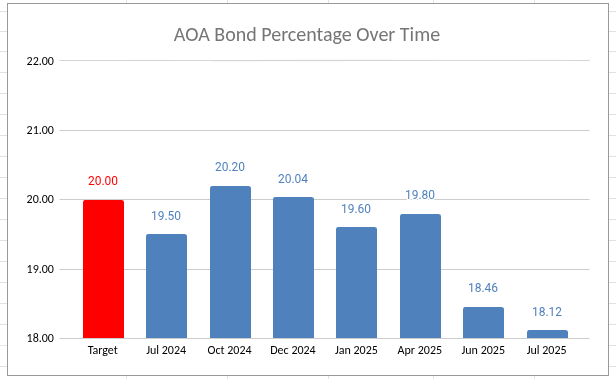
Of late, the fixed income portion AOA has become small, almost 2% lower than it should be. And given that AOA is about 50% of my holdings, it means that my equity exposure is quite a bit higher than I would let it drift myself.

I suppose the next rebalancing in October 2025 will correct this, but I admit it makes me a little uneasy to see that sort of volatility in the asset allocation8. I could of course just sell some AOA and reinvest it in some bond fund (AOA uses IUSB and IAGG, which seem like fine choices) but then I’m just working around the asset allocation strategy I’m paying for in AOA’s management fees, which seems dumb. Not to mention that anything I do now will almost certainly have to be undone come October.

So I guess this all means I should just let sleeping dogs lie. I have minor bits of money to reinvest every month (I still contribute to my TFSAs) so using those funds to buy bonds are probably what I’ll do. It’s a tiny pre-correction that should be addressed come October…or by the next equity meltdown.

  1. And both are on my “ETF all-stars” page ↩︎
  2. And since detailed targets are clearly stated, these are the percentages I assume for XGRO in my multi-asset tracker spreadsheet. I could continually update the percentages since they calculated daily on XGRO’s page, but it seems like busywork. ↩︎
  3. My retirement decumulation strategy (VPW) relies on knowing what my asset allocation is, too ↩︎
  4. It does mean, however, that my equity exposure Is higher than I thought. ↩︎
  5. Well, or maybe I’m just not that smart — I’m not really sure if one can calculate the market caps needed to work out the allocations. ↩︎
  6. And unlike XGRO, I actually do track (from time to time) the underlying allocations of AOA so that my multi-asset tracker reflects reality. It was through my most recent update that I discovered that the bond portion of AOA was a lot lower than it had been. ↩︎
  7. Namely the S&P500, the S&P MidCap 400, the S&P SmallCap 600, the S&P Developed Ex-U.S. BMI, and the S&P Emerging BMI ↩︎
  8. It’s still within the stated drift that XGRO tolerates, however. So maybe I’m overthinking this. ↩︎

Capped Index Funds: Good Idea?

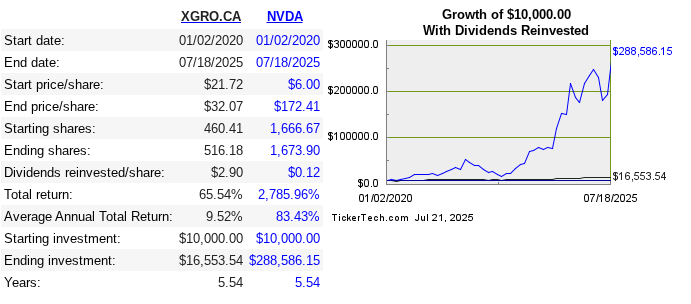
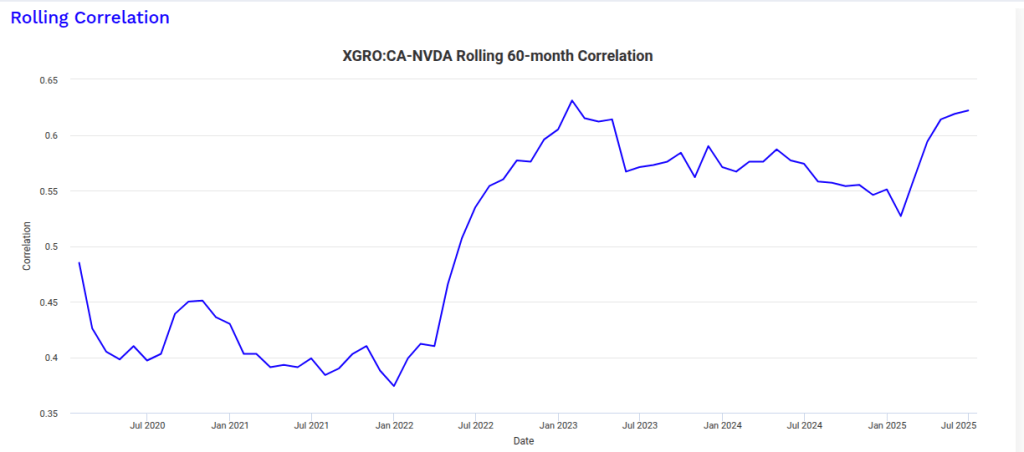
One nagging concern I’ve heard about index investing1 is that you can end up overly concentrated in a handful of stocks. For example, as of today, per XGRO’s fact sheet, for every $100 I have invested in XGRO, I’m actually investing almost $5 between two companies, NVIDIA and Microsoft. And for every $100 I have invested in AOA, it’s $7 in these two companies. Although that sounds like it might be a significant concentration, I found a way to test the correlation using https://www.portfoliovisualizer.com/asset-correlations. As you can see, XGRO and NVIDIA are not terribly well-correlated:

Not very strong correlation between XGRO and NVIDIA

…even though perhaps I perhaps wish they were (sigh):

Wishing XGRO was more strongly correlated with NVIDIA…

Anyway, if you’re still not comfortable with having too much concentration in your holdings, there are ETFs that limit exposure to any one stock in an index. iShares launched an ETF last year that tracks the S&P 500 while limiting the contribution of any member of that index to 3%. That product is called XUSC, which serves as a complement to its XUS uncapped S&P 500 ETF2. So when you compare XUS’s top holdings to those of XUSC, you can quickly spot the difference:

Top HoldingsXUS (S&P 500)XUSC (capped S&P 500)3
NVIDIA7.86%3.49%
Microsoft7.09%3.12%
Apple5.90%3.07%
Amazon4%3.07%
Meta2.86%2.93%
Broadcom2.49%2.96%
Alphabet class A2%1.66%
Tesla1.73%2.05%
Alphabet class C1.63%1.35%
Berkshire Hathaway1.62%1.93%
Comparing top % holdings between XUS and XUSC as of July 2025

For the TSX, there’s not a full equivalent. The closest pairing for the TSX is XIC4 and XIU:

TickerIndexCapped?# of stocks
XICS&P/TSX Capped CompositeYes214
XIUS&P/TSX 60No615

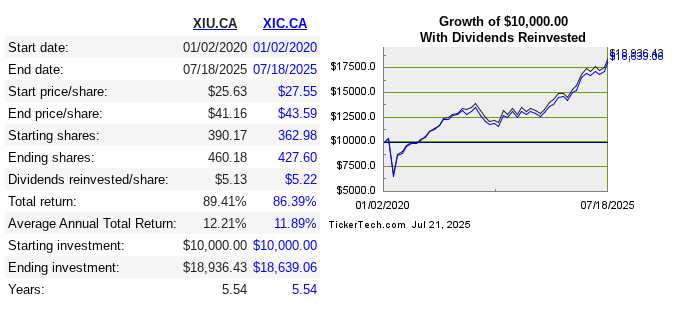
XIC holds a lot more companies, and in addition to capping any single company, this has the effect of shifting the emphasis to smaller companies. So does this make a big difference in performance? Let’s check using this calculator.

So not much difference; over the past 5.5 years, we see a very slight edge to XIU, the uncapped TSX60 fund.

Whether the relationship between XIU and XIC will be the same as XUS/XUSC is anybody’s guess. In my own case, I don’t own the capped version of the S&P 500, but I do own XIC over XIU, mostly because of its significantly lower MER (0.06% versus 0.18% for XIU).

  1. And my biggest holdings (AOA and XGRO) are nothing more than a collection of index funds: S&P 500, TSX, MSCI EAFE… ↩︎
  2. There’s also currency-hedged variants of these, but I never bother with hedging, it just adds expense and tracking errors. ↩︎
  3. You may wonder why an ETF that advertises itself as capping components at 3% has components that exceed 3%. I also have this question. I suppose they probably only trade when the exception is maintained for a period of time, or perhaps by a more significant margin. Otherwise, they’d trade stocks that hovered around the 3% threshold excessively. ↩︎
  4. The “C” is either for “Capped” or “Composite”, you decide. ↩︎
  5. I can’t explain why a “TSX 60” ETF has 61 assets. Maybe they count cash as the 61st? ↩︎

What’s in my retirement portfolio (June 2025)

This is a (hopefully1 monthly) look at what’s in my retirement portfolio. The original post is here. Last month’s is here.

Portfolio Construction

The retirement portfolio is spread across a bunch of accounts2:

  • 7 RRIF accounts (3 for me, 3 for my spouse, 1 at an alternative provider as a test)
  • 2 TFSA accounts
  • 4 non-registered accounts, (1 for me, 1 for my spouse, 2 joint)

The target for the overall portfolio is unchanged:

  • 80% equity, spread across Canadian, US and global markets for maximum diversification
  • 15% Bond funds, from a variety of Canadian, US and global markets
  • 5% cash, held in savings-like ETFs.

You can read about my asset-allocation approach to investing over here.

The view as of this morning

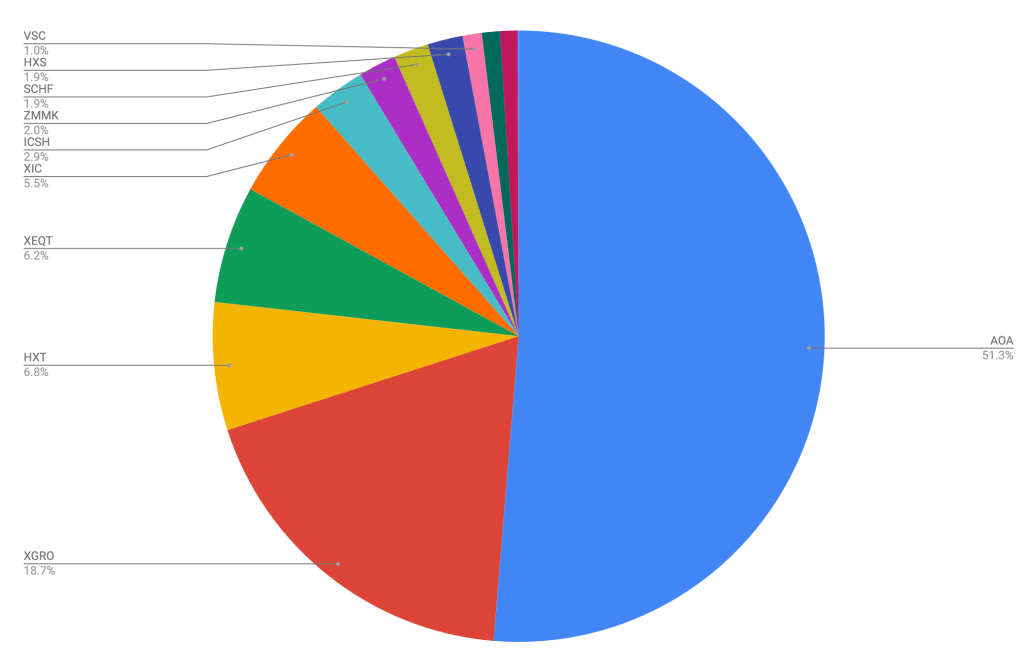
As of this morning, this is what the overall portfolio looks like:

Retirement holdings by ETF, June 2025

The portfolio is dominated by my ETF all-stars; anything not on that page is held in a non-registered account and won’t be fiddled with unless it’s part of my monthly decumulation. Otherwise I’ll rack up capital gains for no real benefit.

The biggest changes over the last 30 days was due to a small rebalancing exercise I executed. I sold off some AOA in order to pick up more ICSH. The stock market has been roaring lately, and it caused my target allocations to become a bit cash-poor; ICSH is not, strictly speaking, “cash”, but for my purposes, it’s close enough. (You can read about my cash thoughts here). I could have instead sold XGRO to pick up more ZMMK, but US interest rates are a lot better than Canadian ones at the moment, so I figured I’d enjoy the extra few percentage points of return on my cash holdings.

Plan for the next month

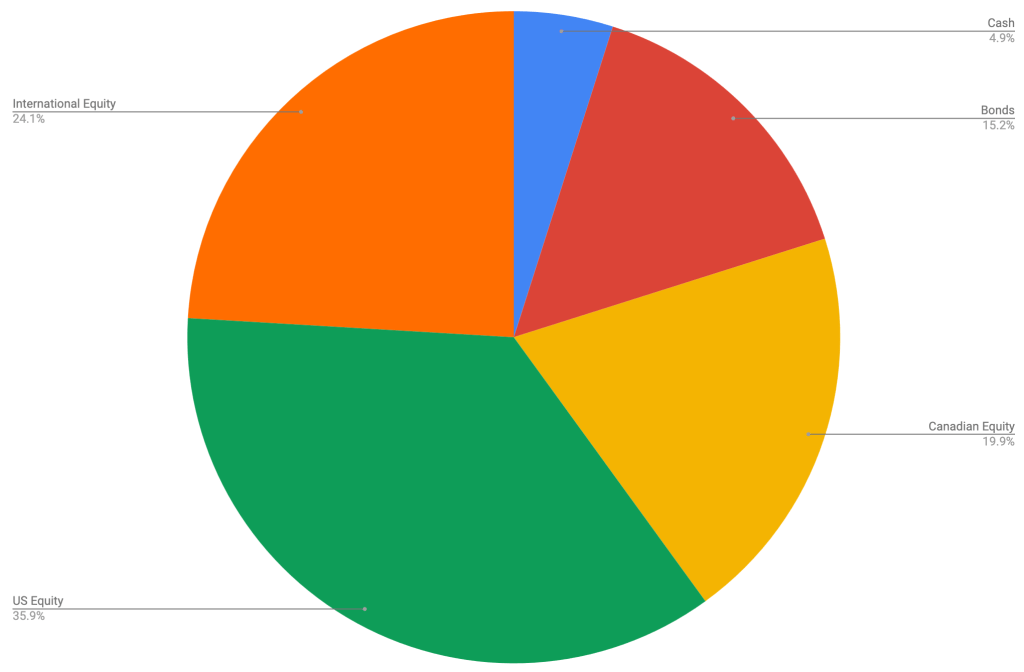
The asset-class split looks like this

This looks to be pretty close to my target percentages which haven’t changed:

  • 5% cash or cash-like holdings like ICSH and ZMMK
  • 15% bonds (almost all are buried in XGRO and AOA)
  • 20% Canadian equity (mostly based on ETFs that mirror the S&P/TSX 60)
  • 36% US equity (dominated by ETFs that mirror the S&P 500, with a small sprinkling of Russell 2000)
  • 24% International equity (mostly, but not exclusively, developed markets)

The pie is looking almost perfect at the moment. I don’t see any near-term need for fiddling with what’s there.

Overall

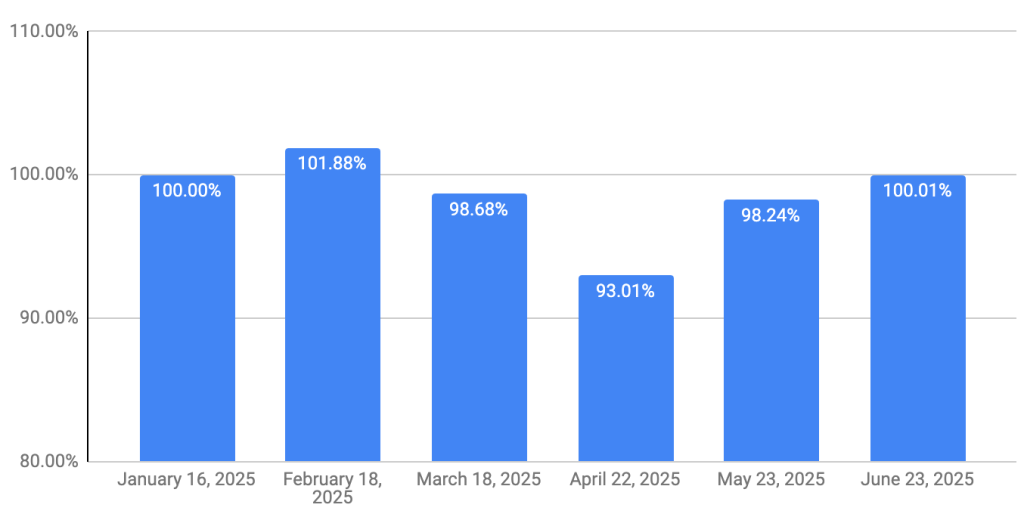
The retirement savings look quite healthy; even though I’ve been drawing a monthly salary for 6 months, I’m now ahead of where I was3 when I started my retirement journey. This is aligned with what my retirement planner told me to expect, but as you can see, the journey has had some interesting ups and downs aready.

Monthly retirement savings, as percentage of Jan 2025 value

My VPW-calculated salary has gone back to more or less where I started at the beginning of the year. And even with the crazy market swings we’ve seen, it’s stayed remarkably stable4. That’s thanks to the built-in shock-absorber of the VPW model (a 6-month cash cushion which smooths out the market gyrations considerably). I also think it’s an endorsement of my choice to take retirement payments monthly; my exposure to short-term market hiccups is greatly reduced since I’m not making big sales of ETFs to fund a year of spending all at once.

Monthly salary, as percentage of Jan 2025 salary

  1. I know it’s July 7, but the numbers are accurate for June, more or less. ↩︎
  2. I treat retirement savings as firewalled from my day to day chequing account. ↩︎
  3. Just barely, but I’ll take it ↩︎
  4. I changed the vertical axis of this chart to align with the other chart; it makes its stability much clearer. ↩︎

TD versus iShares: XEQT/XGRO/XBAL versus TEQT/TGRO/TBAL

My post talking about BMO’s fee reduction for their asset allocation family enticed me to revisit competitive asset allocation funds. TD’s low-low fees (0.17% versus the 0.20% of iShares) are tempting.

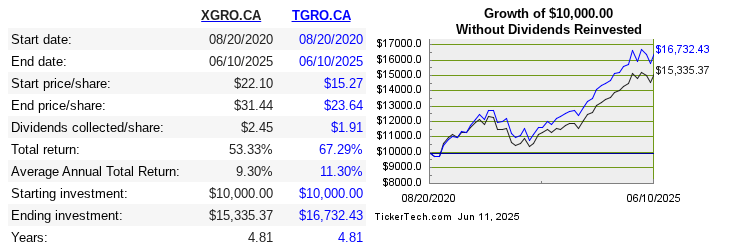
So, quick sanity check — what’s the historical performance of XGRO versus TGRO?12

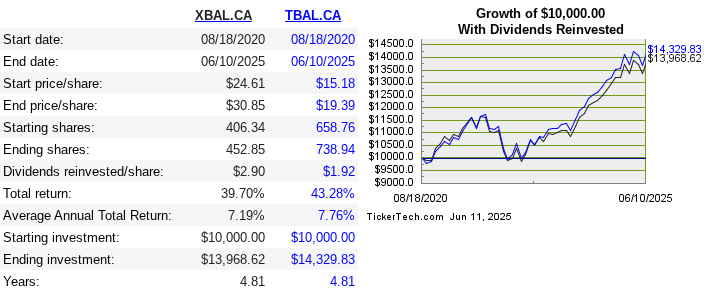
Per https://www.canadastockchannel.com/compound-returns-calculator/ (featured in Tools I Use) I see:

What? The TD fund has returned a full 2 percentage points better? This is a bit hard to believe. They must be rather different somehow?

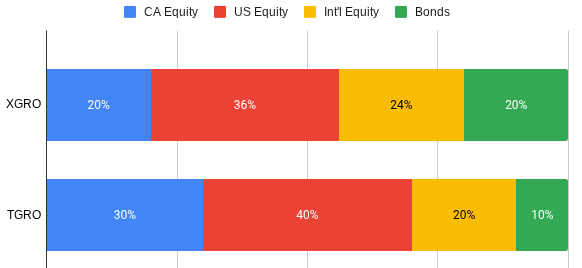
Ah, yes. Revisiting their respective fund pages reveals that TGRO has a lower allocation for bonds — it’s only 10% versus the 20% for XGRO. More bonds will definitely lower return as a reward for lower volatility (I showed that effect here), so that probably explains the difference.

XGRO versus TGRO: Asset Allocation

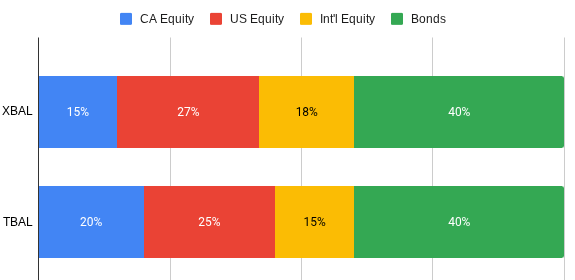
So comparing the returns of XGRO versus TGRO wasn’t an apples to apples comparison. I could instead measure the relative returns of XBAL versus TBAL since the equity/bond ratios of these two are equivalent (both at 60% equity, 40% bonds)3. There are, however, some minor differences in the equity side of the equation:

XBAL versus TBAL: Asset Allocation

TBAL has a higher weighting in Canadian equity at the expense of some International equity, let’s see how that translates in the overall return:

That’s a lot closer, but the advantage still tilts TBAL’s way, which is another positive argument for considering it.

I am curious about how different these two are under the hood.

The first obvious difference is that they use different market indexes to build their portfolios, summarized below:

TGRO/TBALXGRO/XBAL
CAD EquitySolactive Canada Broad Market IndexS&P®/TSX® Capped Composite Index
US EquitySolactive US Large Cap CAD IndexS&P Total Market Index
Int’l EquitySolactive GBS Developed Markets ex North America Large & Mid Cap CAD IndexMSCI EAFE® Investable Market Index, MSCI Emerging Markets Investable Market Index
Bonds FTSE Canada Universe Bond IndexFTSE Canada Universe Bond Index and others
Underlying indices tracked by TGRO and XGRO

So sure, the indices are different, but is it really a big deal? Doing a bit of digging I can confidently say that:

  • On the Canadian Equity front, TGRO’s holdings are more broad and include smaller stocks.
  • On the US Equity front, the opposite is true — XGRO holds more smaller US stocks
  • On the International Equity front, XGRO has exposure to Emerging markets that TGRO lacks
  • On the bond front, XGRO includes non-Canadian holdings, so a bit more diversified

Are any of these differences of great significance? No idea. Doubtful. TGRO has a recent small (0.5%) advantage, which is still worth digging in to. I took a look at the underlying assets…It’s easiest to do that by looking at the ETFs that underpin TGRO, one by one (TPU, TTP and TTE). XGRO’s product page shows the underlying assets so you don’t have to do the same (tedious) exercise for it.

Top CAD EquityTop US EquityTop Int’l Equity
TEQT/TGRO/TBALRBC, Shopify, TD, Enbridge, BrookfieldMicrosoft, NVIDIA, Apple, Amazon, MetaSAP, ASML, Nestle, Novo Nordisk, Roche
XEQT/XGRO/XBALRBC, Shopify, TD, Enbridge, BrookfieldMicrosoft, NVIDIA, Apple, Amazon, MetaTaiwan Semi, SAP, ASML, Nestle, Novo Nordisk
Top stock holdings, by asset category, for TGRO and XGRO

Hmph. Almost the same. I guess the difference is really coming down to an advantageous geographic mix for TBAL over XBAL, which may or may not be repeated. As compared to TBAL, XBAL’s greater focus on equities outside North America hurt its performance in the last 5 years.

All this to say that TGRO/TBAL look like fine products, with no real reason not to recommend them. For me, one small complexity with TGRO is its bond allocation, which is lower than XGRO’s, meaning that to keep my usual 20% bond allocation, I would have to either buy a standalone bond fund or buy a TEQT/TBAL combo (a 50/50 ratio works, I did the math).

Perhaps you’ll start to see some of these funds in my monthly update — stay tuned!

  1. I wouldn’t normally do this, especially since the funds don’t have a long history, but in this case I see that the TD funds use obscure (to me) indices so I want to quickly see if there’s a major difference in return. ↩︎
  2. XGRO is the mainstay of the CAD portion of my retirement portfolio and TGRO looks to be the same thing. ↩︎
  3. You may wonder if this is really a valid comparison since what I actually care about is TGRO versus XGRO. I think it is a valid comparison since TBAL and XBAL are still relying on the same underlying indices to build their respective funds, it’s just that the percentages vary. That’s pretty much how most all-in-ones approach the problem of building multiple risk levels: take a set of ingredients (the indicies) and mix them in different ratios to get to the final all-in-one product. It’s really a test to see if TBAL’s indices are somehow “better” than XBAL’s. ↩︎

News: BMO reduces fees on all-in-one ETFs

Summary: BMO has reduced fees on its family of asset-allocation ETFs (ZCON, ZBAL, ZGRO, ZEQT) to put its Management Expense Ratio (MER) in the same realm as competing families from GlobalX, iShares and TD.

If you’re a fan of all-in-one ETFs (as I am)1, then there is a new low-cost competitor2 to consider in BMO. BMO announced a reduction in their fees last week, and per Rob Carrick, it’s a win for everyone concerned. If you’re new to the idea of all-in-one ETFs (aka asset allocation ETFs), here’s a good place to start: https://moneyengineer.ca/2025/01/21/why-you-can-fire-your-advisor-asset-allocation-etfs/.

It’s probably worth taking a quick scan of the four lowest-cost families out there. Here’s the overview.

ProviderFund Symbols
TD3TEQT, TGRO,TBAL,TCON
BMO4ZEQT, ZGRO, ZBAL, ZCON
GlobalX5HEQT, HGRW, HBAL, HCON
iShares6XEQT, XGRO, XBAL, XCNS, XINC
Low-cost all-in-one ETF providers, and the symbols you can use to buy them

In my view, any of these families are worthy of your investment dollars. Which particular fund you pick within a family depends on your tolerance for volatility and/or your timeline for needing the money you’re investing. Each list of fund symbols in the table above is listed in order of amount of equity — so for TD, you can see that TEQT has the most equity (100%) whereas TCON has the least (40%). You might want to give https://moneyengineer.ca/2025/05/06/investment-basics-asset-allocation/ a read to get more familiar with the concepts.

  1. XGRO and XEQT are both members of the coveted “ETF All Stars” slot. ↩︎
  2. There are other all-in-one families (Vanguard, Fidelity, Mackenzie), the ones shown here are the least expensive of the lot at 0.20% MER or less. TD is the current winner of the lot with a rock-bottom 0.17% MER. ↩︎
  3. TEQT launched in April 2025. ↩︎
  4. There’s also an ESG asset allocation fund, ZESG. ↩︎
  5. There’s also a bunch of covered call variations that are of no interest to me. ↩︎
  6. iShares is the family I work within. I started with them over the others because they could be traded for free on my former provider (QTrade). My current provider (Questrade) allows free trading for any ETF. ↩︎