
What’s in my retirement portfolio (Aug 2025)

This is a monthly look at what’s in my retirement portfolio. The original post is here. Last month’s is here.

Portfolio Construction

The retirement portfolio is spread across a bunch of accounts:

  • 7 RRIF accounts (3 for me, 3 for my spouse, 1 at an alternative provider as a test)
  • 2 TFSA accounts
  • 4 non-registered accounts, (1 for me, 1 for my spouse, 2 joint)

The target for the overall portfolio is unchanged:

  • 80% equity, spread across Canadian, US and global markets for maximum diversification
  • 15% Bond funds, from a variety of Canadian, US and global markets
  • 5% cash, held in savings-like ETFs.

You can read about my asset-allocation approach to investing over here.

The view post-payday

I pay myself monthly in retirement, so that’s a good trigger to update this post. At market close, August 22, this is what it looks like:

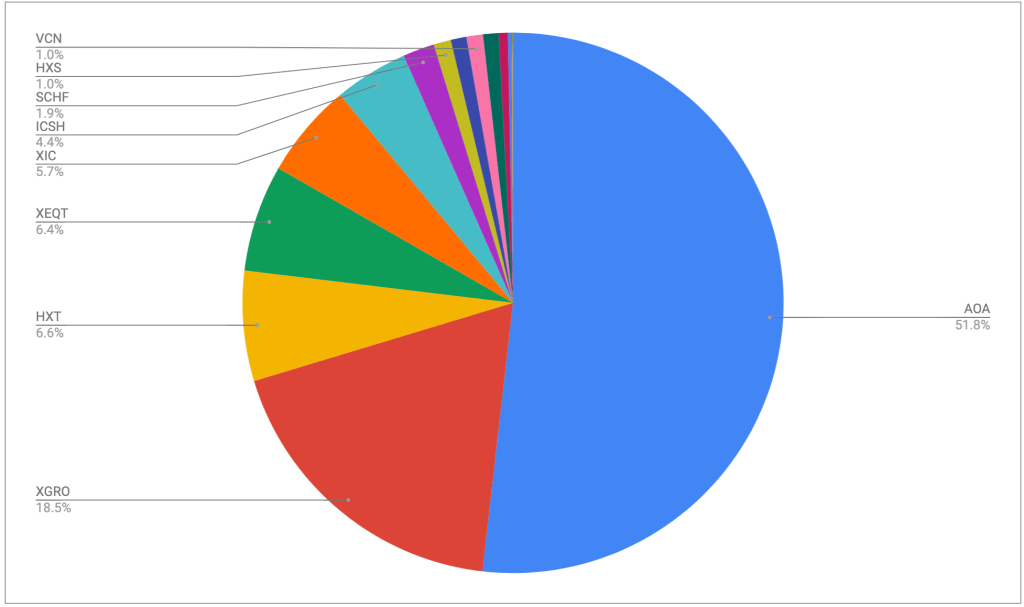
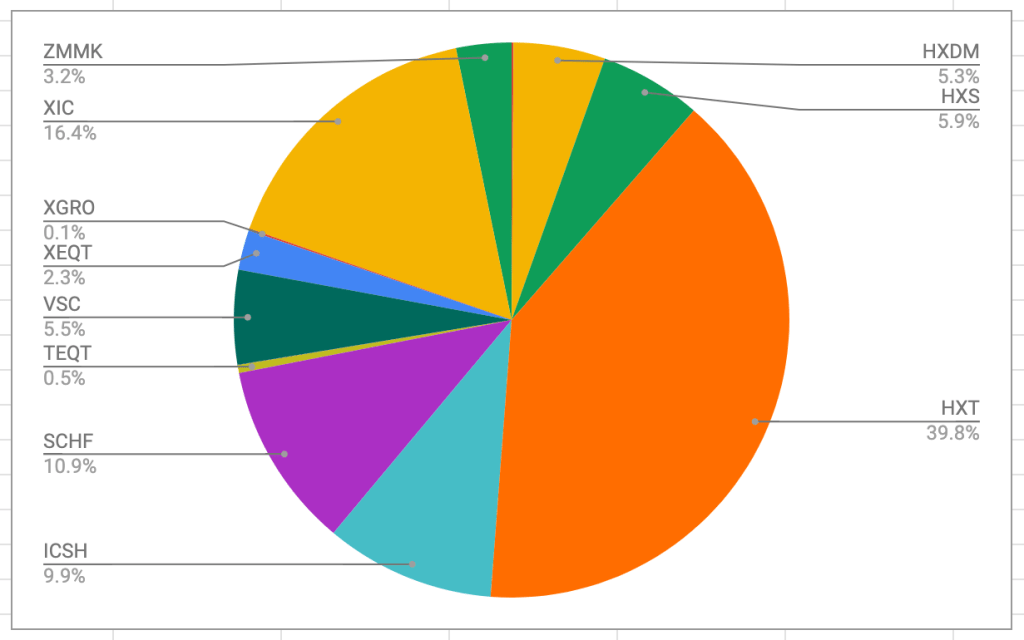
Retirement holdings by ETF, August 2025

The portfolio is dominated by my ETF all-stars; anything not on that page is held in a non-registered account and won’t be fiddled with unless it’s part of my monthly decumulation. Otherwise I’ll rack up capital gains for no real benefit.

The most noticeable change is a growth in the importance of ICSH to my portfolio at the expense of ZMMK. I did the math to justify performing a Norbert’s Gambit of the CAD generated by selling ZMMK and picking up ICSH. The amount of HXS remaining in the portfolio is dwindling, and may be gone altogether by next month. I choose which assets to sell out of my non-registered accounts by simply determining which asset category needs to be trimmed based on my multi-asset spreadsheet.

I also have a new way to track my AOA splits; since it rebalances itself twice annually, it seems to me wiser to fix its bond contribution at 20% in my multi-asset tracker. The equity splits between US, International, and Canadian are still dynamically calculated at least monthly using a properly weighted formula.

Plan for the next month

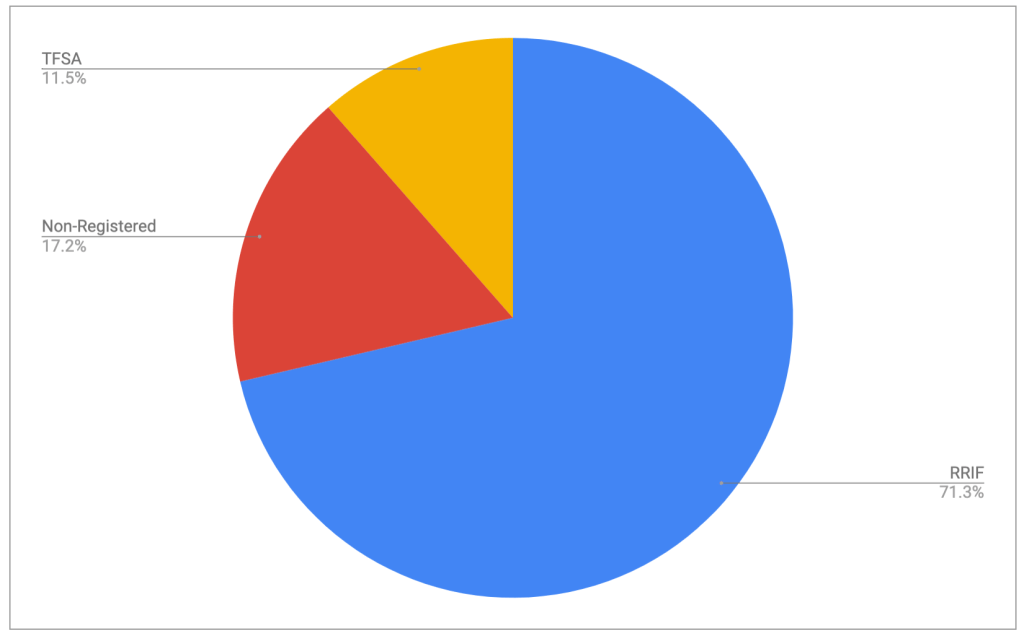
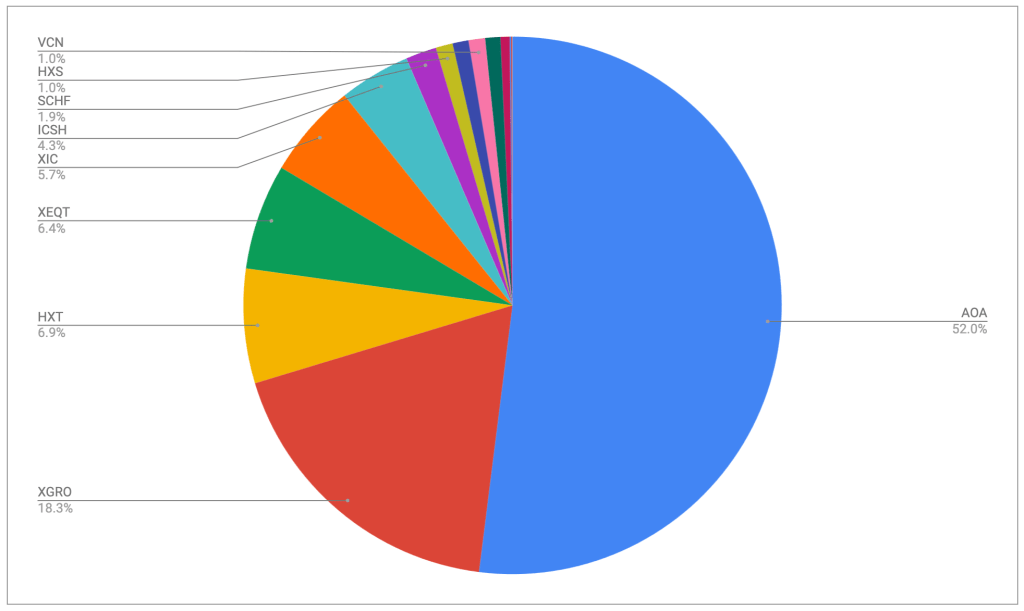
The asset-class split looks like this
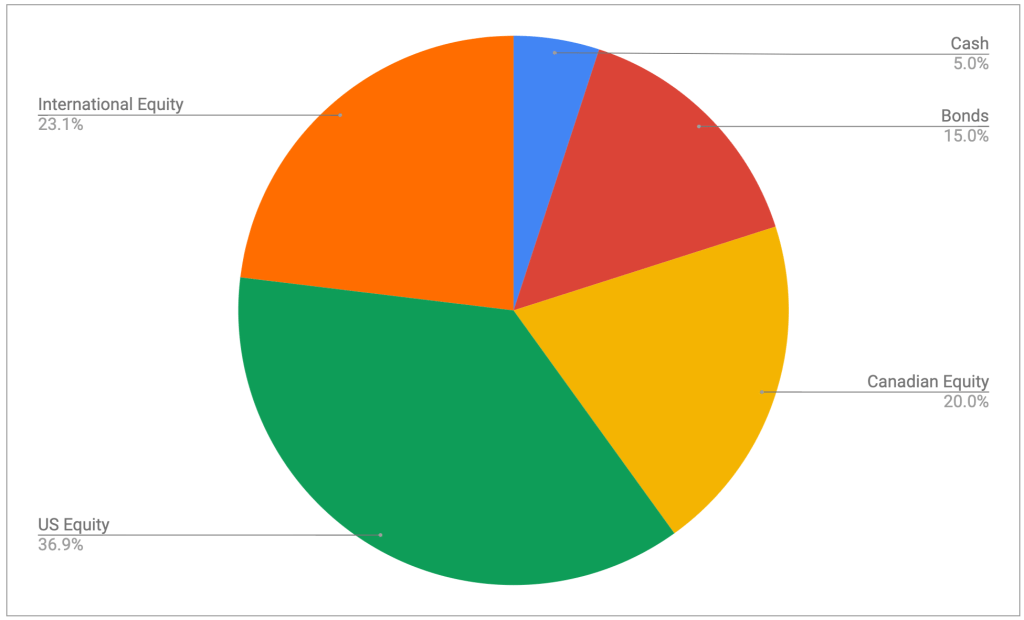
It’s looking pretty close to the targets I have, which are unchanged:

  • 5% cash or cash-like holdings like ICSH and ZMMK
  • 15% bonds (almost all are buried in XGRO and AOA)
  • 20% Canadian equity (mostly based on ETFs that mirror the S&P/TSX 60)
  • 36% US equity (dominated by ETFs that mirror the S&P 500, with a small sprinkling of Russell 2000)
  • 24% International equity (mostly, but not exclusively, developed markets)

I don’t really see a need to make changes based on what I see here. Cash flowing in to the account (bonus payments, regular TFSA contributions) will be re-invested in one of XEQT or XGRO1, typically2.

Overall

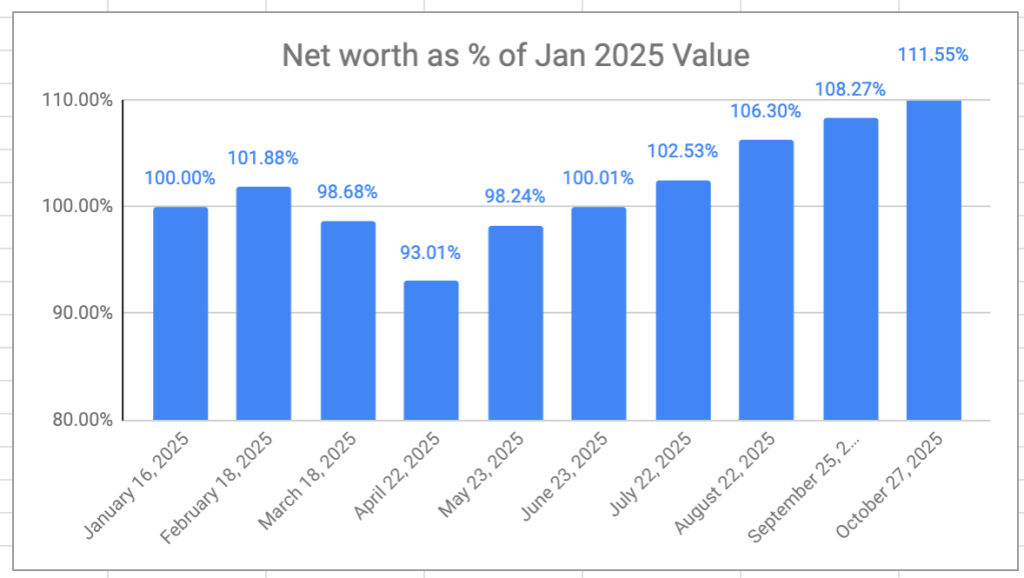
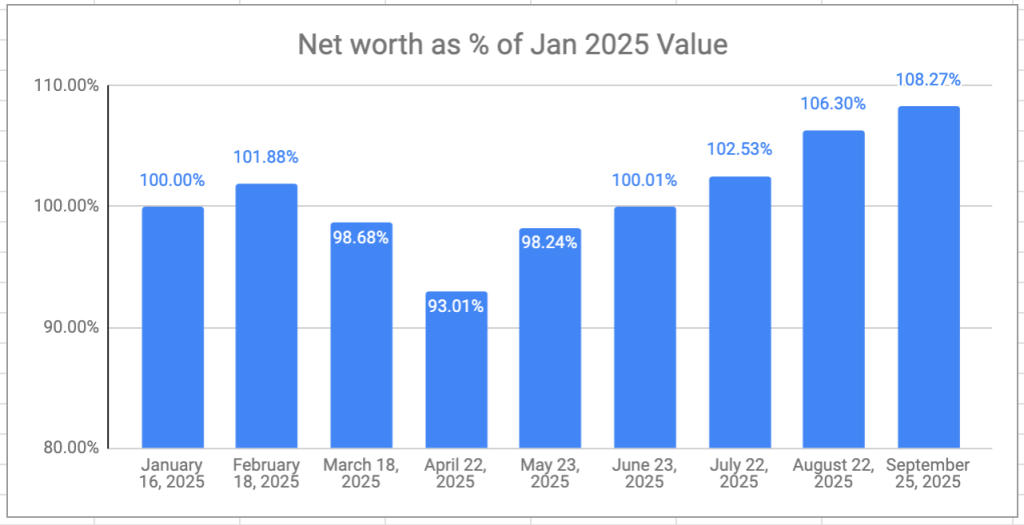
The retirement savings had a great month. Overall, I’m ahead of where I started even though I’ve been drawing a monthly salary since the beginning of the year. This is aligned with what my retirement planner told me to expect, but as you can see, the journey has had some interesting ups and downs already.

Monthly retirement savings, as percentage of Jan 2025 value

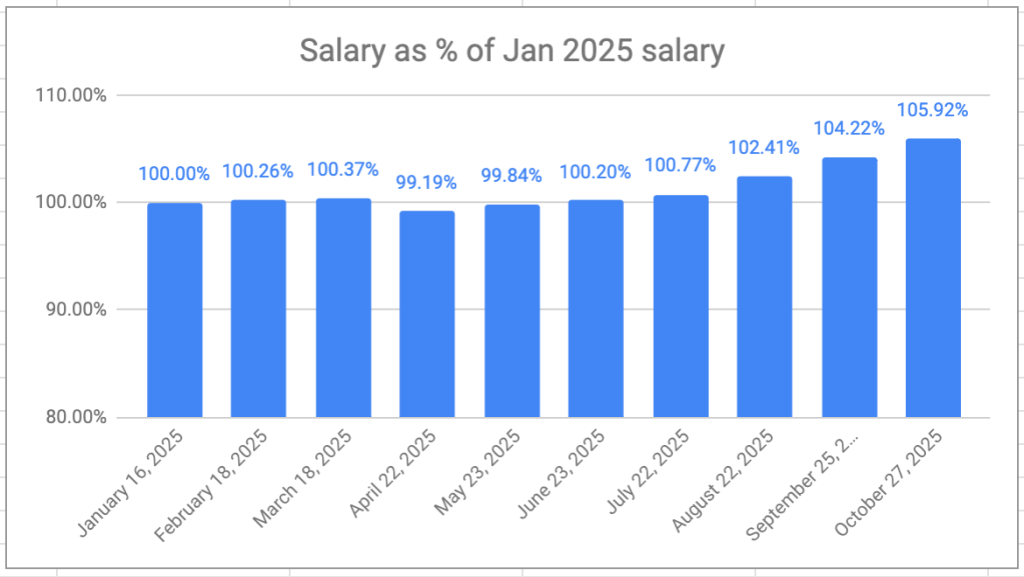
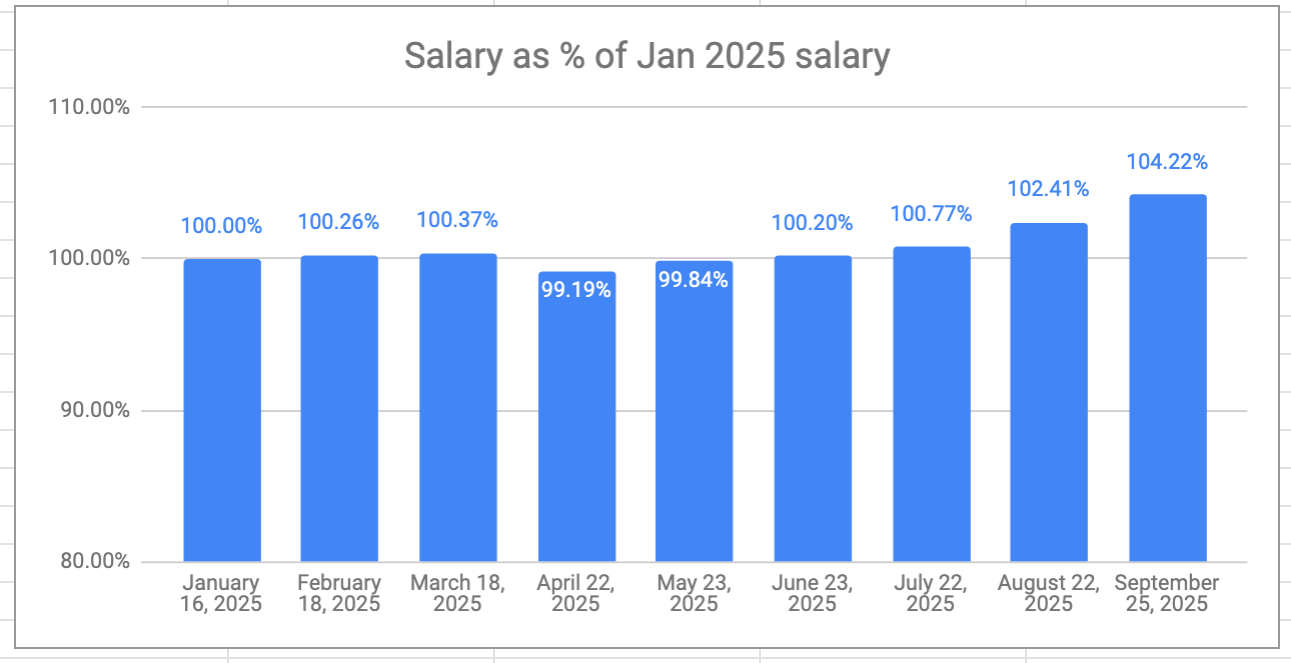
My VPW-calculated salary has hit a new high this year, 2.41% higher than my first draw in January3. This is also expected, since it tracks the value of the retirement portfolio, albeit in a much more controlled way. The VPW “cash cushion” smooths out the ups and downs of the monthly returns. I suppose I really should see an increase in my salary on par with inflation so that I maintain my spending power. I’ll have to think about how to track that4.

Monthly salary, as percentage of Jan 2025 salary
  1. I have purchased some TEQT lately since it has a lower MER. I covered TD’s family of all-in-ones here. ↩︎
  2. Since my target is 15% bonds, and XGRO is 20% bonds, I have to offset some of the XGRO purchases with 100% equity purchases. ↩︎
  3. Not a bad raise. ↩︎
  4. Looks like https://www.statcan.gc.ca/en/subjects-start/prices_and_price_indexes/consumer_price_indexes is a good place to start. ↩︎

HISA Table for August 2025

HISAs, for those in the know, are “High Interest Savings Accounts” and offer a nearly zero risk way to earn some interest on your cash holdings. Read all about them here. “Class F” funds are usually available via your online broker, often bought and sold in the same module as mutual funds, although they are NOT mutual funds.

Both central banks in the Canada and the USA declined to decline their interest rates at their last meetings, so there’s no significant changes to report in the table from last month.

If your broker doesn’t give you access to HISAs (or you have to pay large transaction fees to acquire them1), then there’s also ETFs that fit the bill, and some of them are now in this table, too.

ProviderFundLinkRate SheetRate
RBCRBF2011, RBF2021, RBF2031, RBF2041RBCLink2.55%
ScotiabankDYN6004, DYN5004, DYN3065, DYN3055, DYN3075ScotiabankLink2.70%
Equitable BankEQB1001, ETR1001Equitable Bankn/a2.55%
TDTDB8151, TDB8156, TDB8158, TDB8160TDn/a2.55%
RenaissanceATL5071Renaissancen/a2.55%
Home TrustHOM101,
HOM201
Home TrustLink2.65%
B2BBTB101B2B Bankn/a2.75%
ManulifeMIP610, MIP810Manulifen/a2.40%
National BankNBC200, NBC6200, NBC8200NBI Altamira CashPerformern/a2.55%
Global XCASHCASH Fact Sheetn/a2.55%2
EvolveHISAHISA Fact Sheetn/a2.79%3
BMOZMMKZMMK Fact Sheetn/a2.76%4
Canadian HISA rates, last updated August 5, 2025

Since I hold a substantial amount of USD-denominated ETFs, I also track US interest rates.

ProviderFundLinkRate SheetRate
RBCRBF2015RBCLink4.15%
ScotiabankDYN6005,
DYN5005
ScotiabankLink4.15%
Equitable BankEQB1101,
ETR1101
Equitable Bankn/a3.80%
TDTDB8153TDn/a4.15%
RenaissanceATL5075Renaissancen/a4.15%
ManulifeMIP611Manulifen/a3.30%
National BankNBC201NBI Altamira CashPerformern/a4.15%
Global XUCSHUCSH Fact Sheetn/a4.12%5
EvolveHISUHISU Fact Sheetn/a4.56%6
iSharesICSHICSH Fact Sheetn/a4.87%7
USA HISA rates, last updated August 5, 2025

UCSH and HISU invest in HISAs exclusively; I instead use ICSH which is a rough equivalent of ZMMK in terms of portfolio makeup. Like ZMMK, I enjoy a slight premium in yield as a reward for taking a bit more risk.

  1. I’m looking at you, Questrade. ↩︎
  2. Per July 31, 2025 dividend ↩︎
  3. Per July 29 dividend. Given what HISA holds (mostly National Bank and Bank of Nova Scotia HISAs), it’s puzzling how they managed to increase their per share dividend by 1.5 cents from last month, but that’s where it’s at. I wouldn’t expect that rate to continue. The website shows 2.58% yield (net). ↩︎
  4. I combined the two dividend payouts issued in July to come up with this number. Not sure why there were two; it’s certainly not the norm. ↩︎
  5. Per July 31, 2025 dividend ↩︎
  6. Per July 29 dividend. Same comment as for the Canadian side. This rate doesn’t make sense. Website shows 4.22%. ↩︎
  7. Per August 1, 2025 dividend. 30 day SEC yield shows 4.52% ↩︎

News: No change to either Canadian or US interest rates

As was widely expected, there was no change in interest rates on either side of the border. The Bank of Canada stood pat for a third month with a policy rate of 2.75% and the Federal Reserve bank stayed the course for the fifth straight month at a rate between 4.25% and 4.5%.

These rates underpin things like the HISA table I update monthly; as a result, I wouldn’t expect much in the way of change for my upcoming August update.

The next announcements from the two are scheduled for September 17.

Can I take advantage of higher US interest rates?

I have a dedicated non-registered account in my retirement portfolio that is the cash cushion for VPW’s decumulation strategy. You can read about the details of how I currently get paid in retirement here.

That non-registered account holds about 85% Canadian dollars, invested in ZMMK, with the remaining 15% invested in ICSH. Both of these ETFs are very short-term bond funds and give me a slight advantage over investing in zero-risk HISAs. ZMMK and ICSH are part of my ETF all-stars lineup, and I track HISA rates on a monthly basis.

The fact is that US interest rates are a lot higher than Canadian interest rates, almost 2% higher as of July 2025. It seems to me that I should take advantage of that fact. Taking advantage of this situation would mean selling some ZMMK, performing Norbert’s Gambit with the resultant cash, and then buying ICSH. There are costs involved at every step of the way1:

  • Selling ZMMK means I’ll get dinged with the bid/ask spread2
  • Performing Norbert’s Gambit costs $9.95 plus HST on Questrade to do the necessary journaling
  • There will be bid/ask spreads to pull off the Gambit…once when buying DLR, once when selling DLR.U
  • Buying ICSH means another bid/ask spread

So at what point is it worth it? Let’s do a bit of math using the following assumptions:

  • The delta between US and Canadian rates is 1.8% in favor of the US rate. That’s an annual rate, and I’ll just divide by 12 to get a monthly rate3.
  • The bid/ask spread for DLR per the ETF fact sheet is 0.1% on the CAD side and 0.07% on the USD side
  • The bid/ask spread for ZMMK is 0.02% per its fact sheet
  • …and the bid/ask spread for ICSH is 0.02% as well per its fact sheet
  • No change in the FX rate for the duration of this exercise4
  • No fees to trade DLR, DLR.U, ZMMK or ICSH5

So for various amounts, the time to profitability6 of doing the Gambit looks like this.

$ CAD changedJournaling Fee7DLR Spread Fee8ZMMK/ICSH spreadTotal costTTP9
$1k$12$1.70$0.40$14.10~10 months
$10k$12$17.10$4$33.10~10 weeks
$100k$12$170$40$222~6 weeks

So clearly, for amounts around $1k this isn’t such an attractive proposition as the costs will take a fair bit of time to be negated by the bump in interest rates. For larger amounts, I’d say it’s worth it. Given ZMMK hasn’t yet paid out its dividend for the month, I guess I’ll wait until I’m ex-dividend (July 30, 2025, per the fact sheet) before doing this transaction.

  1. I’m also ignoring the tax on any capital gains I might pull off. It will be quite small, and will be close to 0. ↩︎
  2. Bid/ask spread is the difference between what the price holders are willing to sell at versus the price offered by a buyer. For ZMMK this is typically 1 cent. ↩︎
  3. Whether this delta continues to hold is anybody’s guess. ↩︎
  4. Which, admittedly, has no hope of being correct. If you do this sort of thing frequently enough, it ought to even out over time. ↩︎
  5. This is true at Questrade. YMMV with your broker. ↩︎
  6. Henceforth “TTP”, naturally ↩︎
  7. Adding HST and rounding ↩︎
  8. Buying DLR is 0.1% and selling it is 0.07% ↩︎
  9. Investing all holdings at 1.8% annual rate of return ↩︎

What’s in my retirement portfolio (July 2025)

This is a (hopefully monthly) look at what’s in my retirement portfolio. The original post is here. Last month’s is here.

Portfolio Construction

The retirement portfolio is spread across a bunch of accounts:

  • 7 RRIF accounts (3 for me, 3 for my spouse, 1 at an alternative provider as a test)
  • 2 TFSA accounts
  • 4 non-registered accounts, (1 for me, 1 for my spouse, 2 joint)

The target for the overall portfolio is unchanged:

  • 80% equity, spread across Canadian, US and global markets for maximum diversification
  • 15% Bond funds, from a variety of Canadian, US and global markets
  • 5% cash, held in savings-like ETFs.

You can read about my asset-allocation approach to investing over here.

The view as of this morning

As of this morning, this is what the overall portfolio looks like:

Retirement holdings by ETF, July 2025

The portfolio is dominated by my ETF all-stars; anything not on that page is held in a non-registered account and won’t be fiddled with unless it’s part of my monthly decumulation. Otherwise I’ll rack up capital gains for no real benefit.

There weren’t big changes this month. My monthly decumulation from my RRIF accounts involves selling enough XGRO to meet RRIF-minimum payments, and the rest of my retirement paycheque is funded by my non-registered accounts. This month, given the run in the US stock market of late, that involved a sale of some shares of HXS1.

Plan for the next month

The asset-class split looks like this

The bond portion of the portfolio is a little smaller than I would like. The targets for my portfolio are unchanged:

  • 5% cash or cash-like holdings like ICSH and ZMMK
  • 15% bonds (almost all are buried in XGRO and AOA)
  • 20% Canadian equity (mostly based on ETFs that mirror the S&P/TSX 60)
  • 36% US equity (dominated by ETFs that mirror the S&P 500, with a small sprinkling of Russell 2000)
  • 24% International equity (mostly, but not exclusively, developed markets)

The change in the bond portion of the portfolio was amplified because I hadn’t updated the asset split of AOA in my multi-asset tracker in a while. AOA has drifted quite a bit since it only rebalances twice a year (next time in October). More on drifting in multi-asset ETFs here.

Overall

The retirement savings look quite healthy; even though I’ve been drawing a monthly salary for 7 months, I’m now ahead of where I was when I started my retirement journey. This is aligned with what my retirement planner told me to expect, but as you can see, the journey has had some interesting ups and downs already.

Monthly retirement savings, as percentage of Jan 2025 value

My VPW-calculated salary has hit a new high this year, a dizzying 0.77% higher than my first draw in January. This stability is thanks to the built-in shock-absorber of the VPW model (a 6-month cash cushion which smooths out the market gyrations considerably). I also think it’s an endorsement of my choice to take retirement payments monthly; my exposure to short-term market hiccups is greatly reduced since I’m not making big sales of ETFs to fund a year of spending all at once.

Monthly salary, as percentage of Jan 2025 salary
  1. Which particular ETF I sell from my non-registered portfolio is based on what asset class is the most overweight at that point in time. If it’s US Equity, then I sell US Equity. If it’s Canadian Equity, then I sell Canadian Equity. ↩︎