
HISA Table for July 2025

HISAs, for those in the know, are “High Interest Savings Accounts” and offer a nearly zero risk way to earn some interest on your cash holdings. Read all about them here. “Class F” funds are usually available via your online broker, often bought and sold in the same module as mutual funds, although they are NOT mutual funds.

The table hasn’t changed since May1, but I’m going to start adding HISA-alternative ETFs to the table just for comparison purposes. CASH and HISA are frequently-used Canadian ETFs that buy HISAs exclusively. I instead use ZMMK, which does not invest in HISAs at all, but instead uses very short term bonds to generate income. This is admittedly a bit riskier than the alternatives but as long as it pays me a bit of a premium, I’m ok with that. I did a market overview of cash and cash-like ETFs back in March, if you’re interested.

ProviderFundLinkRate SheetRate
RBCRBF2011, RBF2021, RBF2031, RBF2041RBCLink2.55%
ScotiabankDYN6004, DYN5004, DYN3065, DYN3055, DYN3075ScotiabankLink2.70%
Equitable BankEQB1001, ETR1001Equitable Bankn/a2.55%
TDTDB8151, TDB8156, TDB8158, TDB8160TDn/a2.55%
RenaissanceATL5071Renaissancen/a2.55%
Home TrustHOM101,
HOM201
Home TrustLink2.65%
B2BBTB101B2B Bankn/a2.75%
ManulifeMIP610, MIP810Manulifen/a2.40%
National BankNBC200, NBC6200, NBC8200NBI Altamira CashPerformern/a2.55%
Global XCASHCASH Fact Sheetn/a2.55%2
EvolveHISAHISA Fact Sheetn/a2.46%3
BMOZMMKZMMK Fact Sheetn/a2.88%4
Canadian HISA rates, last updated July 11, 2025

Since I hold a substantial amount of USD-denominated ETFs, I also track US interest rates.

ProviderFundLinkRate SheetRate
RBCRBF2015RBCLink4.15%
ScotiabankDYN6005,
DYN5005
ScotiabankLink4.15%
Equitable BankEQB1101,
ETR1101
Equitable Bankn/a3.80%
TDTDB8153TDn/a4.15%
RenaissanceATL5075Renaissancen/a4.15%
ManulifeMIP611Manulifen/a3.30%
National BankNBC201NBI Altamira CashPerformern/a4.15%
Global XUCSHUCSH Fact Sheetn/a4.07%5
EvolveHISUHISU Fact Sheetn/a4.02%6
iSharesICSHICSH Fact Sheetn/a4.70%7
USA HISA rates, last updated July 11, 2025

UCSH and HISU invest in HISAs exclusively; I instead use ICSH which is a rough equivalent of ZMMK in terms of portfolio makeup. Like ZMMK, I enjoy a slight premium in yield as a reward for taking a bit more risk.

  1. The next possible change to Canadian interest rates will be on July 30. The next possible change to US interest rates will be on July 29 or 30, so next month’s table may have some changes, most likely downward. ↩︎
  2. Calculated by dividing most recent distribution (June 30, 2025) by NAV price and multiplying by 12. What the providers show on their ETF fact sheet seems a bit random. ↩︎
  3. Based on June 26 distribution. ↩︎
  4. Based on June 27 distribution ↩︎
  5. Based on June 30 distribution ↩︎
  6. Based on June 26 distribution. ↩︎
  7. Based on July 1 distribution. The 30 Day SEC Yield as of July 2, 2025 shows 4.73% which is in the right ballpark. The SEC Yield appears to be a US effort to provide the investor with apples-to-apples comparisons of current yield. ↩︎

What’s in my retirement portfolio (June 2025)

This is a (hopefully1 monthly) look at what’s in my retirement portfolio. The original post is here. Last month’s is here.

Portfolio Construction

The retirement portfolio is spread across a bunch of accounts2:

  • 7 RRIF accounts (3 for me, 3 for my spouse, 1 at an alternative provider as a test)
  • 2 TFSA accounts
  • 4 non-registered accounts, (1 for me, 1 for my spouse, 2 joint)

The target for the overall portfolio is unchanged:

  • 80% equity, spread across Canadian, US and global markets for maximum diversification
  • 15% Bond funds, from a variety of Canadian, US and global markets
  • 5% cash, held in savings-like ETFs.

You can read about my asset-allocation approach to investing over here.

The view as of this morning

As of this morning, this is what the overall portfolio looks like:

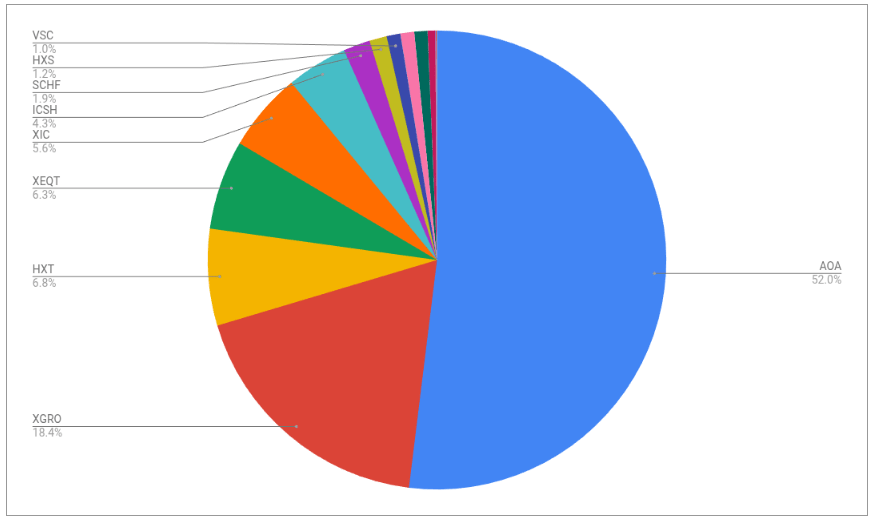
Retirement holdings by ETF, June 2025

The portfolio is dominated by my ETF all-stars; anything not on that page is held in a non-registered account and won’t be fiddled with unless it’s part of my monthly decumulation. Otherwise I’ll rack up capital gains for no real benefit.

The biggest changes over the last 30 days was due to a small rebalancing exercise I executed. I sold off some AOA in order to pick up more ICSH. The stock market has been roaring lately, and it caused my target allocations to become a bit cash-poor; ICSH is not, strictly speaking, “cash”, but for my purposes, it’s close enough. (You can read about my cash thoughts here). I could have instead sold XGRO to pick up more ZMMK, but US interest rates are a lot better than Canadian ones at the moment, so I figured I’d enjoy the extra few percentage points of return on my cash holdings.

Plan for the next month

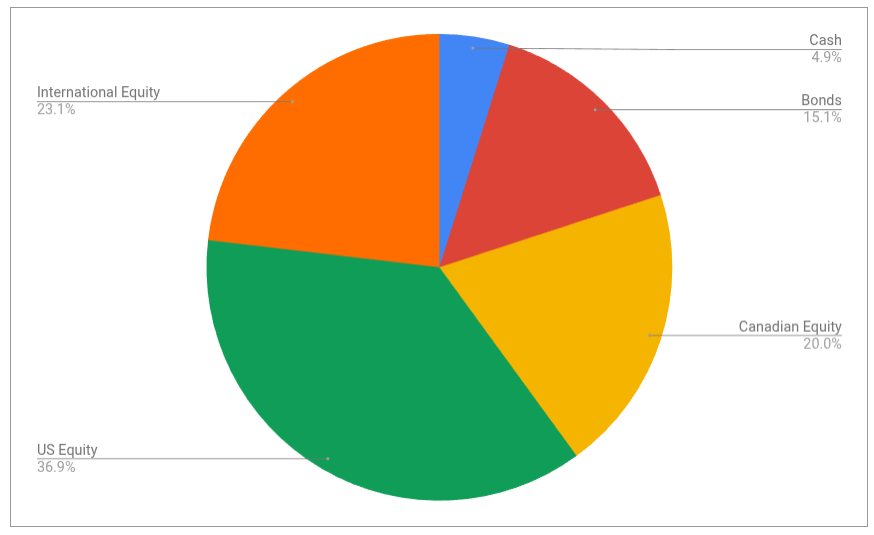
The asset-class split looks like this

This looks to be pretty close to my target percentages which haven’t changed:

  • 5% cash or cash-like holdings like ICSH and ZMMK
  • 15% bonds (almost all are buried in XGRO and AOA)
  • 20% Canadian equity (mostly based on ETFs that mirror the S&P/TSX 60)
  • 36% US equity (dominated by ETFs that mirror the S&P 500, with a small sprinkling of Russell 2000)
  • 24% International equity (mostly, but not exclusively, developed markets)

The pie is looking almost perfect at the moment. I don’t see any near-term need for fiddling with what’s there.

Overall

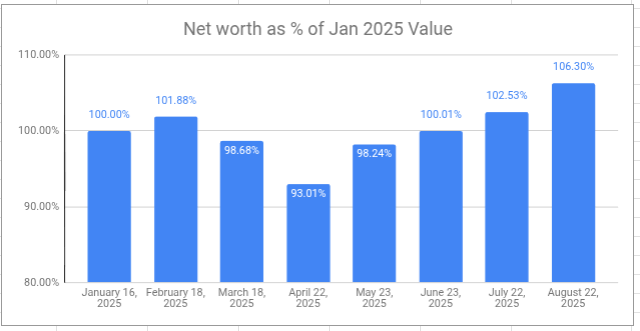
The retirement savings look quite healthy; even though I’ve been drawing a monthly salary for 6 months, I’m now ahead of where I was3 when I started my retirement journey. This is aligned with what my retirement planner told me to expect, but as you can see, the journey has had some interesting ups and downs aready.

Monthly retirement savings, as percentage of Jan 2025 value

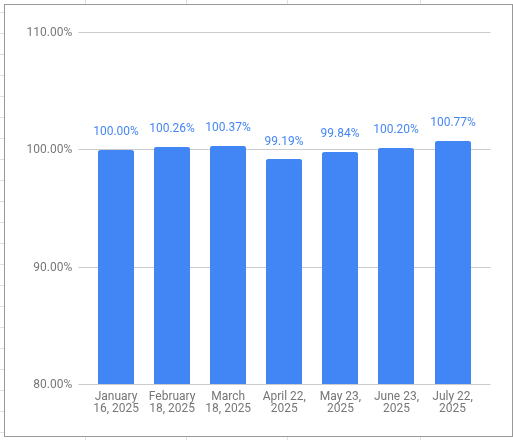
My VPW-calculated salary has gone back to more or less where I started at the beginning of the year. And even with the crazy market swings we’ve seen, it’s stayed remarkably stable4. That’s thanks to the built-in shock-absorber of the VPW model (a 6-month cash cushion which smooths out the market gyrations considerably). I also think it’s an endorsement of my choice to take retirement payments monthly; my exposure to short-term market hiccups is greatly reduced since I’m not making big sales of ETFs to fund a year of spending all at once.

Monthly salary, as percentage of Jan 2025 salary

  1. I know it’s July 7, but the numbers are accurate for June, more or less. ↩︎
  2. I treat retirement savings as firewalled from my day to day chequing account. ↩︎
  3. Just barely, but I’ll take it ↩︎
  4. I changed the vertical axis of this chart to align with the other chart; it makes its stability much clearer. ↩︎

News: Canadian and US interest rates stable; HISA Table for June unchanged

The Bank of Canada maintained their policy rate constant last week1, and as a result the HISA table remains stable, with no changes from the previous month. On the US side, no changes were announced at the mid-may Fed meeting; the next US Fed meeting happens June 18th, and as a result, there’s no changes on the US side either. The US Fed rate remains at 4.33%, the same level it’s been since December 19, 2024.

You can see last month’s table over here, with a newly updated “last update” date 🙂

Since my provider (Questrade) doesn’t provide a way to buy HISAs on the cheap, I use ZMMK for my Canadian cash holdings and ICSH for my USDs. These ETFs are part of my ETF all-stars. ZMMK’s last distribution was $0.12 per share, which works out to a yield of 2.89%2 and ICSH’s last distribution was $0.198284 per share, which works out to a yield of 4.71%.

As expected, I’m getting a slight premium on my interest rate for taking on a slightly more risky investment. I’ll keep on eye on that in future posts!

  1. At 2.75%, if you’re keeping track ↩︎
  2. 0.12/49.90*12 ↩︎

What’s in my retirement portfolio (May 2025)

This is a (hopefully monthly) look at what’s in my retirement portfolio. The original post is here. Last month’s is here.

Portfolio Construction

The retirement portfolio is spread across a bunch of accounts:

  • 7 RRIF accounts (3 for me, 3 for my spouse, 1 at an alternative provider as a test)
  • 2 TFSA accounts
  • 4 non-registered accounts1, (1 for me, 1 for my spouse, 2 joint)

The target for the overall portfolio is unchanged:

  • 80% equity, spread across Canadian, US and global markets for maximum diversification
  • 15% Bond funds, from a variety of Canadian, US and global markets
  • 5% cash, held in savings-like ETFs.

The view as of this morning

As of this morning, this is what the overall portfolio looks like:

Retirement holdings by ETF, May 2025

The portfolio is dominated by my ETF all-stars; anything not on that page is held in a non-registered account and won’t be fiddled with unless it’s part of my monthly decumulation. Otherwise I’ll rack up capital gains for no real benefit.

The biggest changes were caused by two events that happened over the past 30 days:

  • I did a small rebalancing exercise to reduce my exposure to the Canadian equity market, selling VCN in favor of XEQT. (XEQT is only 23% Canadian equity per dollar invested; VCN was 100%). This sort of rebalancing happens whenever I drift more than 1% off of my target allocations.
  • I took some cash from a HISA and invested it in ZMMK; for reasons too boring to report here, that money was effectively not being tracked in these pages until this month — that anomaly won’t be repeated in subsequent months since ZMMK and ICSH are where I park the “cash” position of my portfolio.

Plan for the next month

The asset-class split looks like this

This looks to be pretty close to my target percentages which haven’t changed:

  • 5% cash or cash-like holdings like ICSH and ZMMK
  • 15% bonds (almost all are buried in XGRO and AOA)
  • 20% Canadian equity (mostly based on ETFs that mirror the S&P/TSX 60)
  • 36% US equity (dominated by ETFs that mirror the S&P 500, with a small sprinkling of Russell 2000)
  • 24% International equity (mostly, but not exclusively, developed markets)

So, the plan for next month is, do nothing out of the ordinary. Reinvest cash (dividends, TFSA contributions) in one of AOA, XEQT/XGRO, ICSH or ZMMK depending on the asset category most in need on the day of the reinvestment. All these ETFs are covered on my ETF All-Stars page.

One thing I may do is to try to make shifts2 to get a little more return out of my cash position. US interest rates are quite a bit higher than Canadian rates, and so if my cash position is held in USD, I stand to eke a few more points of return there. TBD.

Overall

My retirement savings had a nice bounce-back this month, looks like I can cancel the mega-pack of pot noodles I had on order.

Monthly retirement savings, as percentage of Jan 2025 value

The salary I collect month to month recovered a bit, too, although not as quickly. That’s the magic of using VPW’s cash cushion — neither boom nor bust months translate into large changes in the take-home pay.

Monthly salary, as percentage of Jan 2025 salary

  1. That’s up one from the previous month. In order to collect on Questrade’s transfer bonus, (which they have yet to pay me, they are apparently in a world of hurt on the IT front) you have to have a non-registered account to get paid into. The other 3 are “normal” — one non-registered account for me, one for my spouse, and jointly held one that serves as a cash cushion to smooth out month to month variations in my retirement salary. Read more about that over at https://moneyengineer.ca/2025/01/31/im-retired-now-how-do-i-get-paid/ ↩︎
  2. With Questrade, all ETF trades are free to make, so I don’t have any real reason not to make such changes. ↩︎