
Travel is something I like doing. Spending money on seeing new places, trying new things, all good from my perspective. But spending unnecessary money to line the pockets of a bank? I’m not so good with that.
For many years, I’ve used my credit card everywhere, in every country. Very convenient. I recall my first big trip abroad (circa 1992) where my main source of money was Travelers Cheques, if you can believe it. (Looks like they aren’t even available in Canada anymore).
But I never realized how much this habit was costing me. From https://www.cibc.com/en/personal-banking/credit-cards/articles/foreign-currency-credit-card.html:
It’s common for a credit card company to charge a foreign currency conversion fee between 1% and 3% of the transaction amount.
What’s especially sneaky, and the reason I never gave it much thought, is that the fee is buried in the exchange rate that is posted as part of the transaction. As a result, it’s easy to miss how much you’re giving to the bank.
Now, 1% to 3% extra for a cup of coffee or a taxi ride isn’t going to break the bank, but for a multi-night stay in a hotel? Show tickets? Car rentals? It can start to add up.
Here are two products that I use to help get rid of those fees. There are others out there, but these I have used myself and can recommend them.
Wealthsimple’s Cash Card
I’ve been rather curious about Wealthsimple for a while now. I started with using their “pay what you want” tax service and saw it got a mention from the Globe and Mail’s Rob Carrick (an excellent resource, by the way) which led me to investigate further. This is NOT their “beta” Wealthsimple Infinite Visa credit card that is coming out in 2025.
From https://www.wealthsimple.com/en-ca/spend:
Now you can feel like a local while shopping abroad. With no additional foreign transaction or ATM fees from Wealthsimple, your Cash card is a must-have travel companion.
The Cash Card, as far as a vendor is concerned, looks like a MasterCard. But to you, the card holder, the Cash Card looks like a debit card. Any transaction charged to the Cash Card is instantly debited, so you have to have the money available in your Weathsimple account before you go on a shopping spree.
Signing up for the Cash Card was done online, in minutes. Putting money on your Cash Card can be done using Interac e-transfer from your “usual” bank account, and is available pretty much instantly as well. Cash Card supports Apple Pay and as a nice bonus, also provides you with a “virtual card” accessible from the Wealthsimple app so you can enter credit card details for online purchases. You can also order up a physical card, but I’m still waiting for mine….The Canada Post strike apparently is still being used as an excuse in that regard. (Not a big deal, I rarely use a physical card anymore).
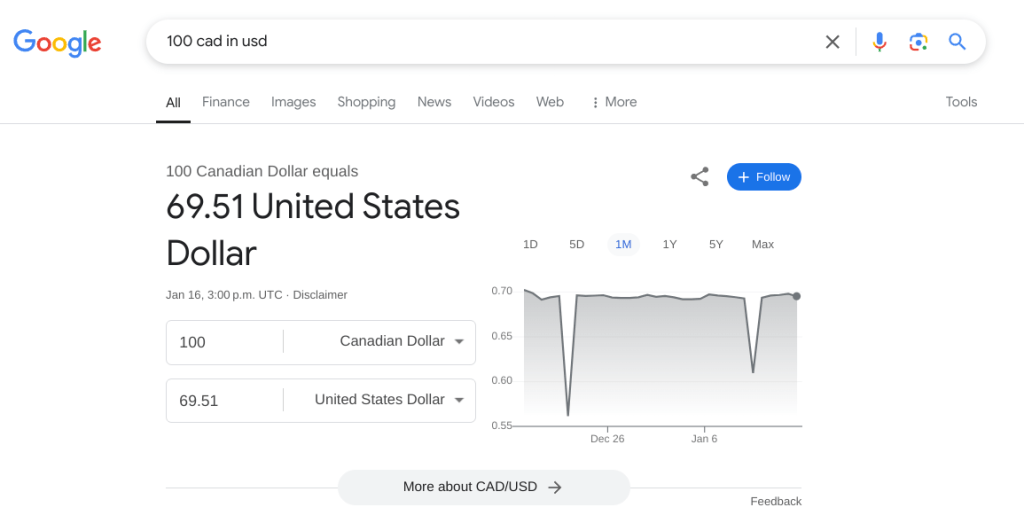
I’ve now successfully used the Cash Card for US dollar and British pound purchases, and the rate I got was exactly the same as the rate I saw in real time from Google (cries quietly at the current exchange rate):
- Pro: Very easy to set up, does what it says — no extra foreign exchange fees
- Pro: Supports multiple foreign currencies, with only a few exceptions.
- Pro: It’s free, and the money in your Cash account actually earns a bit of interest.
- Con: You have to have the money available up front, it’s not a credit card that you can pay later.
CIBC’s US Dollar Aventura Gold Visa Card + CIBC US Dollar Savings Account
If instead you’re looking for a REAL credit card and you’re only interested in US dollar transactions, then CIBC’s US Dollar Aventura Gold Visa might be a choice. I signed up for this card because a lot of my retirement funds are in US Dollars, I travel and shop in US Dollars pretty regularly, and I happen to bank with CIBC which also makes things easier.
However, unless you already have a US Dollar bank account that can pay off your US Dollar credit card, you’ll need to set that up at the same time. So for that I used the CIBC US Dollar Savings account. This should not be confused with CIBC’s US checking account which isn’t required (I have this account too, but have very limited use for it).
So, applying for these products is the typical Canadian bank experience. Multiple days, multiple forms, mildly unpleasant, but as a self-directed investor, not unusual, either.
The Visa card has an annual fee ($35, which includes up to 3 additional cards) and allows you to collect a small amount of Aventura points which can be redeemed for cash or gift cards. The card supports Apple Pay and generally works like any other card you may have used. Just make sure you don’t accidentally use it for a Canadian dollar transaction or else you’ll get charged that extra conversion fee that you were trying to avoid in the first place.
The savings account pays a paltry amount of interest (0.05% for balances under $10,000 USD) and charges $0.75 USD for every transaction. So, nothing to write home about there. But it is in essence a Canadian bank account in every way; this means (for example) it can be set up as a legitimate bank account with your online broker.
- Pro: if you’re already banking with CIBC, both the credit card and the savings account are linked to your existing CIBC bank card, so you can see everything from one login.
- Pro: Related to the above, you can set up auto payment of your USD credit card from your USD savings account
- Pro: Related to the above, you can easily move money from your Canadian accounts to your US accounts. Of course, with this convenience comes the added foreign exchange fee that you were hoping to avoid, but if you’re short US Dollars, then it’s an option. (In another post, I’ll talk about how I convert US dollars cheaply).
- Pro: It’s a real credit card, meaning you can defer payment.
- Con: Compared with Wealthsimple, it’s somewhat painful to set up
- Con: it’s only useful for US dollar transactions
For most people, the Wealthsimple Cash Card is the easy way to save money on foreign transactions, and the downside is small. If you have access to US dollars (maybe you’re paid in USD, or like me, have investments in USD), then perhaps the CIBC Aventura card might make sense, too.
Discover more from The Money Engineer
Subscribe to get the latest posts sent to your email.
 The Money Engineer
[…] I have a lot of US dollar assets in my retirement portfolio. I’m not really convinced it’s a good idea, but it has taught me the ins and outs of USD foreign exchange rates. Here I’m talking about getting access to (or changing from) US funds for the purposes of investing in your brokerage account. Getting access to US funds to buy things is a different1 animal, one that I covered in a previous post. […]
LikeLike
[…] with Wealthsimple. I have one RRIF account with them (history of why is found here), their Cash card is a wonderful tool to save money when traveling and their chequing accounts actually pay reasonable […]
LikeLike
[…] been a fan of Wealthsimple’s prepaid Mastercard for a while now. I wrote about it over here. My favourite feature of this prepaid Mastercard is that it does not charge the usual 1.5% foreign […]
LikeLike