News: Deal for DIY Retirement Planning

Disclaimer: I get nothing from pointing out this deal, and I haven’t used the product below myself. But all the same, it might be of possible interest to readers of this blog.

“Cashflows and Portfolios” is one of my top places to get advice. (It’s listed along with other great resources, in the blogroll).

Along with great (and free) advice, the folks behind the blog offer for-fee retirement planning services. But they do have one twist for the hard-core DIYer: they offer access to retirement projection software so you can do your own projections. (Looks like they use Adviice — just like a lot of planners do).

Anyway, their latest newsletter indicates that they’ve lowered the price of their DIY retirement planning service and are offering an additional 10% off. You can get all the details here.

I do recommend paying for some kind of retirement planning service; I did it and it gave me the confidence to set my retirement plan in motion 2 years earlier than I first anticipated. You can read about how I came to the decision to “pull the plug” here.

What’s in my retirement portfolio (April 2025)

This is a (hopefully monthly) look at what’s in my retirement portfolio. The original post is here. Last month’s is here.

Portfolio Construction

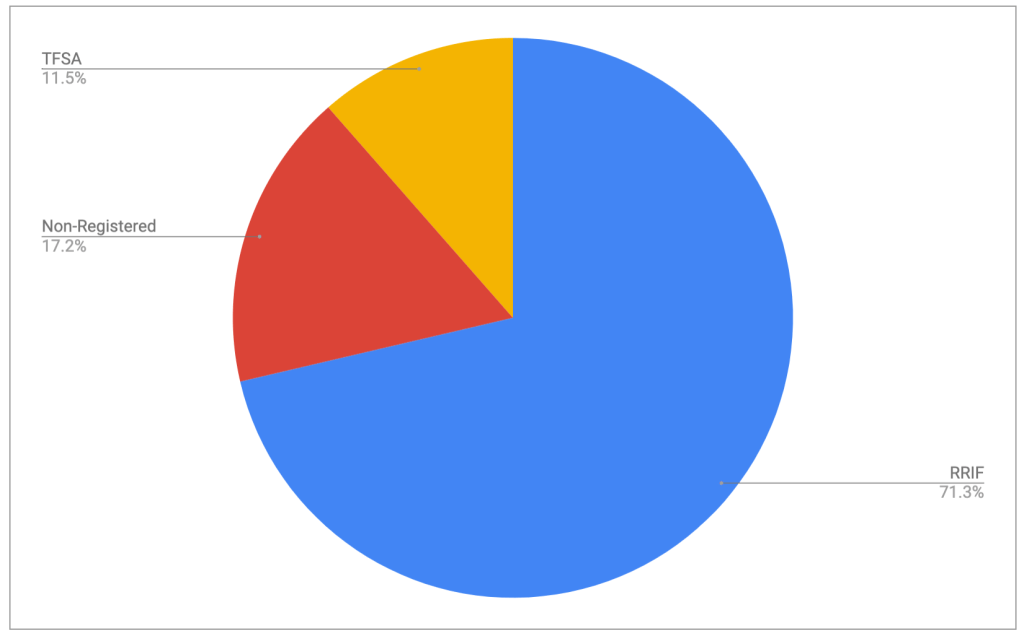
The retirement portfolio is spread across a bunch of accounts:

  • 7 RRIF accounts (3 for me, 3 for my spouse, 1 at an alternative provider as a test)
  • 2 TFSA accounts
  • 3 non-registered accounts1, (1 for my spouse, 2 joint)

The target for the overall portfolio is unchanged:

  • 80% equity, spread across Canadian, US and global markets for maximum diversification
  • 15% Bond funds, from a variety of Canadian, US and global markets
  • 5% cash, held in savings-like ETFs.

The view as of this morning

As of this morning, this is what the overall portfolio looks like:

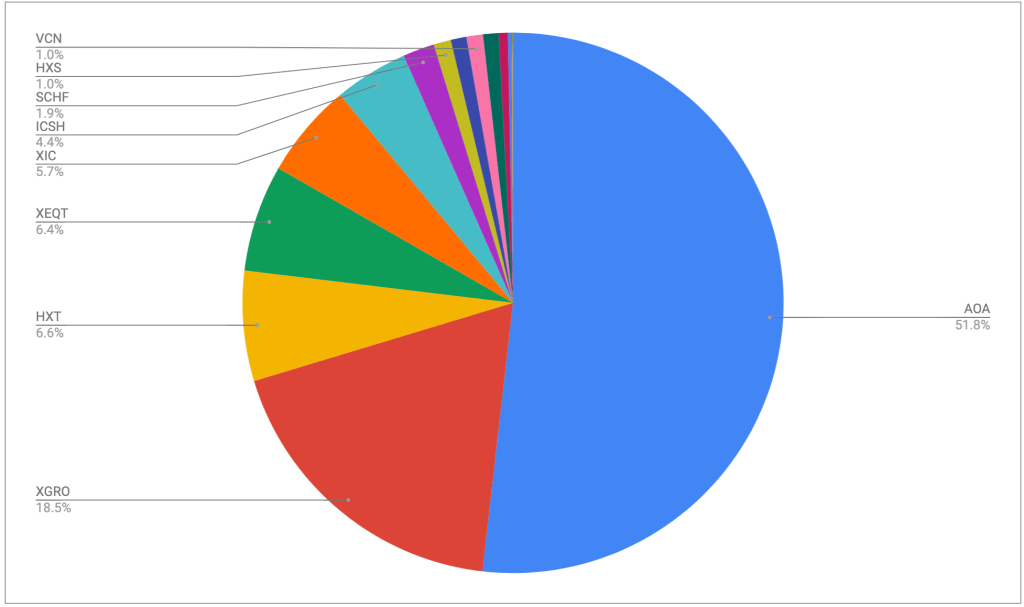
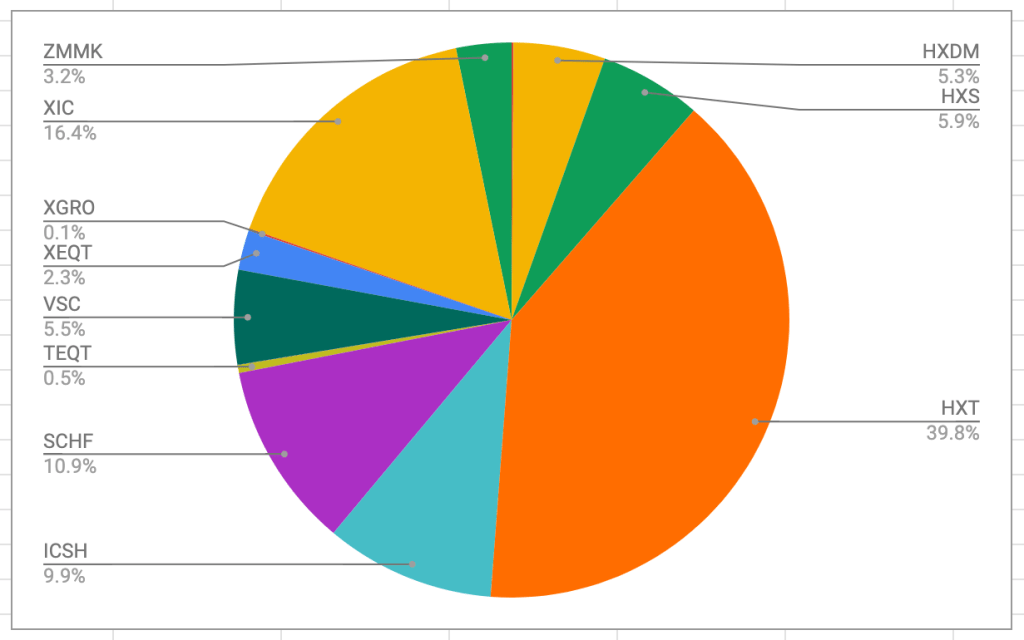
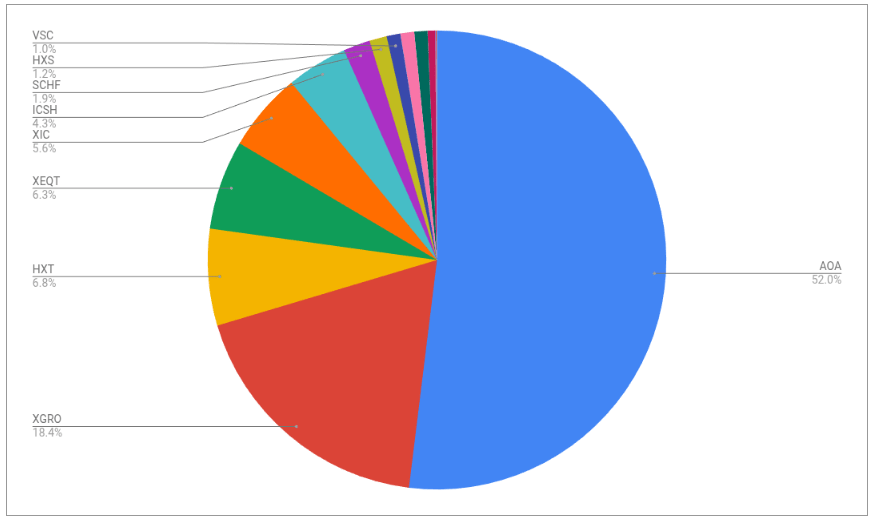
Overall retirement portfolio by holding, April 2025

The portfolio, as always, is dominated by AOA and XGRO which are 80/20 asset allocation funds in USD and CAD, respectively. The rest are primarily either cash-like holdings in two ETFs: ZMMK in CAD and ICSH in USD) or residual ETFs held in non-registered accounts for which I don’t want to create unnecessary capital gains just for the sake of holding AOA or XGRO.

The biggest month over month change was a small decline in AOA and a small uptick in XEQT, about a 1% shift overall. This was because I shifted some of my USD assets to CAD assets in the RRIF using Norbert’s Gambit2. I chose XEQT over XGRO because the contribution of bonds in the portfolio was slightly over my asset allocation target3. XEQT is essentially XGRO, minus the bond holdings (it’s a 100% equity fund).

There was also a noticeable reduction in the contribution of ICSH to the portfolio; this was largely due to the unfavourable change in the USD/CAD exchange rate over the course of the month, and not due to any change in the holdings there.

Plan for the next month

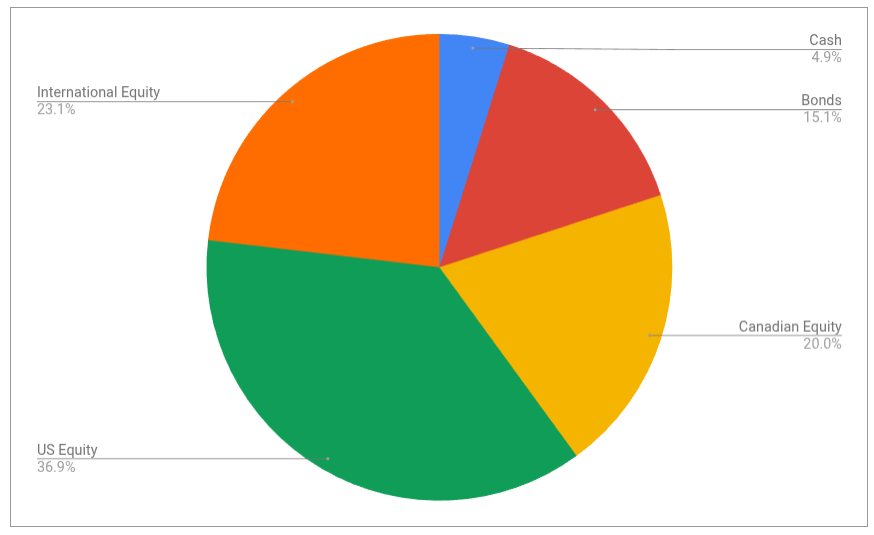
The asset-class split looks like this
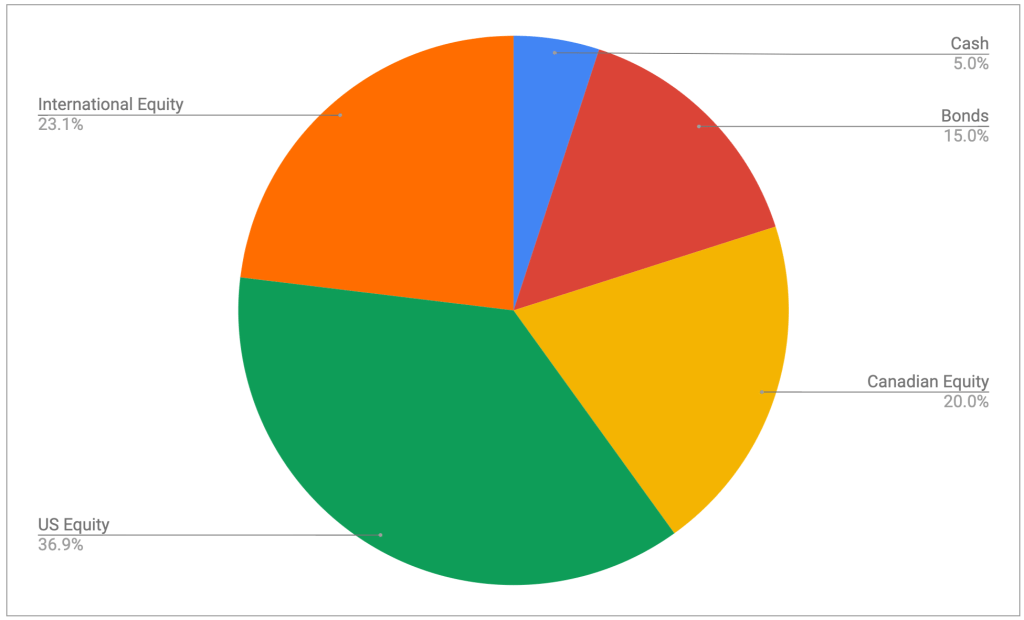
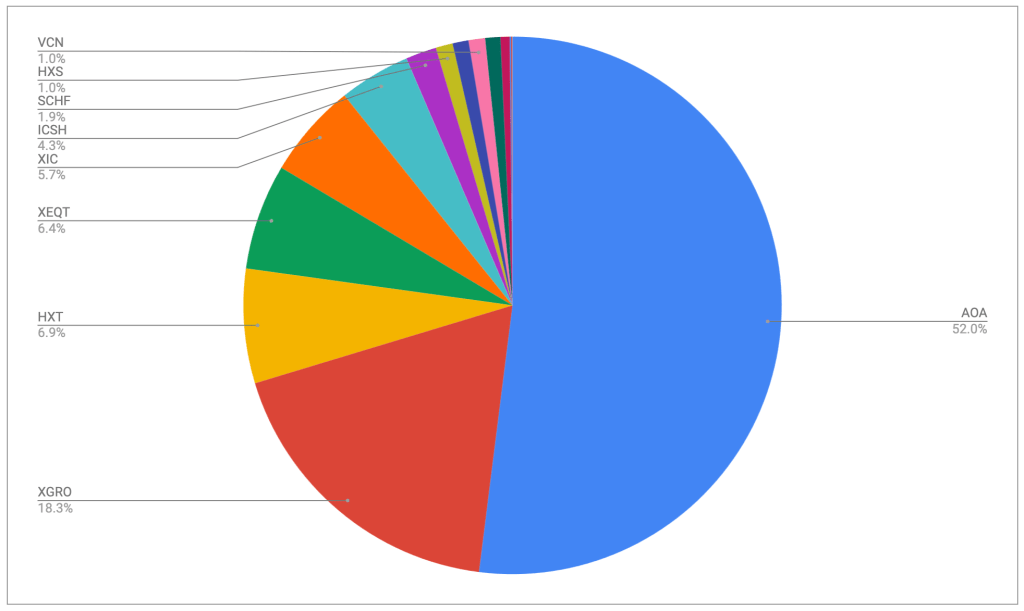
Overall retirement portfolio by market, April 2025

This looks to be pretty close to my target percentages which haven’t changed:

  • 5% cash or cash-like holdings like ICSH and ZMMK
  • 15% bonds (almost all are buried in XGRO and AOA)
  • 20% Canadian equity (mostly based on ETFs that mirror the S&P/TSX 60)
  • 36% US equity (dominated by ETFs that mirror the S&P 500, with a small sprinkling of Russell 2000)
  • 24% International equity (mostly, but not exclusively, developed markets)

So, the plan for next month is, do nothing out of the ordinary. Reinvest cash (dividends, TFSA contributions) in one of AOA, XEQT/XGRO, ICSH or ZMMK depending on the asset category most in need on the day of the reinvestment. All these ETFs are covered on my ETF All-Stars page.

Overall

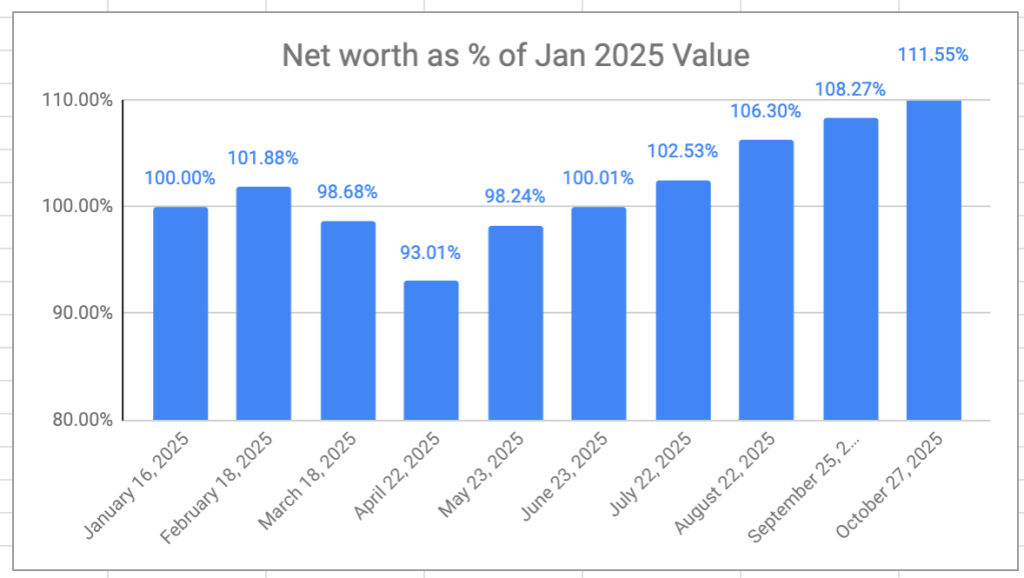
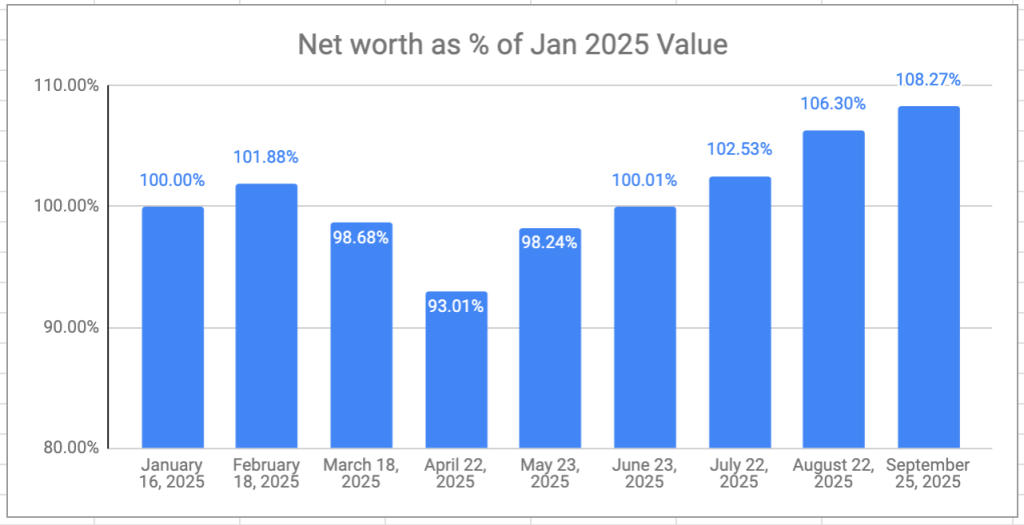
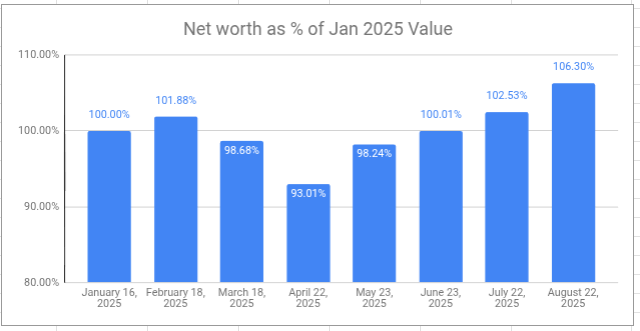
My retirement savings declined 5.75% over the month (down 7% since January) due to the continuing meltdown in the equity markets. It’s not a pretty picture!

Net worth of retirement savings compared to start of retirement

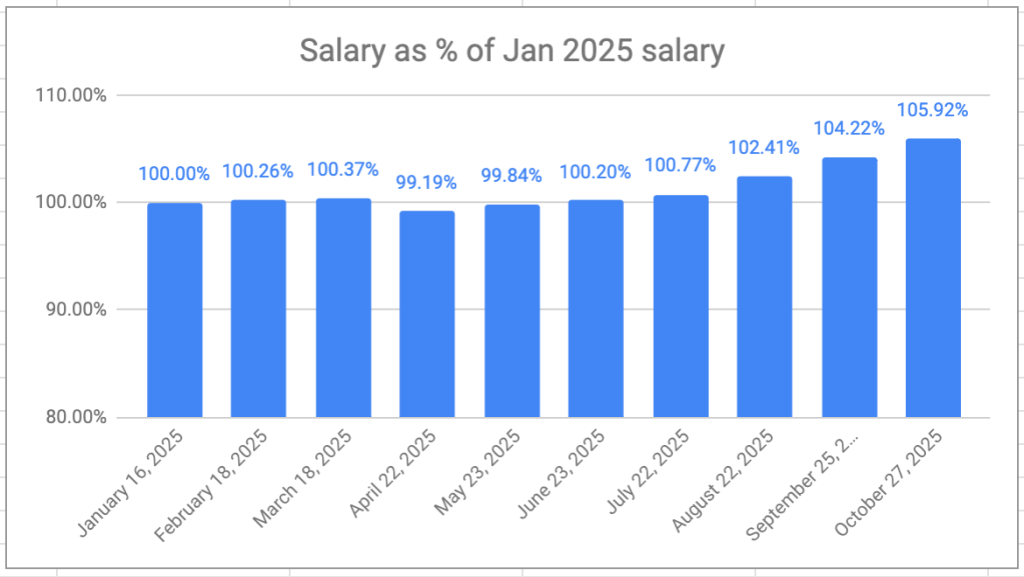
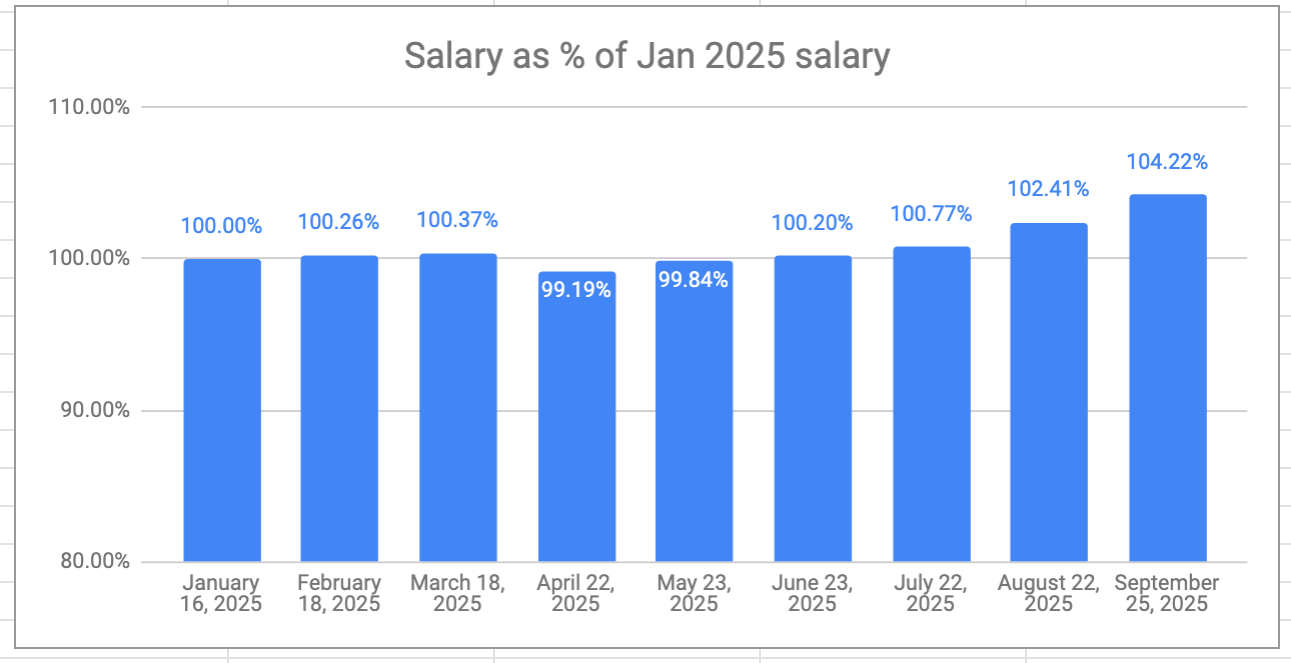
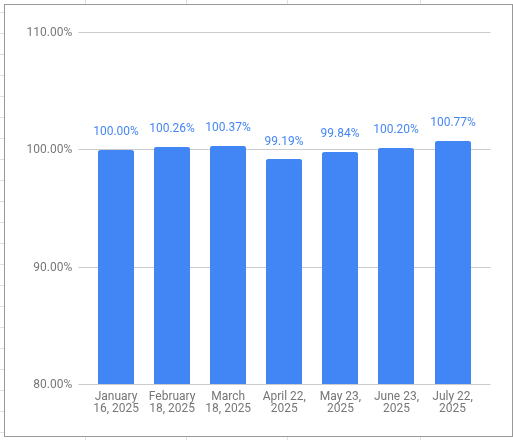
This has not translated to a the same degree of change in my monthly salary. Why? My retirement payouts are calculated by Variable Percentage Withdrawal (VPW), which I cover here. VPW has a built-in cash cushion, which serves to dampen month to month swings in my net worth, either up or down. As you can see in the chart below, my monthly salary has stayed within a 1% band of the first salary I drew in January.

Month over month salary, as compared to start of retirement

  1. Since Questrade combines USD and CAD assets under the same account umbrella, I was able to reduce the number here. ↩︎
  2. I shift funds from the USD to the CAD side of the RRIF more or less quarterly since all RRIF payments are currently coming out of the CAD side of the portfolio. ↩︎
  3. That’s the optimistic point of view; it’s perhaps more accurately stated as “bonds haven’t melted down quite as much as the equity portion of my portfolio”. ↩︎

What’s in my retirement portfolio (March 2025)

This is a (hopefully monthly) look at what’s in my retirement portfolio. The original post is here. Last month’s is here.

Portfolio Construction

The retirement portfolio is spread across a bunch of accounts1:

  • 7 RRIF accounts (3 for me, 3 for my spouse, 1 at an alternative provider as a test)
  • 2 TFSA accounts
  • 5 non-registered accounts, (2 for me 1 for my spouse, 2 joint)

The target for the overall portfolio is unchanged:

  • 80% equity, spread across Canadian, US and global markets for maximum diversification
  • 15% Bond funds, from a variety of Canadian, US and global markets
  • 5% cash, held in savings-like ETFs.

The view as of this morning

As of this morning, this is what the overall portfolio looks like:

Overall retirement portfolio by holding, March 2025

The portfolio, as always, is dominated by AOA and XGRO which are 80/20 asset allocation funds in USD and CAD, respectively. The rest are primarily either cash-like holdings in two ETFs: ZMMK2 in CAD and ICSH3 in USD) or residual ETFs held in non-registered accounts for which I don’t want to create unnecessary capital gains just for the sake of holding AOA or XGRO.

The biggest month over month change is due to switching brokers. My old broker (QTrade) allowed the purchase of HISAs, but my new broker (Questrade) doesn’t seem to offer them4. So I replaced DYN6004 with ZMMK and DYN6005 with ICSH. I made these changes in my QTrade account to avoid any problems with doing an “in-kind” transfer to Questrade.

I’m still in need of USD to pay off some vacation bills, so there is a small hit to SCHF to help out.

Plan for the next month

The asset-class split looks like this

Overall retirement portfolio by market, March 2025

The international equity percentage is below my target of 24%, and so I’ll have to fix that5. VEU looks like it provides exposure to both developed and emerging markets at a rock-bottom price6. XEF would be a perfect fit in the Canadian market, although I should probably also consider XEC to get some emerging markets exposure.The cash position is artificially high because I already did the necessary transactions to get paid out of my RRIF and non-registered accounts (if I did this exercise at the beginning of the month, rather than mid-month, that would disappear). That extra cash will flow to my bank account in the coming days.

A quarterly activity that I’ll be performing this month7 is to shift some of my USD RRIF holdings into my CAD RRIF. I do this to make sure I’m not overexposed to changes in the CAD/USD exchange rate. My current provider reportedly allows me to make RRIF payments natively in USD, so that may be another option to consider. I’ll make an attempt at some point!

One final note: my retirement savings declined 3%8 over the month due to the wild (mostly downward) swings in the stock market, but this leaves me roughly even since my retirement started at the beginning of the year. Here’s the monthly returns for the 2 ETFs that make up the lion’s share of my portfolio9.

XGRO and AOA monthly returns so far
  1. The list is sort-of accurate. I’m in the middle of changing online brokers and since Questrade combines USD and CAD assets in one account, the number of accounts is diminishing. ↩︎
  2. Current 12-month yield: 3.6% ↩︎
  3. Current 30-day SEC yield: 4.61% ↩︎
  4. This specific topic addressed at https://www.financialwisdomforum.org/forum/viewtopic.php?t=125308. ↩︎
  5. The observant reader will note I also said this LAST month. That was before I decided to switch brokers. Once my holdings settle at Questrade, I’ll revisit. ↩︎
  6. MER = 0.04%. VEU has some Canadian exposure too, which isn’t ideal, but I don’t think there’s a USD ETF that excludes both Canada and the USA. ↩︎
  7. And should have done last month, sorry. ↩︎
  8. It would have been worse, except the USD also went up versus the Canadian dollar in the time period. Diversification works 🙂 ↩︎
  9. “Without dividends reinvested” since these two ETFs only pay out quarterly. There haven’t been any yet — next month! ↩︎

Significant birthdays for the DIY Investor

There are significant birthdays every DIY investor should be aware of. Did you know about all of them?

The list below is a gross simplification — like all things in the Canadian Tax code, the exceptions and caveats fill many pages, but this is roughly correct. I’ve included links so you can read the relevant sections yourself and see if you agree with my simplifications!

The day of your child’s birth

Per the feds, a birth certificate for your child is all you need to apply for a Social Insurance Number. And although their working days are far into the future, their RESP eligibility starts right away — but you can’t open an RESP for a child unless that child has a SIN. The lifetime limit for donations to an RESP is currently set at $50k/child. The sooner those contributions start, the sooner you can collect free money (the CESG, $500/year, $7200 per child lifetime), and the longer your contributions can benefit from the power of compounding.

Your 18th birthday

This is significant one for a number of reasons!

TFSA

Once you turn 181, you can open a TFSA and begin contributing. Even if you don’t start contributing, your TFSA limit starts to accumulate the year you turn 18. In 2025, that annual limit is $7000 per year, and it grows at the rate of inflation2. It’s cumulative, so it’s not a “use it now or lose it forever” kind of proposition. At the start of every calendar year, there are a flurry of announcements indicating the new annual limit.

You can contribute to your TFSA forever, even in retirement. I am!

CPP contributions kick in

If you’re over 18 and earn more than $3500 a year, you’ll have to pay CPP contributions. While current you may balk at this sort of reduction in your take-home pay, future you will appreciate the inflation-index adjusted salary you can collect later in life.

FHSA

You can open a First Home Savings Account on your 18th birthday…or maybe your 19th birthday3. And the year you open it, you add $8000 in eligible contribution room…which continues every year, to a maximum of $40000.

Your 19th birthday

The so-called “age of majority4” in Ontario allows you to roll in free money in the forms of GST credits, Trillium benefits5 (in Ontario) and carbon tax credits6 . The cost of admission is filing a tax return. No excuses — plenty of online providers offer free returns for “simple” returns and my friends at Wealthsimple offer “pay what you want” tax filing.

This is also a time you are eligible to open an RRSP7, which may make sense if you’re already maxing out your TFSA contributions.

Your 35th birthday (or later)

An RESP can only be open for 35 years.

Your 60th birthday

This is the first year you can choose to collect CPP; generally speaking, most experts recommend that you delay collecting CPP for as long as possible, for two reasons:

  • It may be the only inflation-protected income you have (this applies to me, I have no other pension)
  • You get more money the longer you wait. (you lose 0.6% of payment for every month you start before your 65th birthday. That adds up to a reduction of 36% if you start on the day you turn 60).

My tools page includes the very helpful CPP calculator, which can help you make a decision concerning your CPP start date.

Your 65th birthday

This is the first year you can choose to collect OAS. Experts are a little more split on whether or not to delay this one — the benefits to delaying to age 70 are not as strong as for CPP8. My plan is to delay, as it’s another inflation-adjusted benefit.

If you’re collecting any sort of pension (RRIF payments, CPP, employer pension) this is the first age at which you can split that income with your spouse. This can reduce your tax bill.

Your 70th birthday

You have to start taking CPP and OAS by this time.

Your 71st birthday

You can no longer contribute to an RRSP and you have to open a RRIF. Lots of the literature out there seems to imply that this is the ONLY time you can open a RRIF, but rest assured, there’s no minimum age for opening a RRIF — I’ve been collecting from mine since the start of the year 🙂

Your 85th birthday

This is the last year you can start collecting from an ALDA (advanced life deferred annuity) you have set up. The ALDA is a vehicle I just learned about, and need to do a bit more research. It may be a way to fund income in your later years when the complexity of managing withdrawals in a DIY fashion may be too cognitively overwhelming.

What birthdays are you thinking about? Let me know at comments@moneyengineer.ca.

  1. Or possibly 19, depending on where you live. ↩︎
  2. But only in increments of $500. Even though inflation is drifting back down to more usual levels, doing the math indicates that we should expect more frequent increases in the TFSA limits in the years to come. Adding $500 to a $7000 limit (a 7% bump)is a lot easier than adding $500 to a $5000 limit (a 10% bump) ↩︎
  3. Per https://www.canada.ca/en/revenue-agency/services/tax/individuals/topics/first-home-savings-account/opening-your-fhsas.html “certain provinces and territories, the legal age at which an individual can enter into a contract (which includes opening an FHSA) is 19 years old” ↩︎
  4. This language is so opaque, it’s like a parody of government speak. Or maybe it’s a commentary on the aging demographic of Ontario? ↩︎
  5. Some of the benefits even kick in earlier ↩︎
  6. A limited time offer, presumably ↩︎
  7. Per CRA, there is NO minimum age at which you can open an RRSP. Contributing to an RRSP requires that you enter into a contract (meaning you have to be of an age that permits this, either 18 or 19) and you have to earn money. ↩︎
  8. It’s still 0.6% per month of delay, or 36% over 5 years. That’s pretty good RoI, in my view. ↩︎