RRIF Support Showdown: Wealthsimple, Questrade, QTrade

I’m currently holding RRIF accounts at three different online providers (QTtrade, Questrade and Wealthsimple)1. So I am perhaps uniquely positioned to comment on the relative goodness and badness of the support of this kind of account at these three brokers. I also have some experience with BMO Investorline in this regard, but that experience is getting a bit long in the tooth now.

So without further ado, let’s take a look:

Wealthsimple

Wealthsimple now provides support for both RRIFs and (relatively recently) Spousal RRIFs. And although Wealthsimple supports USD accounts, they do not (for whatever reason) support USD RRIFs2, which, for many readers, isn’t a big deal, but to me it is.

But for all that, I still hold a CAD RRIF with Wealthsimple. It started last year, when I realized my DPSP couldn’t be immediately converted to a RRIF, and Wealthsimple was offering a shiny new Macbook to win the business. How could a certified cheapskate refuse?

Since I only opened the RRIF last year, this year is the first year where I’m obliged to take out RRIF-minimum payments. Wealthsimple makes this stupidly easy on many levels:

  • They clearly display what your minimum payment for the year is right on the account screen, and they also show how much you have left to go against that minimum
  • They make it easy to create a “recurring withdrawal” from the RRIF, which is something I do every month, and I can easily change this whenever I want, although I’m not planning on doing that.
  • And — bonus — they support XGRO fractional shares AND the ability to place a sell trade in dollars and cents rather than # of units. This means I can sell EXACTLY the number of XGRO units I need to every month, with no excess dead-money cash floating around.

You have to set up your bank account for EFT withdrawals before this works, of course.

QTrade

I still hold 3 RRIF accounts at QTrade, although I’ve been trying to move them to Questrade since late November. Seems that there is an industry-wide freeze on moving RRIF accounts in the month of December.

QTrade supports USD and CAD RRIF accounts, and they keep them completely separate — different account numbers, even. They are linked, however, because the TOTAL value of the 2 accounts is used to determine your CAD RRIF minimum payment. I’ve only withdrawn RRIF funds in Canadian dollars, because I couldn’t get a straight answer whether I could withdraw USD funds natively to my USD account.

QTrade also supports Norbert’s Gambit, which is important if you want to convert between USD and CAD cheaply.

With QTrade, you have to send in a form to set up your RRIF withdrawals, either monthly/quarterly/annually. And per their fee schedule, if you deviate from this, you owe them $503.

Once the schedule is in place, the withdrawals happen automatically. You have to make sure you sell your assets in advance of the withdrawal date. What happens if you don’t have enough funds? Not sure, cannot find any documentation that addresses this. There is also no indication online as to what your RRIF minimum payment is; you have to contact support if you want the exact amount.

Questrade

The majority of my RRIF holdings are here. As mentioned above, I’m trying to move 3 RRIF accounts from QTrade to Questrade. The delay from end of November to beginning of January seems like it’s explainable by the aforementioned industry-wide freeze. But since then, I lay the blame fully on Questrade for dragging their feet on getting the right forms in QTrade’s hands.

Questrade supports USD RRIFs, and combines them with CAD holdings. Same account for both, and they do a nice job of providing you with multiple views so you can see your portfolio in either currency.

Questrade also supports Norbert’s Gambit, and I’ve used it multiple times already to convert USD holdings into CAD holdings.

Questrade requires a form to set up RRIF payments, and like anything involving a form at Questrade, you have to sit on top of support to make sure someone actually reads the form.

Like QTrade, Questrade treats RRIF minimum payments as some sort of secret, forcing you to contact support if you don’t know what the value is.

You can also exceptionally get “extra” payments using the “Move Money” menu. I am not sure how withholding tax would work if you did this. It appears that you could also withdraw USD from this menu. The “Move Money” menu is one that seems to be rather fragile — bank accounts previously linked have a habit of disappearing from this screen.

As I write this, Questrade is only batting .500 in delivering the first RRIF payment. I got mine, but my spouse did not. Unclear why this may be, the support person I spoke to also seemed perplexed.

The Verdict

If you have USD in your RRIF, I would probably pick Questrade over QTrade. Questrade’s support of “on demand” payments is a nice flexibility. The one downside is that Questrade charges a flat fee to execute Norbert’s Gambit, whereas QTrade, as far as I can tell, does not.

But once Wealthsimple supports USD in RRIFs and Norbert’s Gambit4, they would be my #1 pick for managing the RRIF payments. High degree of automation, high degree of flexibility, high degree of transparency. If you don’t have USD in your RRIF, then I could recommend Wealthsimple over the other two.

  1. Mishaps and greed have contributed to this current situation. I don’t condone it. ↩︎
  2. Proof: https://help.wealthsimple.com/hc/en-ca/articles/17933575404315-Open-a-RRIF#h_01H8Y8853951RYHHA80S11T5Y9:~:text=Can%20I%20hold%20USD%20cash%20in%20my%20self%2Ddirected%C2%A0RRIF%3F ↩︎
  3. I’ve never had the need, but be forewarned! ↩︎
  4. Coming this quarter per this PR. ↩︎
News: Interest Rate Updates for Canada, US

Eight times a year, the Bank of Canada and the US Federal Reserve have meetings to set and announce their key interest rates. In what I’m sure is a total coincidence, they often happen on the same day. Per the Bank of Canada and the US Fed, here are the dates for 2026:

  • Wednesday, January 28
  • Wednesday, March 18
  • Wednesday, April 29
  • Wednesday, June 10 / June 17th for the Fed
  • Wednesday, July 15 / July 28th for the Fed
  • Wednesday, September 2 / September 15th for the Fed
  • Wednesday, October 28
  • Wednesday, December 9

Normally I don’t really pay too much attention to financial headlines. But since interest rates have a direct impact on the monthly income I can expect from the cash holdings in my portfolio (and by “cash” I mean ultra short-term bond funds1), and since I try to keep my HISA and short-term bond table (Canada & US) accurate, I do pay attention to that particular piece of market intel.

So the Bank of Canada leaves their rate unchanged (again), at 2.25%.

And the US Federal reserve also leaves its target range untouched, at 3.5%<->3.75%2 .

I’ll take a look at rates listed on HISA and short-term bond table (Canada & US) to make sure they remain accurate in the coming days. You can always let me know if something looks off. I’m at comments@moneyengineer.ca.

  1. ZMMK in CAD, ICSH in USD, both members of the ETF All-Stars club ↩︎
  2. And here you see why most of my “cash” is in ICSH instead of ZMMK. US interest rates are higher in Canada, and although there is of course foreign exchange risk involved, I’m ok with that. ↩︎

What’s in my retirement portfolio (Jan 2026)?

This is a monthly look at what’s in my retirement portfolio. The original post is here.

Portfolio Construction

The retirement portfolio is spread across a bunch of accounts:

  • 6 RRIF accounts
    • 3 for me (Questrade, QTrade, Wealthsimple)
    • 3 for my spouse (Questrade, QTrade)
  • 2 TFSA accounts (Questrade)
  • 4 non-registered accounts, (1 for me, 1 for my spouse, 2 joint, all at Questrade)

The view post-payday

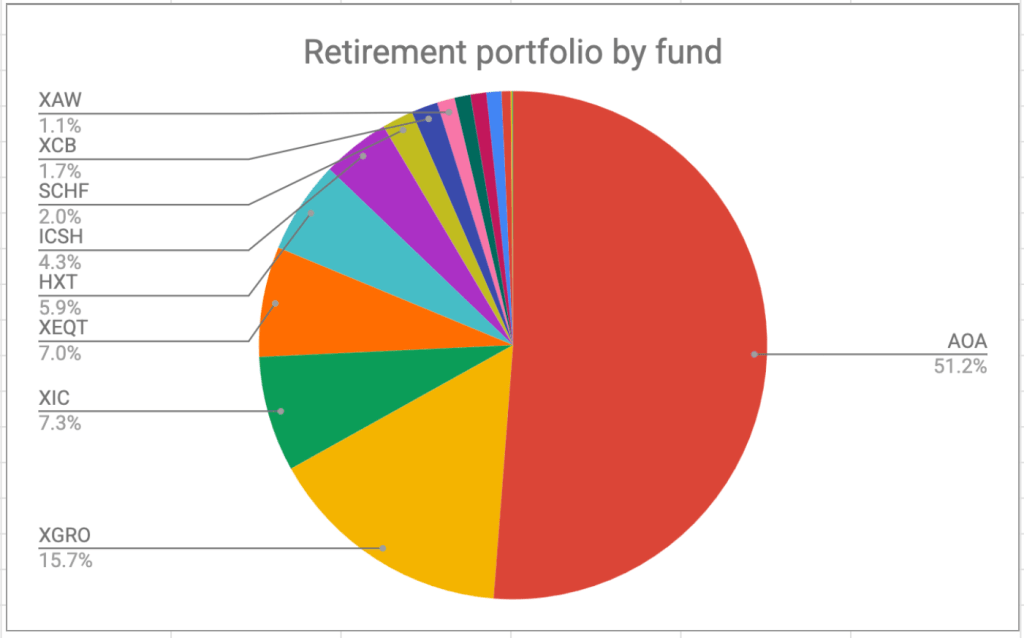
I pay myself monthly in retirement, so that’s a good trigger to update this post. On January 26, this is what it looks like:

The portfolio is dominated by my ETF all-stars, but if you’ve been following along, you’ll see a few changes.

  • As mentioned in a previous post, I did some shifting around and you now see XAW and XIC increasing their contribution to the portfolio at the expense of XGRO.
  • I also tidied up some extra funds that aren’t needed — VCN was replaced with XIC1, and I turfed some small holdings.
  • I sold more HXT than I needed to for my monthly paycheque, and when I discovered the mistake2, I just bought XIC instead.
  • And, I did my quarterly Norbert’s Gambit to shift some AOA to XGRO. And again, I came out ahead!

Plan for the next month

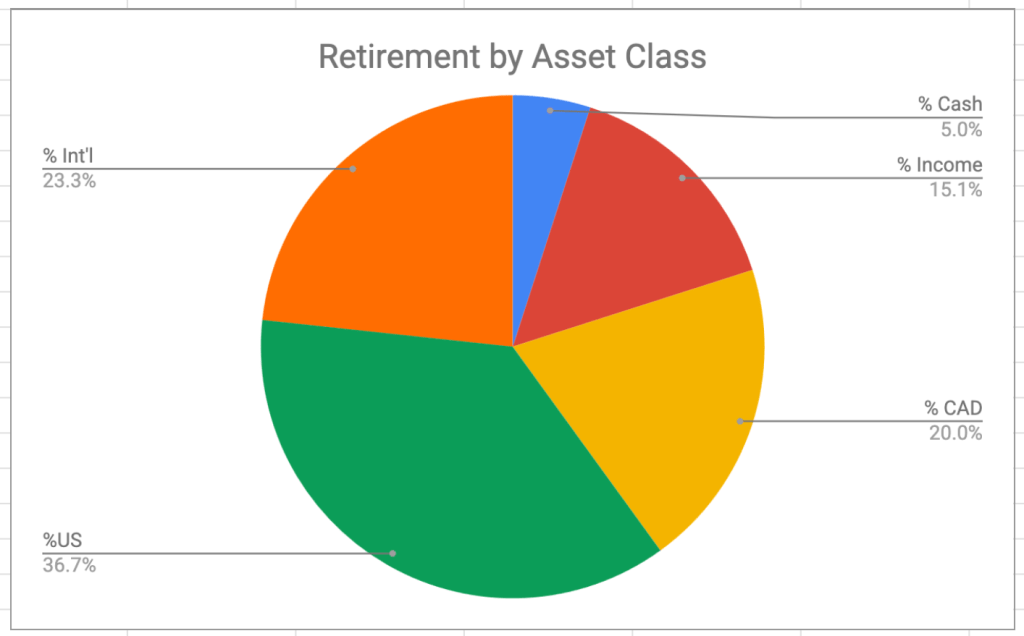
The asset-class split looks like this; you can read about my asset-allocation approach to investing over here.

It’s looking pretty close to the targets I have, which are unchanged:

  • 5% cash or cash-like holdings like ICSH and ZMMK
  • 15% bonds (most are buried in XGRO and AOA, some are in XCB)
  • 20% Canadian equity (mostly based on ETFs that mirror the S&P/TSX)
  • 36% US equity (dominated by ETFs that mirror the S&P 500)
  • 24% International equity (mostly, but not exclusively, developed markets)

Overall

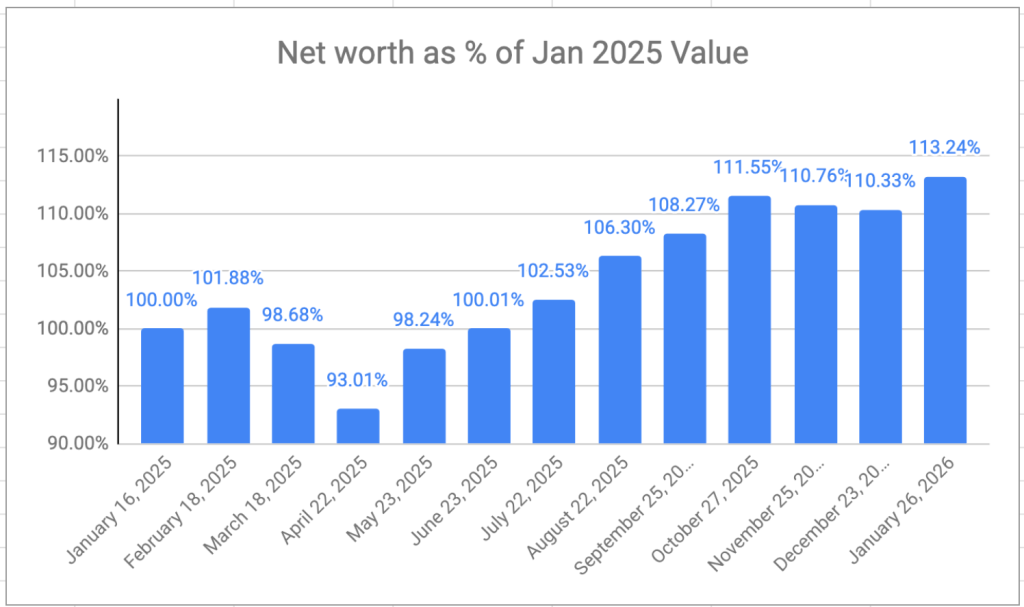
Net worth overall is up month over month, reversing a 2 month losing streak and hitting a new all-time-high:

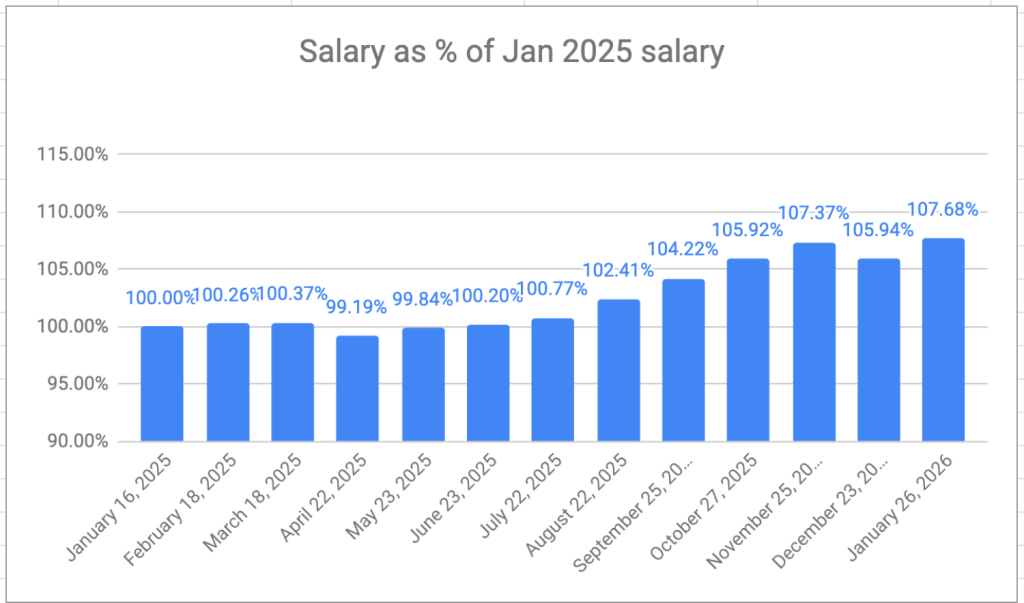
My VPW-calculated salary resumed its upward trend, also hitting an all-time high.

My QTrade RRIFs should move perhaps this week, but I’m no longer confident about that. More on that once resolved.

  1. Which, in my mind, are equivalent. This post goes in lots more detail. ↩︎
  2. I had to do some quick manual calculations because I had already updated my auto-calculating spreadsheet to reflect fewer RRIF accounts. My RRIF transfers are 2 months in progress and counting. I guess trying to move a RRIF near the end of the year was a bad idea. ↩︎

News: QTrade Offers Free Money

New year, new promotions! QTrade (different from Questrade, don’t mix them up) is offering free money to new clients. It’s featured prominently here.

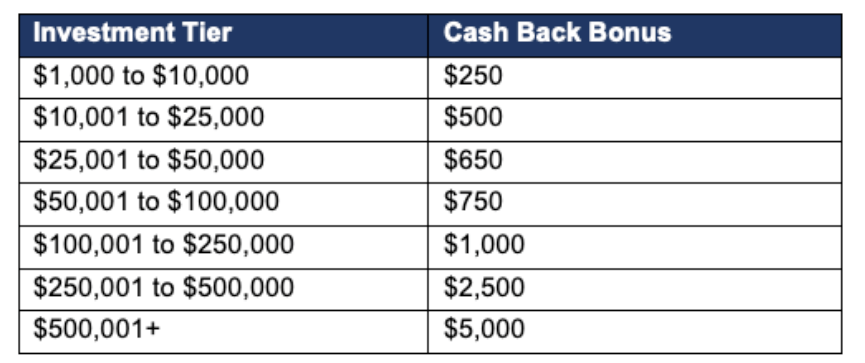
Detailed terms and conditions are here, but it’s pretty straightforward: register for the promotion with promo code CASHBACK26 and fund your account by April 30th. Keep it there for a year, and this is what you can expect your payout to be in May 2027:

The higher tier amounts aren’t particularly noteworthy as compared to others out there. But you’d be hard pressed to find a better ROI than $250 for a $1000 investment.

Portfolio Optimization In Practice

My retirement portfolio is spread across multiple brokers and multiple accounts. And although I treat the portfolio as a unified entity when it comes to asset allocation (the concept is discussed here), different accounts have different allocations. The reasons are varied, but I would rank inertia as one of the big contributors — sticking with what’s there seems like a lot less effort than the other options.

What I think in important to point out is that the portfolio is still dealing with inflows and outflows every single month:

  • I pay myself RRIF minimum from my RRIF accounts, and this usually means selling some shares of XGRO
  • If RRIF minimum isn’t sufficient for my expenses (and it hasn’t been), then I have to liquidate shares from my non-registered account.
  • I contribute to our TFSAs every month
  • Questrade gives me free money every month as a reward for shifting assets their way (see how I did it here). This money shows up in my non-registered accounts1.
  • Dividends show up every month2; every quarter there is an even bigger distribution
  • And quarterly I convert some of my AOA holdings to XGRO within my RRIF using Norbert’s Gambit3. When I do this, it reduces my US and international equity holdings and replaces it with Canadian equity4.

So given all these ins and outs, there are always opportunities to tweak the asset allocations so that they remain close to my targets.

The targets, as always, are unchanged:

  • 5% Cash (mostly ultra short-term bonds)
  • 15% bonds
  • 20% Canadian Equity
  • 36% US Equity
  • 24% International Equity

Last week, a reader’s question (please send questions or comments to comments@moneyengineer.ca) led me to take a different look at what was in each of my retirement accounts (RRIFs, TFSAs, non-registered), and this week I acted on correcting a flaw in the way the accounts were structured.

The reader was actually asking about foreign withholding tax implications since the rules are different depending on whether the asset is held in non-registered, TFSA or RRIF but after spending a lot of time looking at it, I decided that, from a tax perspective, the portfolio was actually in reasonable shape. (If you want to dive into this yourself5, you can read https://www.finiki.org/wiki/Foreign_withholding_taxes and https://pwlcapital.com/wp-content/uploads/2024/08/2017-12_Ben-Felix_WP_Asset-Location-Uncertainty.pdf).

But this study did make me realize that the small allocation I had of bonds in my TFSA was wrong-headed. Since in my planning the TFSA is the LAST place I’ll head to fund my retirement, it follows that it should have the longest-timeline investments. So, for me, that means 100% equity is the correct allocation for the TFSA accounts. So what did I do?

  • I sold the bonds in my TFSA (XSH was the ETF), and put them in my RRIF (choosing instead to use XCB, a longer-duration corporate bond fund)
  • Of course, since you can’t add money to a RRIF, something had to be sold there. XGRO was plentiful, so that’s how I funded the bond purchase. From an asset allocation perspective, selling XGRO meant that I reduced my Canadian, International and US Equity exposure at the same time.
  • To compensate, the cash I generated in my TFSA by selling XSH was used to buy a combination of XIC (Canadian Equity) and XAW (US and International equity combined). XIC was already in the TFSA6. XAW is new but gives back the US Equity and International Equity I lost by selling XGRO7.

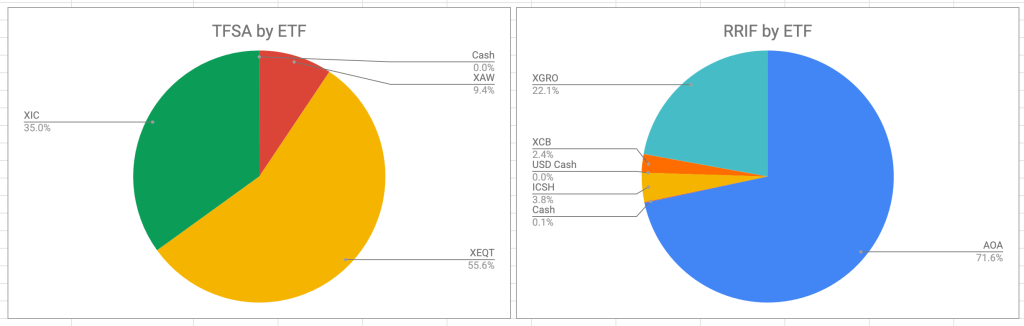
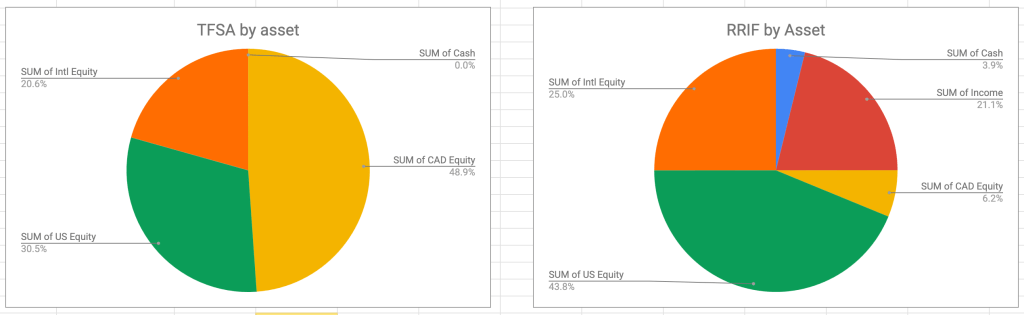
This is how the two accounts break down now, both from an ETF and an asset-allocation perspective. (In the asset allocation charts “Income” is the nomenclature I use for “bonds” and “Cash” means actual money as well as ultra-short-term bond funds like ICSH and ZMMK).

The result is my TFSA is now 100% equity, and the lower-growth cash-generating bonds are now all in my RRIF accounts. More efficient all around!

  1. Leaving the free money as part of the retirement portfolio was a conscious decision. I could have just as easily decided to withdraw the money every month. ↩︎
  2. Both ZMMK and ICSH pay monthly. They are both featured in my ETF all-stars. ↩︎
  3. You can read about it here. ↩︎
  4. AOA is 50% US equity, 28% International equity. XGRO is 36% US Equity, 24% International Equity. ↩︎
  5. It’s not a straightforward topic. In the end, the foreign withholding tax isn’t huge but as a cheapskate, it’s noticeable and can be higher than MERs of the ETFs you hold. ↩︎
  6. XIC helps tilt the overall Canadian equity allocations in the right direction. AOA tilts it in the wrong direction. ↩︎
  7. The current numbers don’t allow me to use an XEQT/XIC combination. Over time, this will change. ↩︎