
On being retired: So what is it you do, now?

People still working are always fascinated with what a recent retiree gets up to. I guess the short answer is that I’m still busy, still procrastinating, still learning — but with far fewer constraints on how I spend my day.

This Blog

MoneyEngineer.ca was an idea that grew out of something I had been doing occasionally before I retired. I would discover something interesting in the world of being a DIY investor or in being a cheapskate and I would tell a bunch of friends and family about it, usually via email. But I figured that I could tell more people about what I’ve learned by starting a blog.

Knowing my procrastination habits, I took steps to make sure I would get that going on day 1. So in late December 2024 I prepurchased 2 years of WordPress and registered a domain. Investing a bit of cash in my proposed endeavor I knew would motivate me to actually DO it.

The time I spend on the blog now versus the early days has diminished quite a bit (partly because I’m now way more familiar with how WordPress works) but I enjoy the structure of heading down to the basement office and doing the work of researching and putting words on the page. And watching the website grow in popularity has also been gratifying. So thanks to all for reading and sharing!

Website views and unique visitors for MoneyEngineer.ca since launch

Managing Money

I do enjoy managing my own retirement income, and chasing whatever deal gets thrown my way. And I do try to simplify as much as I can. Being a cheapskate sometimes has the cost of adding complexity, it’s true. And outside the blog, I’m a frequent contributor to investing-related subreddits.

Volunteering

There are many organizations out there who are happy to put a recent retiree to work either on a recurring or on a one-off basis. Getting out of the house is a good thing, I figure. Here are a few of the places I’ve spent my time:

Fitness

I’ve always been a fan of outdoor exercise — gyms have zero appeal for me, and so even before I retired I made a habit of getting outside to ski, ride, run or walk thirty minutes four to five times a week. In retirement, I’ve become more interested in running and entered my first distance races this year; to avoid injury, I’ve added more miles and more structure2.

I have never liked strength training, but know that as I get older, that’s something I have to pay attention to. I recently discovered darebee.com and am following their strength training program; lots of variety and it’s mostly based on body weight exercises, so I can do them practically anywhere.

Piano

Both my kids took lessons and we own an upright as a result. The kids are both out of the house and instead of letting the instrument collect dust, I’ve started learning myself.

Once again, in order to prevent myself from avoiding doing the daily work, I invested in an annual subscription to pianote.com3. I suppose most accomplished musicians would frown upon anything other than in-person, tailored lessons, but the approach of pianote really appealed to me: playing songs but with enough technique to build skills.

On most days, I spend between 30 and 60 minutes at the piano. I’m currently working on the piano accompaniment to “Someone Like You“.

So there you have the view of what this retiree gets up to — what have you found that fills your days after work? Let me know at comments@moneyengineer.ca. I’m always curious about new things to try!

  1. Not a princely sum by any means, and not very regular employment (about 4 hours so far this year), so I don’t think it counts as a side hustle. ↩︎
  2. Training plans provided by chatGPT in both cases. ↩︎
  3. And although their billing is all in USD, they are in fact a Canadian company. Go figure. ↩︎

Update: Credit Card Cheapskate

As you may have read, last month, I began the journey of switching credit cards to take advantage of better benefits with lower fees. A side effect of this was switching my tv/phone/internet provider to Rogers. This turned out to be more effort than I expected, but not for the reasons you might think.

I had decided to get the Rogers Red Elite Mastercard which offers 2% cashback on all purchases if you have any Rogers services, and effectively 3% if you purchase Rogers services with the card. This was just fine with me, as my Bell Fibe services had been creeping upward in price for months — it was time to churn providers, too.

Applying for the Rogers card was the easy part. It arrived quickly and setting it up was relatively pain-free. One unexpected downside was that its credit limit was a lot lower than my former primary credit card; about once a year, normally around vacation time, that actually becomes important. (I always, always, always pay credit balances in full). So, instead of getting one new card, I got two:

  • Rogers Red for most things (but with a lower credit limit)
  • And a CIBC Costco Mastercard1 to replace my fee-based CIBC Dividend card. “Replacement” in this case is quite literal; I called CIBC and explained I wanted to switch credit card products, and confirmed that this was possible — credit limit and all.

So the cheapskate plan needed two more things to complete:

  • The installation of my Rogers service
  • The delivery of my CIBC Costco Mastercard (actually two — one for me, one for my spouse)

Little did I know that this would turn into two separate sagas…

The Rogers Saga

TL/DR: Two installation technicians, many hours on the phone with support, a formal complaint to the CCTS, and I now have fully functioning internet, television and home phone service. I would not wish their home phone service on my worst enemy. Oh, but I am getting 2% back on all my purchases now!

October 19: Technician arrives. Modem installed with no issue. TV “settop” installed, no issue. Dial tone on my home phone. Calls in/out seem to work (tested with cell phone). I sent the installer on his way after about 45 minutes.

October 20: I attempt to set up my home phone voicemail. *98 to get access. “Welcome to Rogers Wireless Voicemail”. uh oh. Mailbox not recognized, can’t leave a voicemail to my home phone. Off to support. Ticket of some kind raised.

October 21: Weird. My “Myrogers” profile shows i have no services installed, and my installation appointment (that took place 2 days ago) shows pending. I report this to support as well. They don’t seem to fussed about that, convinced it will show up in a day or two.

October 27th: still no change. I’m a bit annoyed. A highly articulate Rogers staffer calls me on Saturday morning, wondering why I’ve called support so many times. I walk her through the experience. She comes to the conclusion that the easiest solution is to send a 2nd installer to my house to try again.

October 27th: installer number 2. Installs new modem2. Can’t seem to get the phone to work properly. He’s talking with his own support. He also sees that the internet performance of the new modem is craptacular, more dial-up speed than high-speed. This will require a “push” from the “back office” to correct. I warn my installer friend that the Jays will be on in an hour or two, and I would like to watch the game. He splits the coax and leaves both old modem and new modem connected. I continue to watch tv off the old modem, so peace is saved.

October 28th: the promised push from the back office materializes and the new modem now performs like a high speed modem should. I move my home network to it. Still no working voicemail on my home phone, but now my MyRogers profile shows tv and internet services, so progress.

October 29th: This was my breaking point. After talking to someone senior, they decided that I’ve been talking to the wrong Rogers team and need to call the number portng team or something like that. 90 minutes of hold music, and I was done dealing with anyone from Rogers. I submitted a formal complaint to the CCTS3. https://www.ccts-cprst.ca/about-ccts/.

November 4th: I talk live with a person from “The Office of the President” (sounds important) who commits to resolving my issue. Some junior tech calls the next day to report that they need “a day or two” to resolve. What?

November 6th: I talk to an articulate tech person who I feel fully understands the issue (one could have expected him to read the case notes, but whatever). He suspects (as I do) that because I *used* to be a Rogers home phone customer (over 2 years ago), this caused problems when I tried to port my number *back* to Rogers (from Bell).

November 10th: I notice i have a phone profile in “MyRogers”. Voicemail now works. Wow. I say nothing, wondering how long the crack team at Rogers will take to figure out that they have fixed my problem.

November 14th: The articulate tech person from last week contacts me and asks to ensure my phone service is working. I assure them it is. An hour later the Office of the President emails me to tell me that they now consider the matter closed. i still haven’t been billed, but my profile shows a $90 credit. For what, I have no idea. Pain and suffering?

So net: everything works, I am getting 2% back, and I haven’t received a bill yet. Stay tuned…

The CIBC saga or does any Canadian company have decent customer service?

So as I mentioned, I called CIBC to confirm that I could switch credit cards. I should have done it on call one, but I wanted to make sure that it wasn’t going to have unintended consequences on preauthorized charges. The day I decided to make the change was a day I was routed to a call center that sounded somewhat like an airport gate area. Unbelievably noisy and hard to hear what the agent was telling me4.

After 25+ minutes on the phone, most of it repeating and re-repeating my Costco membership numbers, it seemed I was good to go. A few minutes after hanging up, I got an email from CIBC letting me know that I could choose to get delivery of my new cards5 to a branch instead of my home. Given the ongoing Canada Post work actions, I figured a branch might be a better bet.

A week or so later, I got an email from CIBC congratulating me on the use of my new card. Which would be impossible since I didn’t get it yet. Paranoia sets in, and so I hop on the line with CIBC to make sure someone hadn’t intercepted my card somehow. After being disconnected after explaining my predicament the first time, I tried again. (The first agent was just as confused as I was…he seemed to know the number of my new card, even if I didn’t). The second agent assured me nothing untoward was going on, just an automated email. Fine. (Well, not fine, so if anyone at CIBC is reading this, you might want to look into how those emails get generated).

A day or so later, my wife received her card via Canada Post. Naturally.

I waited a few more days, no contact from my branch. I was in the neighbourhood so I stopped in and asked. The teller seemed to think it wasn’t really possible for a letter addressed to me to go unreported to me, but in the interest in humouring me, she look a look in the drawer (!) behind the counter. And to her surprise, there was indeed an envelope waiting for me. She laughed it off and handed it to me without comment, apology or anything else to say other than “my old PIN will work fine”.

I ended up in the branch again a few days later on an unrelated matter (depositing a cheque addressed to my. late mother’s estate…only possible via a human-to-human interaction), when the teller there thought she thought I had mail at the branch. Turns out it was a PIN code letter. Which again, no one had told me about, and one that I had been told wouldn’t be coming my way.

Anyway, I changed the PIN at the branch and went on my way.

Everything else worked as expected. In a strange twist, since this was a card change, my Apple wallet updated itself automatically to start using the new card as soon as I enabled it.

  1. I’m already a Costco member, so no big deal. The cashback isn’t as good as the Rogers card, with the exception of restaurants and Costco gas, both of which give 3% cashback (with a cap). ↩︎
  2. Actually, I think he tried two or three different ones. ↩︎
  3. Possibly my new favourite organization. Thanks! ↩︎
  4. I personally think every CEO should call their own call centres at least monthly. Most of them are terrible. ↩︎
  5. 2 cards, 2 emails. Weird. But ok. ↩︎

Just the (ETF) Facts, Ma’am

Do you ever wonder about the differences between, say, XEQT and VEQT? Or XGRO and TGRO? Of course, you could ask Reddit1, read an article from a trusted source (ahem), or you could investigate it yourself.

How?

Well, my usual starting point is to google “<trading symbol> ETF”, for example “XEQT ETF”. For popular ETFs, this often generates hits for competitive products, so do be careful of that minefield.

But really, there’s a better way. You can instead google “<trading symbol> fact sheet”, for example “XGRO fact sheet”. In my unscientific tests, this search yield the actual fact sheet for the ETF in question as either the 1st or 2nd result — it’s a pdf file in all the cases i tried.

So what’s the fact sheet, and what’s it all about? Let’s hand it over to the pros:

The ETF Facts is a four-page document that summarizes key information about an ETF in a simple, accessible and easily comparable format. It is designed to help you make an informed decision about your investment by including information such as a fund’s investments, risk rating, past performance and the costs associated with owning it.

https://www.securities-administrators.ca/investor-tools/understanding-your-investments/etf-facts/#:~:text=What%20is%20the%20ETF%20Facts%3F

The highlights for me about the ETF fact sheet are:

  • It’s short. 4 pages, and generally the most interesting bits are on pages 1 and 2
  • It’s “easily comparable”. The format is always the same, allowing for an easier side-by-side looksee.
  • It’s got information about what the fund invests in. If you hold multiple ETFs, knowing what’s behind each one will help you avoid inadvertently piling on to one segment of the market2.

The fact sheet isn’t just helpful; it’s the law of the land34.

So let’s take a quick look at my number one Canadian holding, XGRO, to see what it’s about.

Recording the above video taught me that XGRO changed significantly back in 2018, so looking at its performance prior to that is no longer an apples-to-apples comparison. After a bit of searching, I found that XGRO used to be called CBN, which had a MER of about 0.75%. You can read a bit more about that at Canadian Couch Potato, an excellent resource, by the way.

  1. And, inexplicably, people reliably ask this question week after week after week… ↩︎
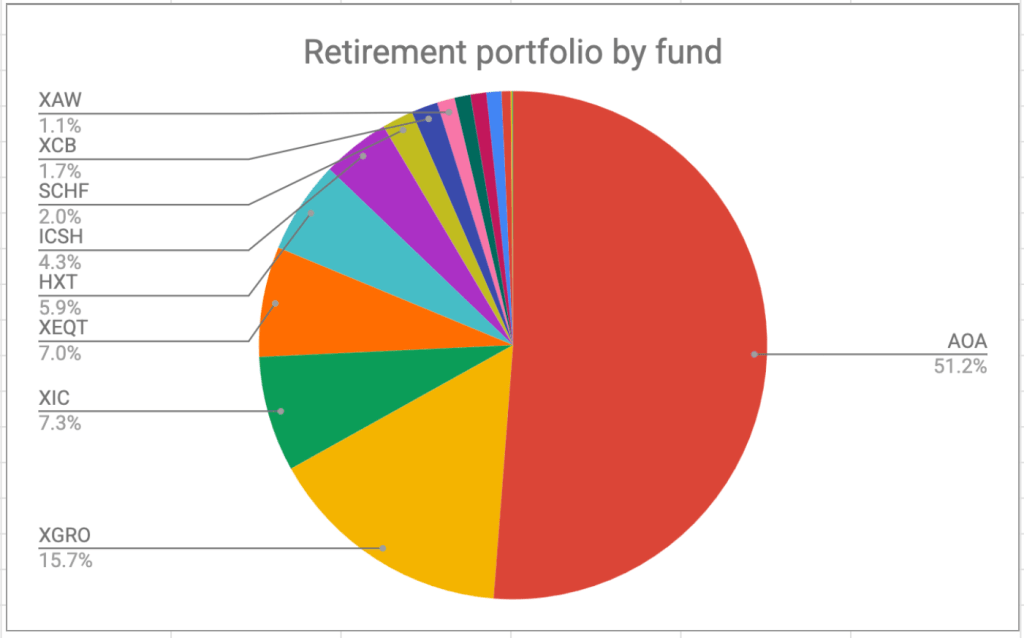
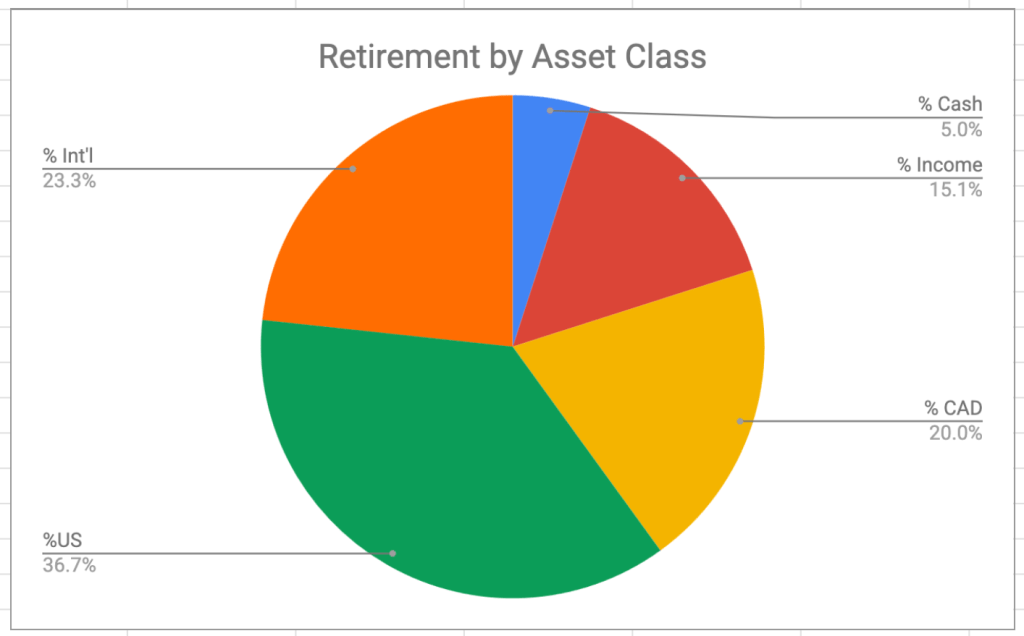
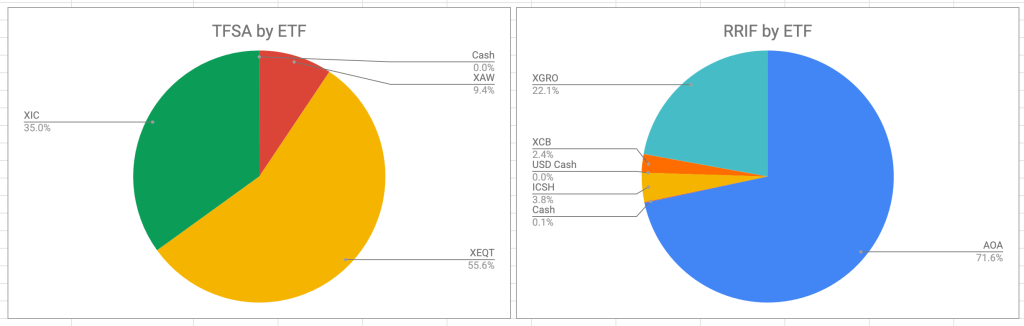
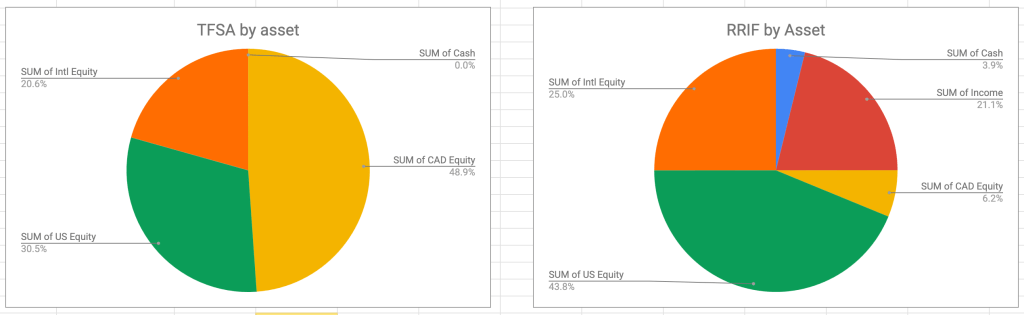
  2. I don’t make segment bets; maintaining my asset allocation percentages (36% US Equity, 24% International Equity, 20% Canadian Equity, 15% Bonds, 5% cash) is the only metric that matters to me. ↩︎
  3. This is the Ontario regulation; because we like bureaucracy in this country, every province has a securities regulator 😦 ↩︎
  4. And I assume this is also the case in the USA since all the US-based ETFs I own have fact sheets. But I couldn’t find a specific regulation about that. ↩︎

Chasing Free Money with Wealthsimple

As I’ve been alluding, my relationship with QTrade is coming to an end. It would have ended back in March 2025 when I moved the majority of my holdings to Questrade, but having an active RRIF can make things a bit more complicated when it comes to changing your online broker.

Anyway, the plan all along was to move the last of my QTrade holdings — 4 RRIF accounts: 2 for me, 2 for my spouse — to Questrade around now, after most of the RRIF payments for 2025 have been taken care of1.

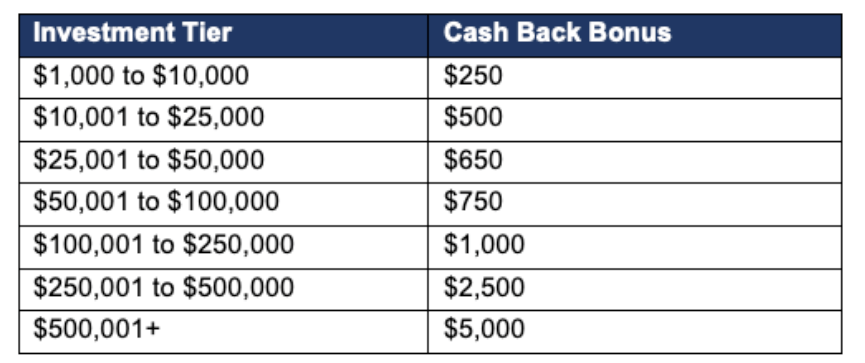
But then Wealthsimple came around and decided to throw free money on the table2. And they even helpfully extended the registration deadline — multiple times — to make it even easier. Now, I know I preach about simplifying your arrangements in retirement to make it easier on your heirs, but hear me out….

Because of a problem with my DPSP, (another cautionary tale for those who are considering retirement), I already had a RRIF with Wealthsimple (and a nice shiny MacBook Air) as a reward for my troubles. If I wanted to keep my MacBook, I had to keep my money with Wealthsimple3 until January 2026, so that RRIF wasn’t going anywhere…I reasoned I wasn’t really making things more complicated. I’m going from using three brokers to using two, so that’s clearly an improvement.

Moving accounts from another provider to Wealthsimple, like many things Wealthsimple does, is totally digital, and very, very easy to accomplish. All that was needed was the account number and a recent statement from my sending broker, and that was it. I think it took all of 10 minutes to get the ball rolling. No printers. No pictures. No pens. Just clicks and swipes.

And even better is Wealthsimple’s super-clear status indicator, visible in the app or when using the web:

How clear is that? Of course, one could complain about how it could possibly take a month for things to move along (I know I did), but it’s stuff like this that makes me realize how far ahead of the competition Wealthsimple is when it comes to serving their clients.

What’s more, the transfer finished *way* ahead of schedule, being fully complete on November 8th, around 2 weeks after initiating the request. And, to make things even more pleasant, Wealthsimple has already reimbursed me the $150 plus GST that QTrade charged me for moving the account — no need for me to provide “proof” — the industry standard is well known to all, including, lately, the federal government.

I’ll provide an update once the free money starts rolling in. I have to update my workflows on how I get paid, since it’ll be a new world starting in January!

  1. I take RRIF payments monthly to make it more like a salary. And to avoid large stock sales all at once, since getting paid means selling assets. ↩︎
  2. I wonder if the gravy train in this space will end — read more about my thoughts on that here ↩︎
  3. The catch with free money (or free gifts) from brokers always involves keeping your money intact with them for some non-trivial amount of time. 12 months and 24 months are both pretty common. No big deal to me, I intend to stay retired a lot longer than that. ↩︎

News: Global X launches new ETFs, lowers fees

New US T-Bill ETFs from Global X

As mentioned elsewhere, I try to keep about 5% of my retirement savings in what I loosely refer to as “cash”. Of course, it’s not cash, cash doesn’t earn any interest, and that would drive me bonkers. Instead, I’ve been using ZMMK and ICSH (two of my ETF all-stars) to serve this purpose. I made a more detailed assessment of available products at the time over here.

But Global X (a company who I do a lot of business with, thanks to XEQT, XGRO and HXT) has launched 4 products that invest solely in US Treasury Bills.

  • TSTX/TSTX.U/TSTX.F: all based on 1-3 year treasury bills, which, in common bond lingo, is “short” duration. TSTX is the one that’s probably of greatest interest to most of you since it trades in CAD. TSTX.U is the same thing but it trades in USD, and TSTX.F trades in CAD but uses currency hedging to smooth out the CAD/USD exchange rate1.
  • TLTX/TLSX.U/TLTX.F: same idea as above, but these products are based on 20 year T-Bills, which would be considered “long” duration and are much more sensitive to changes in the prime interest rate.

They are brand spanking new (launched Oct 7, 2025), but have already paid out their first distributions at the end of October:

CAD ETF Distribution USD (.U) ETF DistributionHedged (.F) ETF Distribution
TSTX family (1-3y)0.140900.139910.13990
TLTX family (20y)0.160560.159430.15941

The TSTX family is paying 3.4% yield, which is way better than any CAD product I’ve evaluated previously2. It’s not as good as USD HISAs, but being able to get US-like interest rates in a Canadian denominated product is a cool thing. T-Bills of this duration are not super sensitive to changes in interest rates, but the 20y ones would be. TSTX is a product I’ll be keeping an eye on as an alternative to ZMMK, potentially, as long as the prime rate in the US remains significantly higher than Canada’s.

Reduced Fees for CNDX (S&P/TSX 60 index)

Global X was running a promo this year that I talked about previously, but they’ve set a new low price for their flagship Canadian index fund at 0.09% MER starting in 2026. (The MER is 0% at the moment). I don’t hold CNDX myself (I use XIC and VCN, which both include all of the TSX and costs 0.06%), but if you like to focus on the larger part of the Canadian market, you may want to take a look here.

  1. I don’t like hedging as a rule, as it just adds cost and I figure that over time, the USD/CAD exchange rate is reasonably stable. ↩︎
  2. And if these ETFs existed at the time, I probably wouldn’t have looked at them because they have a duration that’s a little too long for me to consider them “cash-like”. But I like my “cash” to be cashflow positive, with no downsides. ZMMK and ICSH aren’t guaranteed to do that, but their super-short average duration (90 days or so) makes it far more likely. ↩︎