

This is a monthly look at what’s in my retirement portfolio. The original post is here.
Portfolio Construction
The retirement portfolio is spread across a bunch of accounts:
- 6 RRIF accounts (2 for me, 3 for my spouse, 1 for me at an alternative provider as a test)
- 2 TFSA accounts
- 4 non-registered accounts, (1 for me, 1 for my spouse, 2 joint)
The target for the overall portfolio is unchanged:
- 80% equity, spread across Canadian, US and global markets for maximum diversification
- 15% Bond funds, from a variety of Canadian, US and global markets
- 5% cash, held in savings-like ETFs.
You can read about my asset-allocation approach to investing over here.
The view post-payday
I pay myself monthly in retirement, so that’s a good trigger to update this post. On December 23, this is what it looks like:
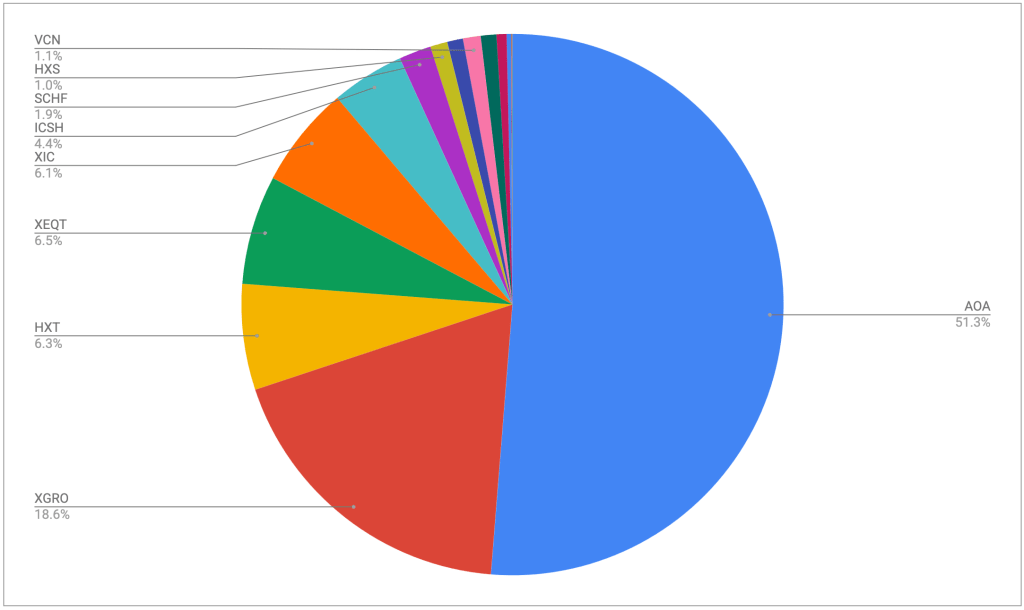
The portfolio is dominated by my ETF all-stars; anything not on that page is held in a non-registered account and won’t be fiddled with unless it’s part of my monthly decumulation. Otherwise I’ll rack up capital gains for no real benefit.
There aren’t really any notable changes this month — AOA’s contribution was down a bit this month, largely due to an unfavourable change in the USD/CAD exchange rate (down about 3% month over month, back down to a level not seen since around May this year). I recalculate the FX rate every month1 since I track my net worth in CAD so I always have an apples-to-apples comparison. I don’t stress too much about the FX rate as it tends to cut both ways. Sometimes it’s a lift to my numbers, sometimes not. In the end, I suppose it all evens out. I tracked my snapshot FX rates starting in February2, just for illustration:

Monthly USD/CAD rates on payday day
Plan for the next month
The asset-class split looks like this
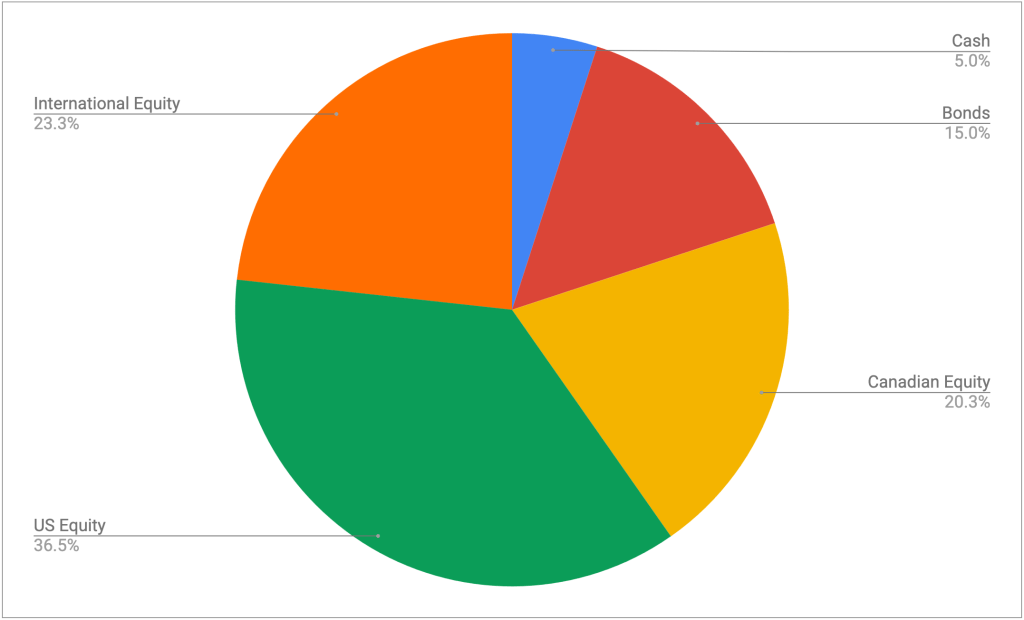
It’s looking pretty close to the targets I have, which are unchanged:
- 5% cash or cash-like holdings like ICSH and ZMMK
- 15% bonds (almost all are buried in XGRO and AOA)
- 20% Canadian equity (mostly based on ETFs that mirror the S&P/TSX)
- 36% US equity (dominated by ETFs that mirror the S&P 500)
- 24% International equity (mostly, but not exclusively, developed markets)
The end of the year will mean more distributions from my holdings; in my RRIF accounts they are set to DRIP since I only hold AOA/XGRO/ICSH in these accounts. The rest I redeploy to the asset classes that are short funds; typically this means investing in one of the *EQT funds since the bond complement of the portfolio frequently moves above the 15% target.
Overall
Net worth overall is down slightly month over month, but up a little over 10% from the start of the year. Hard to be unhappy about that.
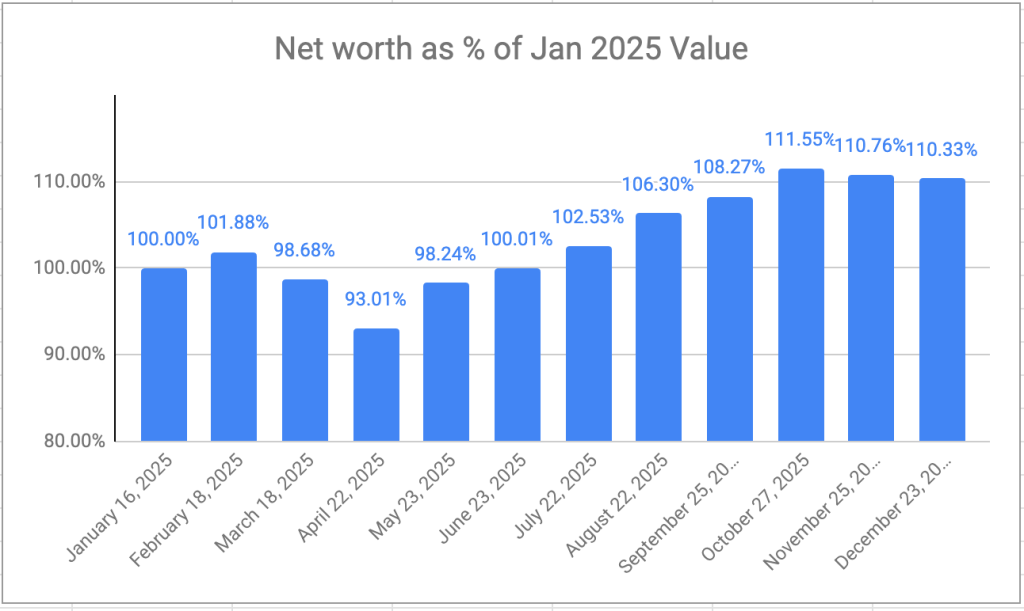
My VPW-calculated salary took a slight decline, breaking the 7 month growth streak. It ends the year a shade under 6% larger than my first paycheque. Not bad. I don’t recall many years where I got a 6% raise 😉

Next month will end my relationship with QTrade as I move the final 3 RRIF accounts to Questrade; I had thought December would be the final month, but as you’ll see in my next post, a (hopefully) small wrinkle has delayed this.
- Using =googlefinance(“USDCAD”) of course ↩︎
- February because I only thought to start tracking that a month in. January’s rate will be lost to the sands of time. Or I could add it back using the official FX rates, I suppose. ↩︎
Discover more from The Money Engineer
Subscribe to get the latest posts sent to your email.
 The Money Engineer
Hello there,
I see you use an 80/20. are you not nervous about this ratio in a retirement scenario? I was always advised at 60/20. 🙂
Kim
LikeLike
Hi Kim, sorry for the late reply — I don’t get so many comments on my posts, haven’t learned how to incorporate them into the workflow!
I guess you mean 60/40 in your comment above, and yes, this is a very common retirement ratio recommendation. 60% equity, 40% bonds. I have a stronger tilt to equities.
The rationale for staying 80/20 was perhaps not super analytical, but my reasons were:
The VPW decumulation strategy I deploy along with only monthly asset sales also protects me (I feel) to not getting totally clobbered by a market downturn.
But in the end, you have to go with the asset allocation you are comfortable with, and i would never suggest that 60/40 is a bad idea.
LikeLike
[…] Let’s start by comparing the makeup of my portfolio at the beginning of the year versus my last update: […]
LikeLiked by 1 person
[…] Now of course, you could find counter examples I suppose. But if capital preservation isn’t a concern6, then these results tell me that dividends needn’t be a concern in retirement. Even with my anemic yield stats, my net worth increased in 2025 even accounting for getting paid every month (chart from my latest What’s in My Retirement Portfolio): […]
LikeLike
[…] TFSAs, non-registered. And although I present them as a monolith in my monthly updates (latest one here), I don’t treat them the same way and they have rather different things inside […]
LikeLike